Nguyen Thanh V, Sacci John B, de la Vega Patricia, John Chandy C, James Anthony A, Kang Angray S
Department of Molecular Biology and Biochemistry, University of California, Irvine, CA 92697, USA.
Malar J. 2009 Oct 23;8:235. doi: 10.1186/1475-2875-8-235.
MB2 protein is a sporozoite surface antigen on the human malaria parasite Plasmodium falciparum. MB2 was identified by screening a P. falciparum sporozoite cDNA expression library using immune sera from a protected donor immunized via the bites of P. falciparum-infected irradiated mosquitoes. It is not known whether natural exposure to P. falciparum also induces the anti-MB2 response and if this response differs from that in protected individuals immunized via the bites of P. falciparum infected irradiated mosquitoes. The anti-MB2 antibody response may be part of a robust protective response against the sporozoite.
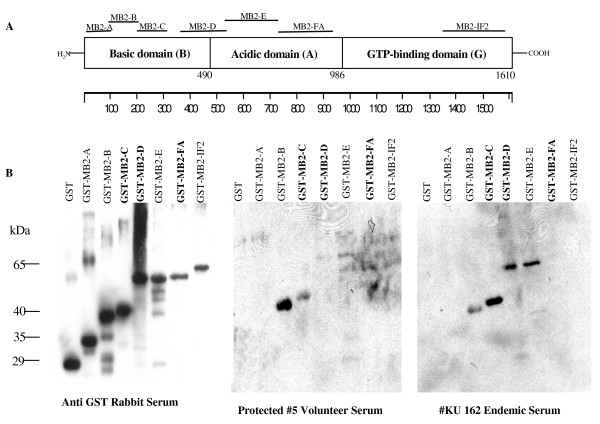
Fragments of polypeptide regions of MB2 were constructed as recombinant fusions sandwiched between glutathione S-transferase and a hexa histidine tag for bacterial expression. The hexa histidine tag affinity purified proteins were used to immunize rabbits and the polyclonal sera evaluated in an in vitro inhibition of sporozoite invasion assay. The proteins were also used in immunoblots with sera from a limited number of donors immunized via the bites of P. falciparum infected irradiated mosquitoes and plasma and serum obtained from naturally exposed individuals in Kenya.
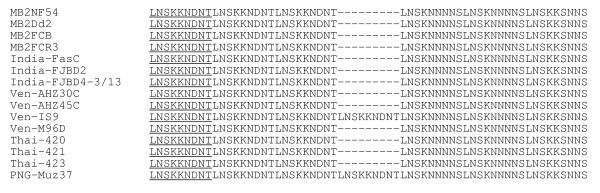
Rabbit polyclonal antibodies targeting the non-repeat region of the basic domain of MB2 inhibited sporozoites entry into HepG2-A16 cells in vitro. Analysis of serum from five human volunteers that were immunized via the bites of P. falciparum infected irradiated mosquitoes that developed immunity and were completely protected against subsequent challenge with non-irradiated parasite also had detectable levels of antibody against MB2 basic domain. In contrast, in three volunteers not protected, anti-MB2 antibodies were below the level of detection. Sera from protected volunteers preferentially recognized a non-repeat region of the basic domain of MB2, whereas plasma from naturally-infected individuals also had antibodies that recognize regions of MB2 that contain a repeat motif in immunoblots. Sequence analysis of eleven field isolates and four laboratory strains showed that these antigenic regions of the basic domain of the MB2 gene are highly conserved in parasites obtained from different parts of the world. Moreover, anti-MB2 antibodies also were detected in the plasma of 83% of the individuals living in a malaria endemic area of Kenya (n = 41).
A preliminary analysis of the human humoral response against MB2 indicates that it may be an additional highly conserved target for immune intervention at the pre-erythrocytic stage of P. falciparum life cycle.
MB2蛋白是人类疟原虫恶性疟原虫的子孢子表面抗原。通过使用来自经恶性疟原虫感染的辐照蚊子叮咬免疫的受保护供体的免疫血清筛选恶性疟原虫子孢子cDNA表达文库,鉴定出了MB2。尚不清楚自然暴露于恶性疟原虫是否也会诱导抗MB2反应,以及这种反应是否与经恶性疟原虫感染的辐照蚊子叮咬免疫的受保护个体中的反应不同。抗MB2抗体反应可能是针对子孢子的强大保护反应的一部分。
构建MB2多肽区域的片段作为重组融合体,夹在谷胱甘肽S-转移酶和六组氨酸标签之间用于细菌表达。用六组氨酸标签亲和纯化的蛋白免疫兔子,并在体外子孢子入侵抑制试验中评估多克隆血清。这些蛋白还用于与来自少数经恶性疟原虫感染的辐照蚊子叮咬免疫的供体的血清以及从肯尼亚自然暴露个体获得的血浆和血清进行免疫印迹分析。
靶向MB2碱性结构域非重复区域的兔多克隆抗体在体外抑制子孢子进入HepG2-A16细胞。对五名通过经恶性疟原虫感染的辐照蚊子叮咬免疫且产生免疫力并完全免受随后未辐照寄生虫攻击的人类志愿者的血清分析表明,他们也具有可检测水平的抗MB2碱性结构域抗体。相比之下,在三名未受保护的志愿者中,抗MB2抗体低于检测水平。受保护志愿者的血清优先识别MB2碱性结构域的非重复区域,而自然感染个体的血浆在免疫印迹中也具有识别包含重复基序的MB2区域的抗体。对11个野外分离株和4个实验室菌株的序列分析表明,MB2基因碱性结构域的这些抗原区域在来自世界不同地区的寄生虫中高度保守。此外,在肯尼亚疟疾流行地区的83%的个体(n = 41)的血浆中也检测到了抗MB2抗体。
对人类针对MB2的体液反应的初步分析表明,它可能是恶性疟原虫生命周期红细胞前期免疫干预的另一个高度保守的靶点。