Xu Jun, Zhang Xiaomei, Pelayo Rosana, Monestier Marc, Ammollo Concetta T, Semeraro Fabrizio, Taylor Fletcher B, Esmon Naomi L, Lupu Florea, Esmon Charles T
Oklahoma Medical Research Foundation, Oklahoma City, OK, USA.
Nat Med. 2009 Nov;15(11):1318-21. doi: 10.1038/nm.2053. Epub 2009 Oct 25.
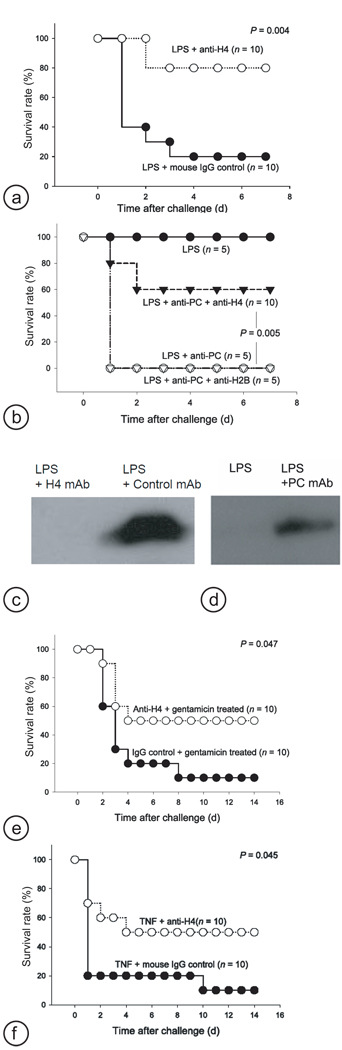
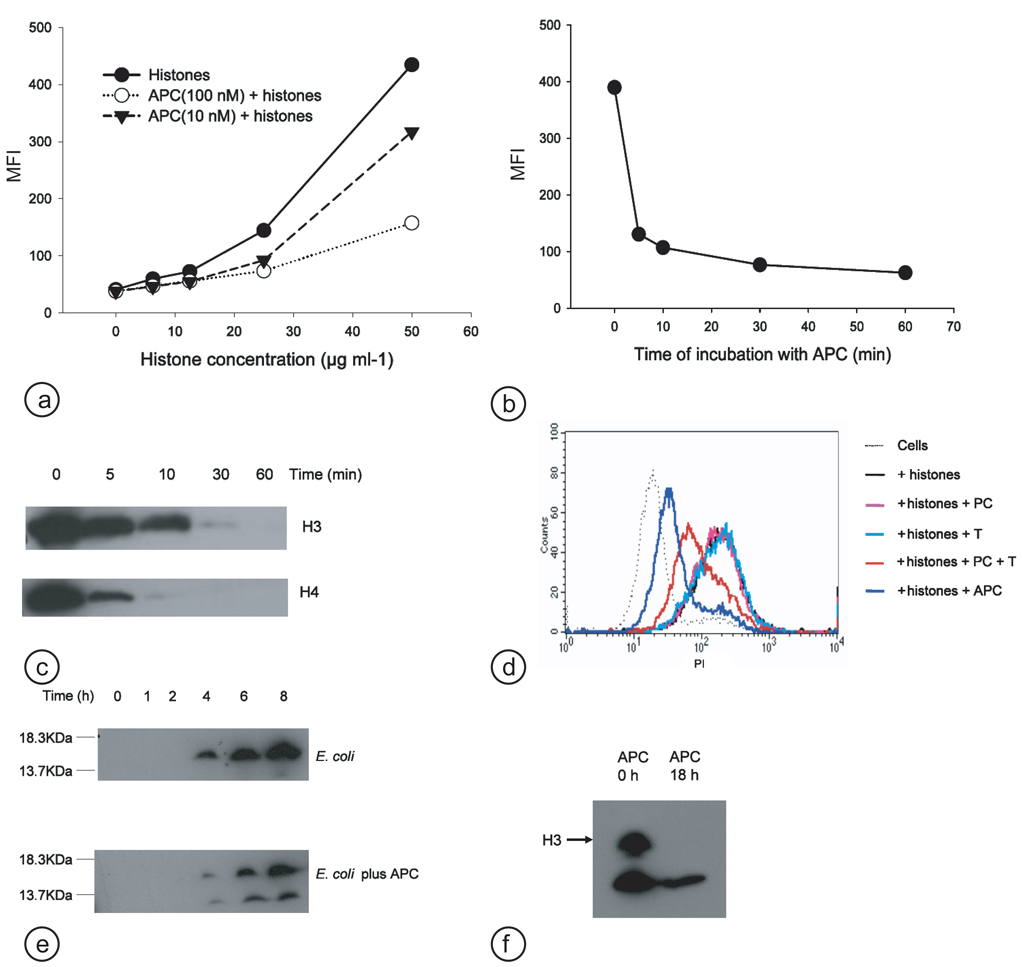
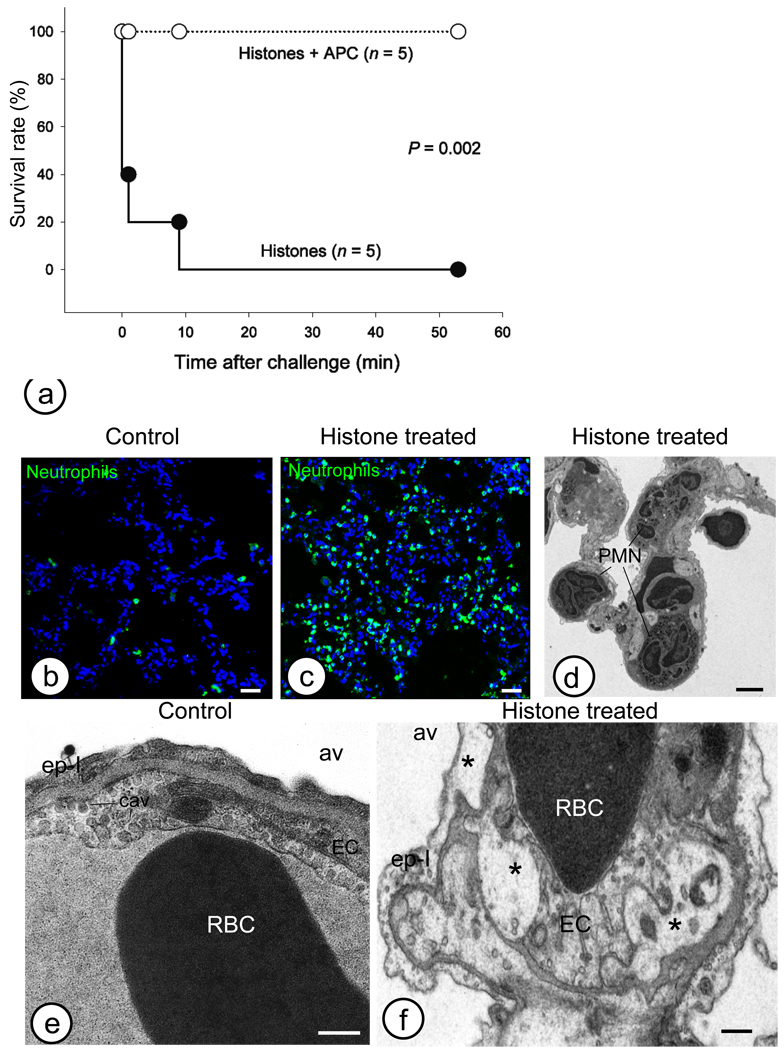
Hyperinflammatory responses can lead to a variety of diseases, including sepsis. We now report that extracellular histones released in response to inflammatory challenge contribute to endothelial dysfunction, organ failure and death during sepsis. They can be targeted pharmacologically by antibody to histone or by activated protein C (APC). Antibody to histone reduced the mortality of mice in lipopolysaccharide (LPS), tumor necrosis factor (TNF) or cecal ligation and puncture models of sepsis. Extracellular histones are cytotoxic toward endothelium in vitro and are lethal in mice. In vivo, histone administration resulted in neutrophil margination, vacuolated endothelium, intra-alveolar hemorrhage and macro- and microvascular thrombosis. We detected histone in the circulation of baboons challenged with Escherichia coli, and the increase in histone levels was accompanied by the onset of renal dysfunction. APC cleaves histones and reduces their cytotoxicity. Co-infusion of APC with E. coli in baboons or histones in mice prevented lethality. Blockade of protein C activation exacerbated sublethal LPS challenge into lethality, which was reversed by treatment with antibody to histone. We conclude that extracellular histones are potential molecular targets for therapeutics for sepsis and other inflammatory diseases.
过度炎症反应可导致包括脓毒症在内的多种疾病。我们现在报告,响应炎症刺激而释放的细胞外组蛋白会导致脓毒症期间的内皮功能障碍、器官衰竭和死亡。它们可以通过抗组蛋白抗体或活化蛋白C(APC)进行药理学靶向。抗组蛋白抗体降低了脂多糖(LPS)、肿瘤坏死因子(TNF)或盲肠结扎和穿刺脓毒症模型中小鼠的死亡率。细胞外组蛋白在体外对内皮细胞具有细胞毒性,在小鼠中具有致死性。在体内,给予组蛋白会导致中性粒细胞边缘化、内皮细胞空泡化、肺泡内出血以及大、微血管血栓形成。我们在感染大肠杆菌的狒狒循环中检测到了组蛋白,并且组蛋白水平的升高伴随着肾功能障碍的出现。APC可切割组蛋白并降低其细胞毒性。在狒狒中将APC与大肠杆菌共同输注或在小鼠中与组蛋白共同输注可预防致死性。阻断蛋白C活化会使亚致死性LPS刺激加剧为致死性,而用抗组蛋白抗体治疗可逆转这种情况。我们得出结论,细胞外组蛋白是脓毒症和其他炎症性疾病治疗的潜在分子靶点。