Board R E, Ellison G, Orr M C M, Kemsley K R, McWalter G, Blockley L Y, Dearden S P, Morris C, Ranson M, Cantarini M V, Dive C, Hughes A
AstraZeneca Pharmaceuticals, Alderley Park, Cheshire SK10 4TG, UK.
Br J Cancer. 2009 Nov 17;101(10):1724-30. doi: 10.1038/sj.bjc.6605371. Epub 2009 Oct 27.
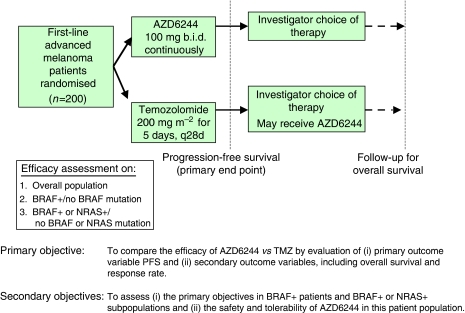
This study investigated the potential clinical utility of circulating free DNA (cfDNA) as a source of BRAF mutation detection in patients enrolled into a phase II study of AZD6244, a specific MEK1/2 inhibitor, in patients with advanced melanoma.
BRAF mutations were detected using Amplification Refractory Mutation System allele-specific PCR. BRAF mutation status was assessed in serum-derived cfDNA from 126 patients enrolled into the study and from 94 matched tumour samples.
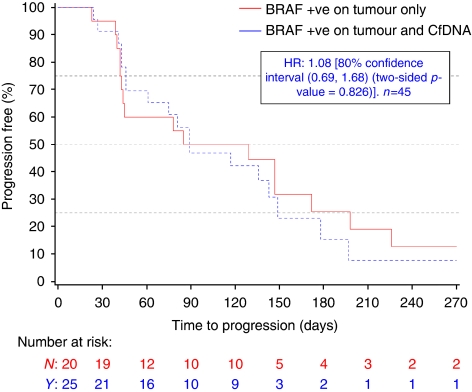
Of 94 tumour samples, 45 (47.9%) were found to be BRAF mutation positive (BRAF+). Serum-derived cfDNA was BRAF+ in 33 of 126 (26.2%) samples, including in five samples for which tumour data were unavailable. Of BRAF+ tumours, 25 of 45 (55.6%) were BRAF+ in cfDNA. In three cases in which the tumour was negative, cfDNA was BRAF+. Progression-free survival (PFS) of patients with BRAF+ tumour and cfDNA was not significantly different compared with tumour BRAF+ but cfDNA BRAF-negative patients, indicating that cfDNA BRAF detection is not associated with poorer prognosis on PFS in stage III/IV advanced melanoma.
These data demonstrate the feasibility of BRAF mutation detection in cfDNA of patients with advanced melanoma. Future studies should aim to incorporate BRAF mutation testing in cfDNA to further validate this biomarker for patient selection.
本研究调查了循环游离DNA(cfDNA)作为BRAF突变检测来源在参加AZD6244(一种特异性MEK1/2抑制剂)II期研究的晚期黑色素瘤患者中的潜在临床应用价值。
采用扩增阻滞突变系统等位基因特异性PCR检测BRAF突变。对入组研究的126例患者血清来源的cfDNA以及94例匹配的肿瘤样本进行BRAF突变状态评估。
在94例肿瘤样本中,45例(47.9%)被发现BRAF突变阳性(BRAF+)。血清来源的cfDNA在126例样本中的33例(26.2%)为BRAF+,其中包括5例无法获得肿瘤数据的样本。在BRAF+肿瘤中,45例中有25例(55.6%)的cfDNA为BRAF+。在3例肿瘤为阴性的病例中,cfDNA为BRAF+。BRAF+肿瘤且cfDNA阳性的患者与肿瘤BRAF+但cfDNA BRAF阴性的患者的无进展生存期(PFS)无显著差异,这表明在III/IV期晚期黑色素瘤中,cfDNA BRAF检测与PFS较差的预后无关。
这些数据证明了在晚期黑色素瘤患者的cfDNA中检测BRAF突变的可行性。未来的研究应旨在将cfDNA中的BRAF突变检测纳入其中,以进一步验证这种生物标志物用于患者选择的有效性。