Craig N, Kass S, Sollner-Webb B
Department of Biological Sciences, University of Maryland Baltimore County, 21228.
Mol Cell Biol. 1991 Jan;11(1):458-67. doi: 10.1128/mcb.11.1.458-467.1991.
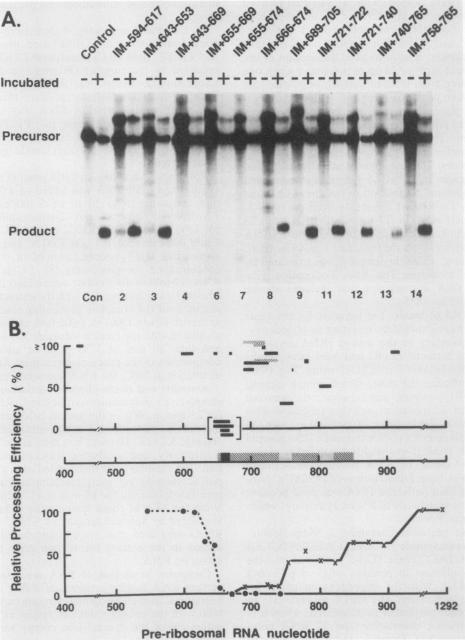
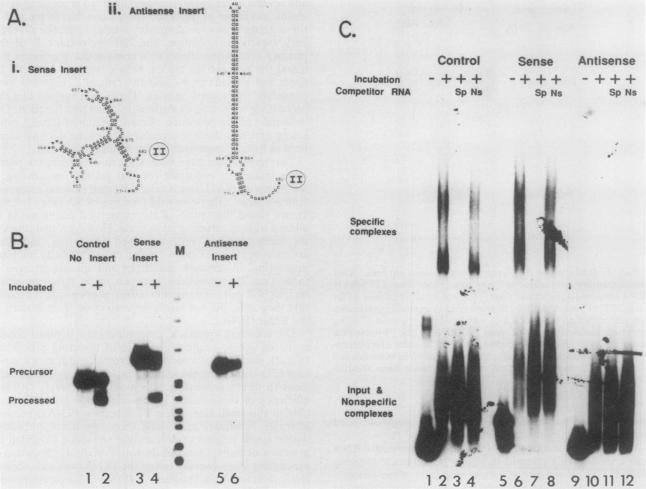
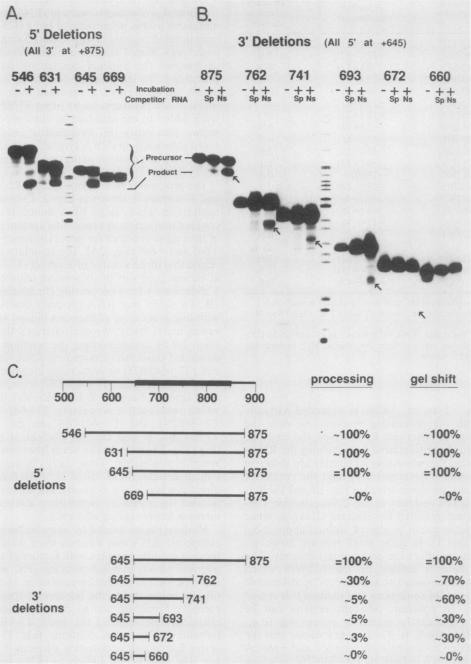
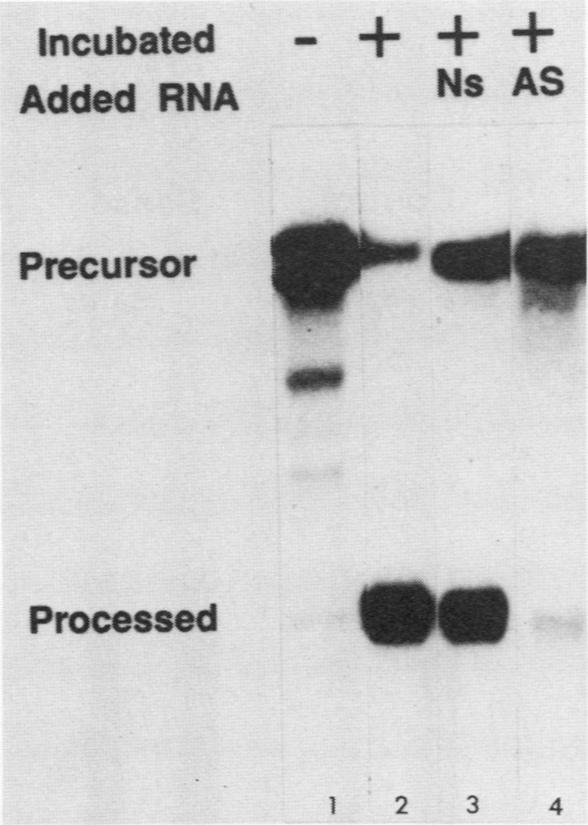
The first processing step in the maturation of mouse precursor rRNA involves cleavage at nucleotide ca. +650, at the 5' border of a 200-nucleotide region that is conserved across mammals and contains the sequences that direct the processing. To identify the relevant sequence elements, we used rRNAs with small internal mutations and short pre-rRNA substrates. Much of the region can be mutated without appreciable effect, but nucleotides +655 to +666 appear to be absolutely required and short segments surrounding +750 and +810 markedly stimulate processing. The minimal processing signal corresponds to rRNA nucleotides +645 to +672. Formation of a ribonucleoprotein complex of retarded electrophoretic mobility is evidently necessary but not sufficient for processing. Computer-assisted analysis suggested a phylogenetic- and mutant-supported secondary structure in which the minimal processing signal forms a stem with the +655 region in the loop, and there is a separate branched duplex containing the downstream stimulatory sequences. Use of antisense RNA, in trans and in cis, to sequester the +655 region in a duplex supported the hypothesis that this critical region was needed in a single-stranded conformation for processing and for specific complex formation.
小鼠前体rRNA成熟过程中的第一步加工涉及在核苷酸约+650处切割,此处位于一个200个核苷酸区域的5'边界,该区域在哺乳动物中保守,且包含指导加工的序列。为了鉴定相关的序列元件,我们使用了带有小的内部突变的rRNA和短的前体rRNA底物。该区域的大部分可以发生突变而没有明显影响,但核苷酸+655至+666似乎是绝对必需的,并且围绕+750和+810的短片段显著刺激加工。最小加工信号对应于rRNA核苷酸+645至+672。形成电泳迁移率减慢的核糖核蛋白复合物显然是加工所必需的,但并不充分。计算机辅助分析表明存在一种系统发育和突变支持的二级结构,其中最小加工信号形成一个茎,+655区域在环中,并且存在一个单独的分支双链体,包含下游刺激序列。使用反义RNA,在反式和顺式中,将+655区域隔离在双链体中,支持了这样的假设,即这个关键区域需要以单链构象进行加工和形成特定复合物。