Bulman D E, Murphy E G, Zubrzycka-Gaarn E E, Worton R G, Ray P N
Department of Genetics, Hospital for Sick Children, Toronto, Ontario, Canada.
Am J Hum Genet. 1991 Feb;48(2):295-304.
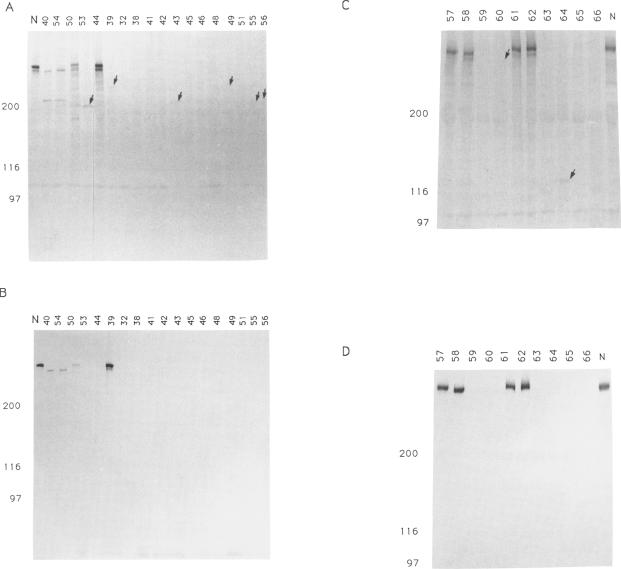
Antibodies directed against the amino- and carboxy-terminal regions of dystrophin have been used to characterize 25 Duchenne muscular dystrophy (DMD), two intermediate, and two Becker muscular dystrophy (BMD) patients. Western blot analysis revealed an altered-size (truncated) immunoreactive dystrophin band in 11 of the 25 DMD patients, in one of the two intermediate patients, and in both BMD patients, when immunostained with antiserum raised against the amino terminus of dystrophin. None of the DMD or intermediate patients demonstrated an immunoreactive dystrophin band when immunostained with an antiserum specific for the carboxy terminus of the protein. In contrast, dystrophin was detected in both BMD patients by the antiserum specific for the carboxy terminus. Quantitative studies indicated that the relative abundance of dystrophin in patients with a severe (DMD), intermediate, or mild (BMD) phenotype may overlap, therefore suggesting that differential diagnosis of disease severity based entirely on dystrophin quantitation may be unsatisfactory. Our results suggest that a differential diagnosis between DMD and BMD would benefit from examination of both the N terminus and C terminus of the protein, in addition to measurements of the relative abundance of the protein.
针对肌营养不良蛋白氨基末端和羧基末端区域的抗体已被用于对25例杜兴氏肌营养不良症(DMD)患者、2例中间型患者和2例贝克氏肌营养不良症(BMD)患者进行特征分析。蛋白质印迹分析显示,当用针对肌营养不良蛋白氨基末端的抗血清进行免疫染色时,25例DMD患者中有11例、2例中间型患者中有1例以及2例BMD患者中均出现了大小改变(截短)的免疫反应性肌营养不良蛋白条带。当用针对该蛋白羧基末端的特异性抗血清进行免疫染色时,DMD患者或中间型患者均未显示出免疫反应性肌营养不良蛋白条带。相比之下,针对羧基末端的抗血清在2例BMD患者中均检测到了肌营养不良蛋白。定量研究表明,严重(DMD)、中间型或轻度(BMD)表型患者中肌营养不良蛋白的相对丰度可能存在重叠,因此表明完全基于肌营养不良蛋白定量进行疾病严重程度的鉴别诊断可能并不理想。我们的结果表明,除了测量该蛋白的相对丰度外,对DMD和BMD进行鉴别诊断时,检查该蛋白的N末端和C末端将有助于诊断。