• 文献检索
  • 文档翻译
  • 深度研究
  • 学术资讯
  • Suppr Zotero 插件Zotero 插件
  • 邀请有礼
  • 套餐&价格
  • 历史记录
应用&插件
Suppr Zotero 插件Zotero 插件浏览器插件Mac 客户端Windows 客户端微信小程序
定价
高级版会员购买积分包购买API积分包
服务
文献检索文档翻译深度研究API 文档MCP 服务
关于我们
关于 Suppr公司介绍联系我们用户协议隐私条款
关注我们

Suppr 超能文献

核心技术专利:CN118964589B侵权必究
粤ICP备2023148730 号-1Suppr @ 2026

文献检索

告别复杂PubMed语法,用中文像聊天一样搜索,搜遍4000万医学文献。AI智能推荐,让科研检索更轻松。

立即免费搜索

文件翻译

保留排版,准确专业,支持PDF/Word/PPT等文件格式,支持 12+语言互译。

免费翻译文档

深度研究

AI帮你快速写综述,25分钟生成高质量综述,智能提取关键信息,辅助科研写作。

立即免费体验

TKI 治疗相关 CML 液体潴留的发生和管理,重点是达沙替尼。

The occurrence and management of fluid retention associated with TKI therapy in CML, with a focus on dasatinib.

机构信息

Jane Anne Nohl Division of Hematology and Center for the Study of Blood Diseases, University of Southern California Medical Center, 1441 Eastlake Ave Suite 7317, Los Angeles, CA 90033, USA.

出版信息

J Hematol Oncol. 2009 Nov 12;2:46. doi: 10.1186/1756-8722-2-46.

DOI:10.1186/1756-8722-2-46
PMID:19909541
原文链接:https://pmc.ncbi.nlm.nih.gov/articles/PMC2785832/
Abstract

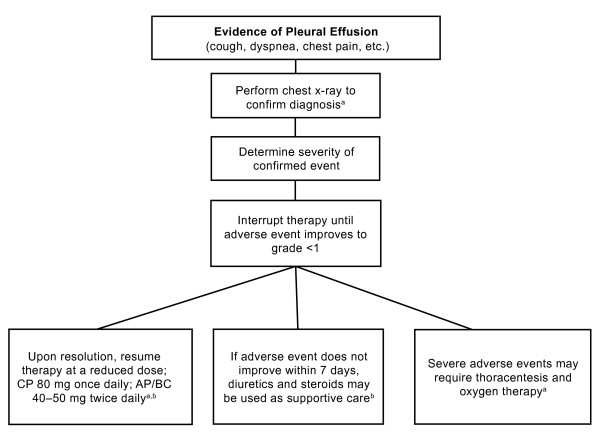
Tyrosine kinase inhibitors (TKIs) like dasatinib and nilotinib are indicated as second-line treatment for chronic myeloid leukemia resistant or intolerant to the current first-line TKI imatinib. These are agents are well tolerated, but potent and as such should be monitored for potentially serious side-effects like fluid retention and pleural effusions. Here we present key clinical trial data and safety considerations for all FDA approved TKIs in context for effective management of fluid retention and pleural effusions. Altering the dasatinib regimen from 70 mg twice daily to 100 mg daily reduces the risk of pleural effusion for patients taking dasatinib. Should pleural effusion develop, dasatinib should be interrupted until the condition resolves. Patients with a history of pleural effusion risk factors should be monitored closely while taking dasatinib. Patients receiving imatinib and nilotinib are not without risk of fluid retention. All patients should also be educated to recognize and report key symptoms of fluid retention or pleural effusion. Pleural effusions are generally managed by dose interruption/reduction and other supportive measures in patients with chronic myeloid leukemia receiving dasatinib therapy.

摘要

酪氨酸激酶抑制剂(TKIs),如达沙替尼和尼洛替尼,适用于对当前一线 TKI 伊马替尼耐药或不耐受的慢性髓性白血病的二线治疗。这些药物耐受性良好,但作用较强,因此应监测可能出现的严重副作用,如体液潴留和胸腔积液。在这里,我们根据有效管理体液潴留和胸腔积液的情况,介绍了所有获得 FDA 批准的 TKI 的关键临床试验数据和安全性考虑因素。将达沙替尼的治疗方案从每日两次 70mg 改为每日 100mg,可以降低接受达沙替尼治疗的患者发生胸腔积液的风险。如果出现胸腔积液,应中断达沙替尼治疗,直至病情缓解。有胸腔积液风险因素病史的患者在服用达沙替尼时应密切监测。接受伊马替尼和尼洛替尼治疗的患者也有发生体液潴留的风险。所有患者还应接受教育,以识别和报告体液潴留或胸腔积液的关键症状。胸腔积液通常通过中断/减少剂量和其他支持性措施来管理,适用于接受达沙替尼治疗的慢性髓性白血病患者。
https://cdn.ncbi.nlm.nih.gov/pmc/blobs/bdfc/2785832/13939eed956e/1756-8722-2-46-1.jpg

相似文献

1
The occurrence and management of fluid retention associated with TKI therapy in CML, with a focus on dasatinib.TKI 治疗相关 CML 液体潴留的发生和管理,重点是达沙替尼。
J Hematol Oncol. 2009 Nov 12;2:46. doi: 10.1186/1756-8722-2-46.
2
Pleural/pericardic effusions during dasatinib treatment: incidence, management and risk factors associated to their development.达沙替尼治疗期间的胸腔/心包积液:发生率、处理方法以及与积液发生相关的风险因素。
Expert Opin Drug Saf. 2010 Sep;9(5):713-21. doi: 10.1517/14740331003742935.
3
Pleural effusions due to dasatinib.达沙替尼引起的胸腔积液。
Curr Opin Pulm Med. 2010 Jul;16(4):351-6. doi: 10.1097/MCP.0b013e328338c486.
4
Chronic myeloid leukemia patients who develop grade I/II pleural effusion under second-line dasatinib have better responses and outcomes than patients without pleural effusion.二线达沙替尼治疗后发生 I/II 级胸腔积液的慢性髓系白血病患者比无胸腔积液患者有更好的反应和结局。
Leuk Res. 2014 Jul;38(7):781-7. doi: 10.1016/j.leukres.2014.04.004. Epub 2014 Apr 18.
5
Treatment-, patient-, and disease-related factors and the emergence of adverse events with tyrosine kinase inhibitors for the treatment of chronic myeloid leukemia.治疗相关因素、患者相关因素和疾病相关因素与酪氨酸激酶抑制剂治疗慢性髓系白血病的不良反应的发生有关。
Pharmacotherapy. 2013 Aug;33(8):868-81. doi: 10.1002/phar.1266. Epub 2013 Apr 3.
6
Dasatinib, large granular lymphocytosis, and pleural effusion: useful or adverse effect?达沙替尼、大颗粒淋巴细胞增多症和胸腔积液:有益还是有害作用?
Crit Rev Oncol Hematol. 2014 Feb;89(2):242-7. doi: 10.1016/j.critrevonc.2013.10.005. Epub 2013 Oct 12.
7
Pleural effusion in patients with chronic myelogenous leukemia treated with dasatinib after imatinib failure.伊马替尼治疗失败后使用达沙替尼治疗的慢性髓性白血病患者的胸腔积液
J Clin Oncol. 2007 Sep 1;25(25):3908-14. doi: 10.1200/JCO.2007.12.0329.
8
Dasatinib-induced pleural effusions: a lymphatic network disorder?达沙替尼诱导的胸腔积液:一种淋巴管网络紊乱?
Am J Med Sci. 2009 Nov;338(5):414-7. doi: 10.1097/MAJ.0b013e3181ae9227.
9
Dasatinib: a review of its use in the treatment of chronic myeloid leukaemia and Philadelphia chromosome-positive acute lymphoblastic leukaemia.达沙替尼:用于治疗慢性髓性白血病和费城染色体阳性急性淋巴细胞白血病的综述。
Drugs. 2011 Sep 10;71(13):1771-95. doi: 10.2165/11207580-000000000-00000.
10
Charlson comorbidity index and adult comorbidity evaluation-27 scores might predict treatment compliance and development of pleural effusions in elderly patients with chronic myeloid leukemia treated with second-line dasatinib.Charlson 共病指数和成人共病评估-27 评分可能预测二线达沙替尼治疗的老年慢性髓系白血病患者的治疗依从性和胸腔积液的发生。
Haematologica. 2011 Oct;96(10):1457-61. doi: 10.3324/haematol.2011.041251. Epub 2011 Jun 17.

引用本文的文献

1
Cardiotoxicity of Anticancer Drugs: Molecular Mechanisms, Clinical Management and Innovative Treatment.抗癌药物的心脏毒性:分子机制、临床管理和创新治疗。
Drug Des Devel Ther. 2024 Sep 12;18:4089-4116. doi: 10.2147/DDDT.S469331. eCollection 2024.
2
Fluid retention-associated adverse events in patients treated with BCR::ABL1 inhibitors based on FDA Adverse Event Reporting System (FAERS): a retrospective pharmacovigilance study.基于 FDA 不良事件报告系统(FAERS)的 BCR::ABL1 抑制剂治疗患者的液体潴留相关不良事件:一项回顾性药物警戒研究。
BMJ Open. 2023 Aug 3;13(8):e071456. doi: 10.1136/bmjopen-2022-071456.
3
Renal Safety Profile of BCR-ABL Tyrosine Kinase Inhibitors in a Real-Life Setting: A Study Based on Vigibase, the WHO Pharmacovigilance Database.

本文引用的文献

1
NCCN clinical practice guidelines in oncology: chronic myelogenous leukemia.美国国立综合癌症网络(NCCN)肿瘤学临床实践指南:慢性粒细胞白血病
J Natl Compr Canc Netw. 2009 Oct;7(9):984-1023. doi: 10.6004/jnccn.2009.0065.
2
Intermittent target inhibition with dasatinib 100 mg once daily preserves efficacy and improves tolerability in imatinib-resistant and -intolerant chronic-phase chronic myeloid leukemia.每日一次服用100毫克达沙替尼进行间歇性靶向抑制可维持疗效,并提高对伊马替尼耐药和不耐受的慢性期慢性髓性白血病患者的耐受性。
J Clin Oncol. 2008 Jul 1;26(19):3204-12. doi: 10.1200/JCO.2007.14.9260. Epub 2008 Jun 9.
3
The Src/ABL kinase inhibitor dasatinib (BMS-354825) inhibits function of normal human T-lymphocytes in vitro.
BCR-ABL酪氨酸激酶抑制剂在实际应用中的肾脏安全性概况:一项基于世界卫生组织药物警戒数据库Vigibase的研究
Cancers (Basel). 2023 Mar 29;15(7):2041. doi: 10.3390/cancers15072041.
4
Suppressing of Src-Hic-5-JNK-AKT Signaling Reduced GAPDH Expression for Preventing the Progression of HuCCT1 Cholangiocarcinoma.抑制Src-Hic-5-JNK-AKT信号通路可降低甘油醛-3-磷酸脱氢酶(GAPDH)的表达,从而预防HuCCT1胆管癌的进展。
Pharmaceutics. 2022 Dec 2;14(12):2698. doi: 10.3390/pharmaceutics14122698.
5
Cross-Domain Text Mining to Predict Adverse Events from Tyrosine Kinase Inhibitors for Chronic Myeloid Leukemia.跨领域文本挖掘以预测慢性髓性白血病酪氨酸激酶抑制剂的不良事件
Cancers (Basel). 2022 Sep 26;14(19):4686. doi: 10.3390/cancers14194686.
6
Case report: Pleural effusion during tyrosine-kinase inhibitor treatment in chronic myeloid leukemia: Not only a dasatinib-related adverse event.病例报告:慢性髓性白血病酪氨酸激酶抑制剂治疗期间的胸腔积液:不仅仅是与达沙替尼相关的不良事件。
Front Oncol. 2022 Sep 13;12:1012268. doi: 10.3389/fonc.2022.1012268. eCollection 2022.
7
Senolytic Therapy to Modulate the Progression of Alzheimer's Disease (SToMP-AD): A Pilot Clinical Trial.衰老细胞清除疗法调控阿尔茨海默病进展(SToMP-AD):一项初步临床试验。
J Prev Alzheimers Dis. 2022;9(1):22-29. doi: 10.14283/jpad.2021.62.
8
Dasatinib-Induced Pleural and Pericardial Effusions.达沙替尼引起的胸腔和心包积液。
Cureus. 2021 Oct 25;13(10):e19024. doi: 10.7759/cureus.19024. eCollection 2021 Oct.
9
Severe pleural effusion associated with nilotinib for chronic myeloid leukaemia: cross-intolerance with tyrosine kinase inhibitors.尼洛替尼治疗慢性髓性白血病相关的严重胸腔积液:与酪氨酸激酶抑制剂的交叉不耐受。
BMJ Case Rep. 2021 Sep 3;14(9):e243671. doi: 10.1136/bcr-2021-243671.
10
Pleural Effusion Secondary to Dasatinib Following Allogenic Hematopoietic Stem Cell Transplantation.异基因造血干细胞移植后继发于达沙替尼的胸腔积液。
Am J Case Rep. 2021 Aug 7;22:e932711. doi: 10.12659/AJCR.932711.
Src/ABL激酶抑制剂达沙替尼(BMS-354825)在体外可抑制正常人T淋巴细胞的功能。
Clin Immunol. 2008 Jun;127(3):330-9. doi: 10.1016/j.clim.2008.02.006. Epub 2008 Apr 18.
4
Pleural effusions in patients with chronic myeloid leukaemia treated with dasatinib may have an immune-mediated pathogenesis.接受达沙替尼治疗的慢性髓性白血病患者出现的胸腔积液可能具有免疫介导的发病机制。
Br J Haematol. 2008 May;141(5):745-7. doi: 10.1111/j.1365-2141.2008.07108.x. Epub 2008 Mar 7.
5
Management of Bcr-Abl-positive leukemias with dasatinib.达沙替尼治疗Bcr-Abl阳性白血病
Expert Rev Anticancer Ther. 2007 Nov;7(11):1529-36. doi: 10.1586/14737140.7.11.1529.
6
Pleural effusion in patients with chronic myelogenous leukemia treated with dasatinib after imatinib failure.伊马替尼治疗失败后使用达沙替尼治疗的慢性髓性白血病患者的胸腔积液
J Clin Oncol. 2007 Sep 1;25(25):3908-14. doi: 10.1200/JCO.2007.12.0329.
7
Chemical proteomic profiles of the BCR-ABL inhibitors imatinib, nilotinib, and dasatinib reveal novel kinase and nonkinase targets.BCR-ABL抑制剂伊马替尼、尼洛替尼和达沙替尼的化学蛋白质组学图谱揭示了新的激酶和非激酶靶点。
Blood. 2007 Dec 1;110(12):4055-63. doi: 10.1182/blood-2007-07-102061. Epub 2007 Aug 24.
8
Nilotinib (formerly AMN107), a highly selective BCR-ABL tyrosine kinase inhibitor, is effective in patients with Philadelphia chromosome-positive chronic myelogenous leukemia in chronic phase following imatinib resistance and intolerance.尼罗替尼(原AMN107)是一种高度选择性的BCR-ABL酪氨酸激酶抑制剂,对伊马替尼耐药和不耐受的慢性期费城染色体阳性慢性髓性白血病患者有效。
Blood. 2007 Nov 15;110(10):3540-6. doi: 10.1182/blood-2007-03-080689. Epub 2007 Aug 22.
9
Lung abnormalities after dasatinib treatment for chronic myeloid leukemia: a case series.达沙替尼治疗慢性粒细胞白血病后的肺部异常:病例系列
Am J Respir Crit Care Med. 2007 Oct 15;176(8):814-8. doi: 10.1164/rccm.200705-715CR. Epub 2007 Jun 28.
10
Bcr-Abl kinase domain mutations, drug resistance, and the road to a cure for chronic myeloid leukemia.Bcr-Abl激酶结构域突变、耐药性与慢性髓性白血病的治愈之路
Blood. 2007 Oct 1;110(7):2242-9. doi: 10.1182/blood-2007-03-066936. Epub 2007 May 11.