Gacci Mauro, Simonato Alchiede, Masieri Lorenzo, Gore John L, Lanciotti Michele, Mantella Annalisa, Rossetti Mario Alberto, Serni Sergio, Varca Virginia, Romagnoli Andrea, Ambruosi Carlo, Venzano Fabio, Esposito Marco, Montanaro Tomaso, Carmignani Giorgio, Carini Marco
Department of Urology, University of Florence, Careggi Hospital, Florence, Italy.
Health Qual Life Outcomes. 2009 Nov 13;7:94. doi: 10.1186/1477-7525-7-94.
After long term disease free follow up (FUp) patients reconsider quality of life (QOL) outcomes. Aim of this study is assess QoL in prostate cancer patients who are disease-free at least 5 years after radical prostatectomy (RP).
367 patients treated with RP for clinically localized pCa, without biochemical failure (PSA <or= 0.2 ng/mL) at the follow up >or= 5 years were recruited.Urinary (UF) and Sexual Function (SF), Urinary (UB) and Sexual Bother (SB) were assessed by using UCLA-PCI questionnaire. UF, UB, SF and SB were analyzed according to: treatment timing (age at time of RP, FUp duration, age at time of FUp), tumor characteristics (preoperative PSA, TNM stage, pathological Gleason score), nerve sparing (NS) procedure, and hormonal treatment (HT).We calculated the differences between 93 NS-RP without HT (group A) and 274 non-NS-RP or NS-RP with HT (group B). We evaluated the correlation between function and bother in group A according to follow-up duration.
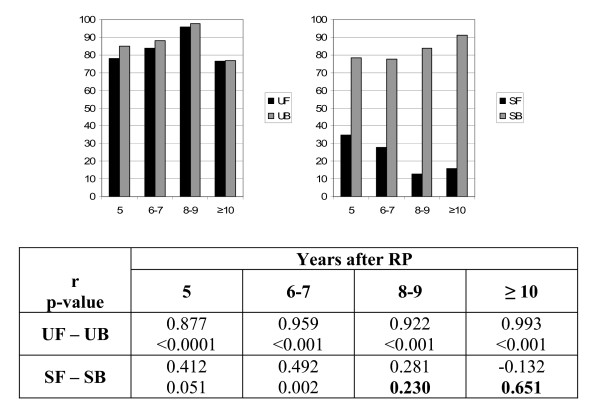
Time since prostatectomy had a negative effect on SF and a positive effect SB (both p < 0.001). Elderly men at follow up experienced worse UF and SF (p = 0.02 and p < 0.001) and better SB (p < 0.001).Higher stage PCa negatively affected UB, SF, and SB (all: p <or= 0.05). NS was associated with better UB, SF and SB (all: p <or= 0.05); conversely, HT was associated with worse UF, SF and SB (all: p <or= 0.05).More than 8 years after prostatectomy SF of group A and B were similar. Group A subjects (NS-RP without HT) demonstrated worsening SF, but improved SB, suggesting dissociation of the correlation between SF and SB over time.
Older age at follow up and higher pathological stage were associated with worse QoL outcomes after RP. The direct correlation between UF and age at follow up, with no correlation between UF and age at time of RP suggests that other issues (i.e: vascular or neurogenic disorders), subsequent to RP, are determinant on urinary incontinence. After NS-RP without HT the correlation between SF and SB is maintained for 7 years, after which function and bother appear to have divergent trajectories.
经过长期无病随访后,患者会重新审视生活质量(QOL)结果。本研究的目的是评估根治性前列腺切除术(RP)后至少5年无病的前列腺癌患者的生活质量。
招募了367例因临床局限性前列腺癌接受RP治疗、随访≥5年且无生化复发(PSA≤0.2 ng/mL)的患者。使用加州大学洛杉矶分校前列腺癌指数(UCLA-PCI)问卷评估泌尿功能(UF)和性功能(SF)、泌尿困扰(UB)和性困扰(SB)。根据治疗时间(RP时年龄、随访持续时间、随访时年龄)、肿瘤特征(术前PSA、TNM分期、病理Gleason评分)、保留神经(NS)手术和激素治疗(HT)对UF、UB、SF和SB进行分析。我们计算了93例未接受HT的NS-RP患者(A组)和274例非NS-RP或接受HT的NS-RP患者(B组)之间的差异。我们根据随访持续时间评估了A组中功能与困扰之间的相关性。
前列腺切除术后的时间对SF有负面影响,对SB有正面影响(均p<0.001)。随访时的老年男性UF和SF较差(p=0.02和p<0.001),SB较好(p<0.001)。较高分期的前列腺癌对UB、SF和SB有负面影响(均p≤0.05)。NS与更好的UB、SF和SB相关(均p≤0.05);相反,HT与更差的UF、SF和SB相关(均p≤0.05)。前列腺切除术后8年以上,A组和B组的SF相似。A组患者(未接受HT的NS-RP)SF恶化,但SB改善,表明随着时间推移SF与SB之间的相关性出现分离。
随访时年龄较大和病理分期较高与RP后较差的生活质量结果相关。UF与随访时年龄直接相关,而与RP时年龄无关,这表明RP后出现的其他问题(即血管或神经源性疾病)是尿失禁的决定因素。在未接受HT的NS-RP后,SF与SB之间的相关性维持7年,之后功能和困扰似乎出现不同轨迹。