Maroof Asher, Beattie Lynette, Kirby Alun, Coles Mark, Kaye Paul M
Centre for Immunology and Infection, Hull York Medical School and Department of Biology, University of York, Wentworth Way, York, United Kingdom.
J Immunol. 2009 Dec 1;183(11):7095-103. doi: 10.4049/jimmunol.0901330. Epub 2009 Nov 16.
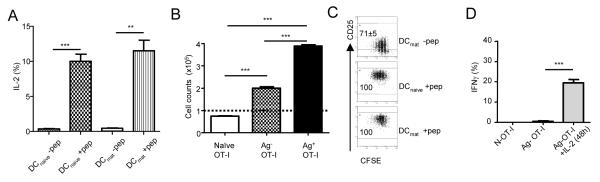
Dendritic cells (DC) licensed by the interaction between pathogen products and pattern recognition receptors can activate naive T cells to undergo Ag-dependent proliferation and cytokine production. In contrast, DC induced to mature by trans-acting inflammatory stimuli are believed to only be capable of supporting Ag-dependent proliferative responses. In this study, we show that uninfected DC matured as a consequence of Leishmania-induced inflammation induce CD8(+) T cells to proliferate in the absence of their cognate Ag. We separated splenic DC from Leishmania donovani-infected mice into those that contained parasites and had been activated to induce IL-12p40, from those that had undergone only partial maturation, measured by increased CD86 expression in the absence of IL-12p40 induction. We then showed that these partially matured DC could induce exogenous peptide-independent proliferation of OT-I and F5 CD8(+) TCR transgenic T cells, as well as polyclonal CD8(+) T cells. Proliferation of OT-I cells was significantly inhibited in vitro and in vivo by anti-CD86 mAb but not by anti-CD80 mAb and could also be inhibited by cyclosporine A. Proliferating OT-I cells did not produce IFN-gamma, even when re-exposed to mature DC. However, these primed OT-I cells subsequently produced effector cytokines, not just on exposure to their cognate peptide but, more importantly, to weak exogenous TCR agonists that otherwise failed to induce IFN-gamma. We further showed that OT-I cells undergoing locally driven proliferation to another pathogen, Streptococcus pneumoniae, rapidly seeded other lymphoid tissues, suggesting that CD8(+) T cells primed in this way may play a role in rapidly countering pathogen dissemination.
病原体产物与模式识别受体相互作用许可的树突状细胞(DC)可激活初始T细胞,使其进行抗原依赖性增殖并产生细胞因子。相比之下,由反式作用炎症刺激诱导成熟的DC被认为仅能够支持抗原依赖性增殖反应。在本研究中,我们发现因利什曼原虫诱导的炎症而成熟的未感染DC可在没有其同源抗原的情况下诱导CD8(+) T细胞增殖。我们将来自感染杜氏利什曼原虫小鼠的脾DC分为含有寄生虫并已被激活以诱导IL-12p40的DC,以及仅经历部分成熟的DC(通过在无IL-12p40诱导情况下CD86表达增加来衡量)。然后我们表明,这些部分成熟的DC可诱导OT-I和F5 CD8(+) TCR转基因T细胞以及多克隆CD8(+) T细胞进行不依赖外源性肽的增殖。OT-I细胞的增殖在体外和体内均被抗CD86单克隆抗体显著抑制,但不被抗CD80单克隆抗体抑制,并且也可被环孢素A抑制。增殖的OT-I细胞即使再次暴露于成熟DC也不产生IFN-γ。然而,这些预激活的OT-I细胞随后不仅在暴露于其同源肽时,更重要的是在暴露于否则无法诱导IFN-γ的弱外源性TCR激动剂时产生效应细胞因子。我们进一步表明,经历局部驱动增殖以应对另一种病原体肺炎链球菌的OT-I细胞迅速播种到其他淋巴组织,这表明以这种方式预激活的CD8(+) T细胞可能在快速对抗病原体传播中发挥作用。