Laboratory for Biomaterials, Swiss Federal Laboratories for Materials Testing and Research (Empa), CH-9014 St, Gallen, Switzerland.
Microb Cell Fact. 2009 Nov 19;8:60. doi: 10.1186/1475-2859-8-60.
Polyhydroxyalkanoates (PHA) are synthesized by many bacteria in the cytoplasm as storage compounds for energy and carbon. The key enzymes for PHA biosynthesis are PHA polymerases, which catalyze the covalent linkage of 3-hydroxyacyl coenzymeA thioesters by transesterification with concomitant release of CoA. Pseudomonas putida GPo1 and many other Pseudomonas species contain two different class II polymerases, encoded by phaC1 and phaC2. Although numerous studies have been carried out on PHA polymerases and they are well characterized at the molecular level, the biochemical properties of the class II polymerases have not been studied in detail. Previously we and other groups purified the polymerases, however, the activities of the purified enzymes were several magnitude lower than the granule-bound enzymes. It is problematic to study the intrinsic properties of these enzymes with such low activities, although they are pure.
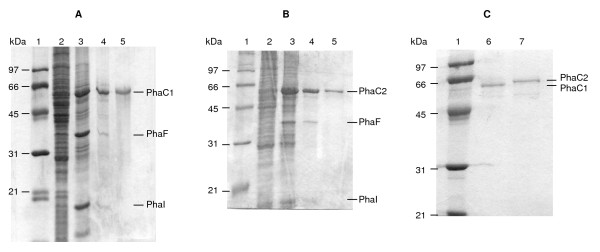
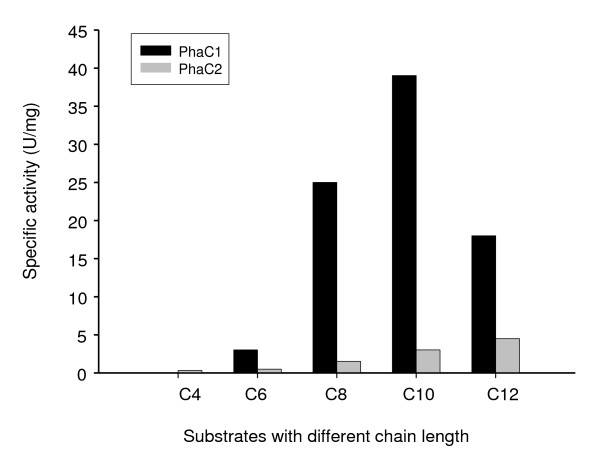
PHA polymerase 1 (PhaC1) and PHA polymerase 2 (PhaC2) from P. putida GPo1 were overexpressed in the PHA-negative host P. putida GPp104 and purified from isolated PHA granules. Only minor activity (two to three orders of magnitude lower than that of the granule bound proteins) could be recovered when the enzymes were purified to homogeneity. Therefore, kinetic properties and substrate ranges were determined for the granule bound polymerases. The polymerases differed significantly with respect to their association with PHA granules, enzyme kinetics and substrate specificity. PhaC2 appeared to bind PHA granules more tightly than PhaC1. When R-3-hydroxyoctanoic acid was used as substrate, the granule-bound PhaC1 exhibited a Km of 125 (+/- 35) muM and a Vmax of 40.8 (+/- 6.2) U/mg PhaC1, while a Km of 37 (+/- 10) microM and a Vmax of 2.7 (+/- 0.7) U/mg PhaC2 could be derived for the granule-bound PhaC2. Granule-bound PhaC1 showed a strong preference for medium chain length (mcl-) 3-hydroxyacly-CoAs, with highest affinity towards 3-hydroxydecanoyl-CoA (40 U/mg PhaC1). Granule-bound PhaC2 demonstrated a far broader specificity ranging from short chain length up to long chain length substrates. Activity increased with increasing chain length with a maximum activity for 3-hydroxyacyl-CoAs containing 12 or more C-atoms.
The kinetic properties and substrate ranges were determined for both granule bound polymerases. Evidence was provided for the first time that two PHA polymerases exhibited significant differences in granule release and in vitro activity profiles, suggesting that there are substantial functional differences between granule bound PhaC1 and PhaC2.
聚羟基烷酸酯(PHA)是许多细菌在细胞质中合成的,作为能量和碳的储存化合物。PHA 生物合成的关键酶是 PHA 聚合酶,它通过 transesterification 与 CoA 的同时释放,催化 3-羟基酰基辅酶 A 硫酯的共价键合。恶臭假单胞菌 GPo1 和许多其他假单胞菌含有两种不同的 II 类聚合酶,由 phaC1 和 phaC2 编码。尽管已经对 PHA 聚合酶进行了大量研究,并且在分子水平上对其进行了很好的表征,但 II 类聚合酶的生化特性尚未进行详细研究。以前,我们和其他小组都纯化了聚合酶,但是,纯化酶的活性比颗粒结合酶低几个数量级。尽管它们是纯的,但用如此低的活性来研究这些酶的固有性质是有问题的。
恶臭假单胞菌 GPo1 的 PHA 聚合酶 1(PhaC1)和 PHA 聚合酶 2(PhaC2)在 PHA 阴性宿主恶臭假单胞菌 GPp104 中过表达,并从分离的 PHA 颗粒中纯化。当酶被纯化为均相时,只能回收少量活性(比颗粒结合蛋白低两到三个数量级)。因此,对颗粒结合聚合酶进行了动力学性质和底物范围的测定。聚合酶在与 PHA 颗粒的结合、酶动力学和底物特异性方面存在显著差异。PhaC2 似乎比 PhaC1 更紧密地结合 PHA 颗粒。当 R-3-羟基辛酸用作底物时,颗粒结合的 PhaC1 表现出 125(+/-35)µM 的 Km 和 40.8(+/-6.2)U/mg PhaC1 的 Vmax,而颗粒结合的 PhaC2 可以衍生出 37(+/-10)µM 的 Km 和 2.7(+/-0.7)U/mg PhaC2 的 Vmax。颗粒结合的 PhaC1 对中等链长(mcl-)3-羟基酰基辅酶 A 表现出强烈的偏好,对 3-羟基癸酰基辅酶 A 的亲和力最高(40 U/mg PhaC1)。颗粒结合的 PhaC2 表现出更广泛的特异性,从短链长度到长链长度的底物。随着链长的增加,活性增加,含 12 个或更多碳原子的 3-羟基酰基辅酶 A 的活性最高。
为两种颗粒结合聚合酶确定了动力学性质和底物范围。首次提供证据表明,两种 PHA 聚合酶在颗粒释放和体外活性谱方面存在显著差异,这表明颗粒结合的 PhaC1 和 PhaC2 之间存在显著的功能差异。