Department of Pathology, University of Utah, Salt Lake City, Utah, USA.
BMC Immunol. 2009 Nov 22;10:59. doi: 10.1186/1471-2172-10-59.
Regulatory T cells (Tregs) can employ a cell contact- and granzyme B-dependent mechanism to mediate suppression of bystander T and B cells. Murine studies indicate that granzyme B is involved in the Treg-mediated suppression of anti-tumor immunity in the tumor microenvironment and in the Treg-mediated maintenance of allograft survival. In spite of its central importance, a detailed study of granzyme B expression patterns in human Tregs has not been performed.
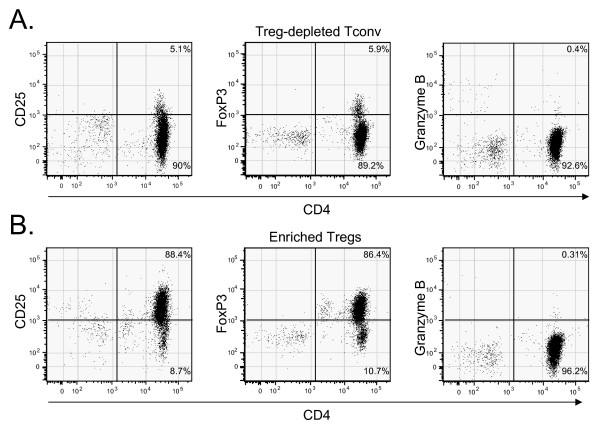
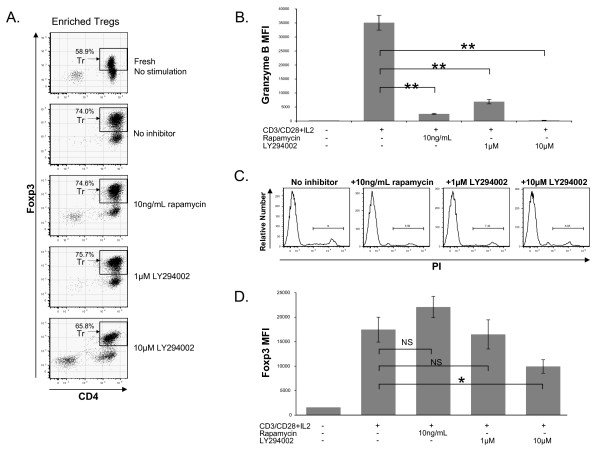
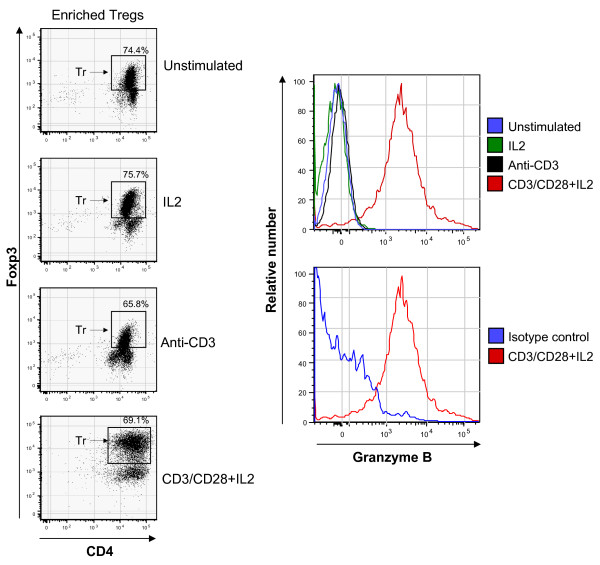
Our data demonstrated that natural Tregs freshly isolated from the peripheral blood of normal adults lacked granzyme B expression. Tregs subjected to prolonged TCR and CD28 triggering, in the presence of IL-2, expressed high levels of granzyme B but CD3 stimulation alone or IL-2 treatment alone failed to induce granzyme B. Treatment of Tregs with the mammalian target of rapamycin (mTOR) inhibitor, rapamycin or the PI3 kinase (PI3K) inhibitor LY294002 markedly suppressed granzyme B expression. However, neither rapamycin, as previously reported by others, nor LY294002 inhibited Treg proliferation or induced significant cell death in TCR/CD28/IL-2 stimulated cells. The proliferation rate of Tregs was markedly higher than that of CD4+ conventional T cells in the setting of rapamycin treatment. Tregs expanded by CD3/CD28/IL-2 stimulation without rapamycin demonstrated increased in vitro cytotoxic activity compared to Tregs expanded in the presence of rapamycin in both short term (6 hours) and long term (48 hours) cytotoxicity assays.
TCR/CD28 mediated activation of the PI3K-mTOR pathway is important for granyzme B expression but not proliferation in regulatory T cells. These findings may indicate that suppressive mechanisms other than granzyme B are utilized by rapamycin-expanded Tregs.
调节性 T 细胞(Tregs)可以采用细胞接触和颗粒酶 B 依赖的机制来介导对旁观者 T 和 B 细胞的抑制。鼠类研究表明,颗粒酶 B 参与了肿瘤微环境中 Treg 介导的抗肿瘤免疫抑制以及 Treg 介导的同种异体移植物存活的维持。尽管它具有重要意义,但尚未对人类 Tregs 中的颗粒酶 B 表达模式进行详细研究。
我们的数据表明,从正常成年人外周血中新鲜分离的天然 Tregs 缺乏颗粒酶 B 的表达。Tregs 在 IL-2 存在下,经过长时间的 TCR 和 CD28 触发,表达高水平的颗粒酶 B,但单独的 CD3 刺激或单独的 IL-2 处理都不能诱导颗粒酶 B。用哺乳动物雷帕霉素靶蛋白(mTOR)抑制剂雷帕霉素或 PI3 激酶(PI3K)抑制剂 LY294002 处理 Tregs,显著抑制颗粒酶 B 的表达。然而,雷帕霉素既没有像其他人之前报道的那样抑制 Treg 的增殖,也没有在 TCR/CD28/IL-2 刺激的细胞中诱导显著的细胞死亡。在雷帕霉素处理的情况下,Tregs 的增殖率明显高于 CD4+常规 T 细胞。与在有雷帕霉素存在的情况下扩增的 Tregs 相比,在没有雷帕霉素的情况下通过 CD3/CD28/IL-2 刺激扩增的 Tregs 在短期(6 小时)和长期(48 小时)细胞毒性测定中显示出更高的体外细胞毒性活性。
TCR/CD28 介导的 PI3K-mTOR 途径的激活对颗粒酶 B 的表达很重要,但对调节性 T 细胞的增殖不重要。这些发现可能表明,雷帕霉素扩增的 Tregs 利用了除颗粒酶 B 以外的抑制机制。