Department of Orthopaedics, Section of Hand Surgery, Regional Hospital Holstebro, Laegaardvej 12, DK-7500 Holstebro, Denmark.
BMC Musculoskelet Disord. 2009 Nov 22;10:144. doi: 10.1186/1471-2474-10-144.
Endoscopic carpal tunnel release with a single portal technique has been shown to reduce sick leave compared to open carpal tunnel release, claiming to be a less invasive procedure and reducing scar tenderness leading to a more rapid return to work, and the purpose of this study was to identify prognostic factors for prolonged sick leave after endoscopic carpal tunnel release in a group of employed Danish patients.
The design was a prospective study including 75 employed patients with carpal tunnel syndrome operated with ECTR at two hospitals. The mean age was 46 years (SD 10.1), the male/female ratio was 0.42, and the mean preoperative duration of symptoms 10 months (range 6-12). Only 21 (28%) were unable to work preoperatively and mean sick leave was 4 weeks (range 1-4). At base-line and at the 3-month follow-up, a self-administered questionnaire was collected concerning physical, psychological, and social circumstances in relation to the hand problem. Data from a nerve conduction examination were collected at baseline and at the 3-month follow-up. Significant prognostic factors were identified through multiple logistic regression analysis.
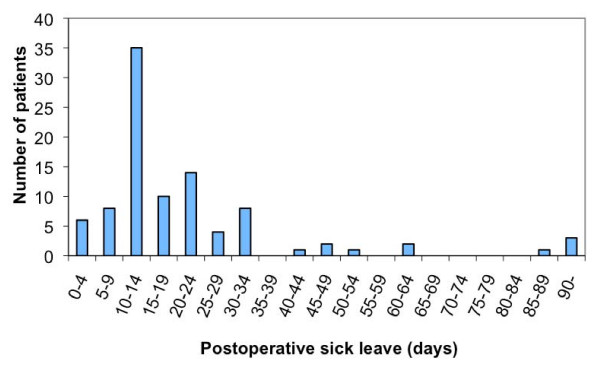
After the operation, the mean functional score was reduced from 2.3 to 1.4 (SD 0.8) and the mean symptom score from 2.9 to 1.5 (SD 0.7). The mean sick leave from work after the operation was 19.8 days (SD 14.3). Eighteen patients (24%) had more than 21 days of sick leave. Two patients (3%) were still unable to work after 3 months. Significant prognostic factors in the multivariate analysis for more than 21 days of postoperative sick leave were preoperative sick leave, blaming oneself for the hand problem and a preoperative distal motor latency.
Preoperative sick leave, blaming oneself for the hand problem, and a preoperative distal nerve conduction motor latency were prognostic factors for postoperative work absence of more than 21 days. Other factors may be important (clinical, demographic, economic, and workplace) in explaining the great variance in the results of sick leave after carpal tunnel release between studies from different countries.
与开放式腕管松解术相比,单通道内镜腕管松解术可减少病假,声称该手术具有侵袭性小、减少术后疤痕触痛从而更快恢复工作等优势。本研究的目的是确定一组丹麦就业患者行内镜腕管松解术后延长病假的预后因素。
这是一项前瞻性研究,纳入了在两家医院接受 ECTR 治疗的 75 名有腕管综合征的就业患者。平均年龄为 46 岁(标准差 10.1),男女比例为 0.42,平均术前症状持续时间为 10 个月(6-12 个月)。只有 21 名(28%)患者术前无法工作,平均病假为 4 周(1-4 周)。在基线和 3 个月随访时,使用自填式问卷收集与手部问题相关的身体、心理和社会情况。在基线和 3 个月随访时收集神经传导检查数据。通过多变量逻辑回归分析确定显著的预后因素。
术后,功能评分从 2.3 分降至 1.4 分(标准差 0.8),症状评分从 2.9 分降至 1.5 分(标准差 0.7)。术后平均缺勤天数为 19.8 天(标准差 14.3)。18 名患者(24%)的病假超过 21 天。2 名患者(3%)术后 3 个月仍无法工作。多变量分析显示,术后病假、将手部问题归咎于自己和术前远侧运动潜伏期是术后缺勤超过 21 天的显著预后因素。
术前病假、将手部问题归咎于自己和术前远侧神经传导运动潜伏期是术后缺勤超过 21 天的预后因素。其他因素(临床、人口统计学、经济和工作场所)可能在解释不同国家腕管松解术后病假结果的巨大差异方面很重要。