Department of Paediatrics, School for Oncology and Developmental Biology (GROW), Maastricht University Medical Centre, PO Box 5800, 6202 AZ Maastricht, the Netherlands.
Respir Res. 2009 Nov 23;10(1):116. doi: 10.1186/1465-9921-10-116.
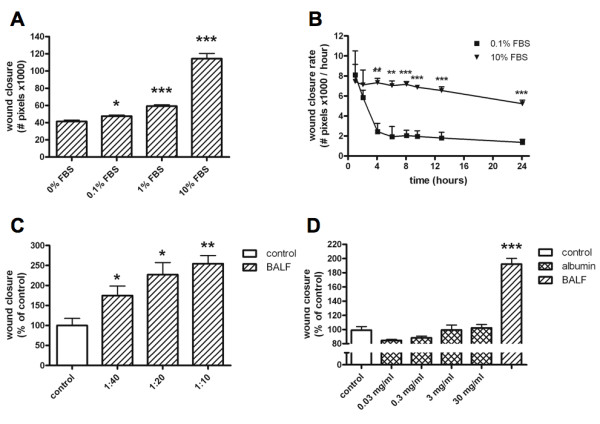
Preterm infants are highly susceptible to lung injury. While both chorioamnionitis and antenatal steroids induce lung maturation, chorioamnionitis is also associated with adverse lung development. We investigated the ability of bronchoalveolar lavage fluid (BALF) from ventilated preterm infants to restore alveolar epithelial integrity after injury in vitro, depending on whether or not they were exposed to chorioamnionitis or antenatal steroids. For this purpose, a translational model for alveolar epithelial repair was developed and characterised.
BALF was added to mechanically wounded monolayers of A549 cells. Wound closure was quantified over time and compared between preterm infants (gestational age < 32 wks) exposed or not exposed to chorioamnionitis and antenatal steroids (>or= 1 dose). Furthermore, keratinocyte growth factor (KGF) and vascular endothelial growth factor (VEGF) were quantified in BALF, and their ability to induce alveolar epithelial repair was evaluated in the model.
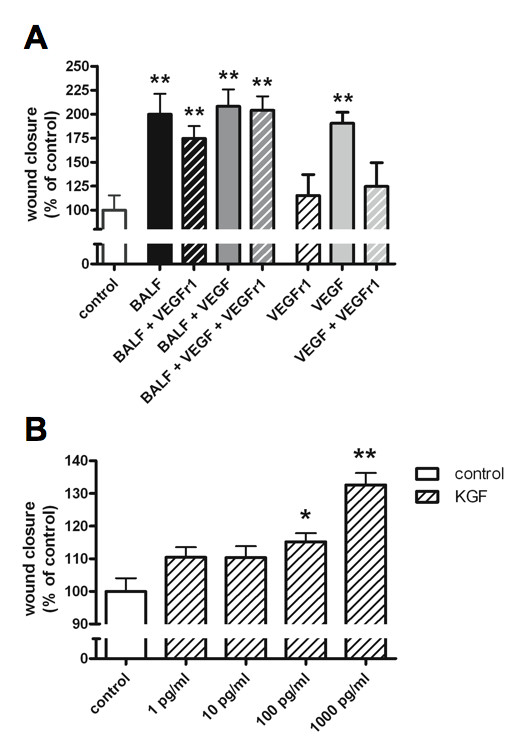
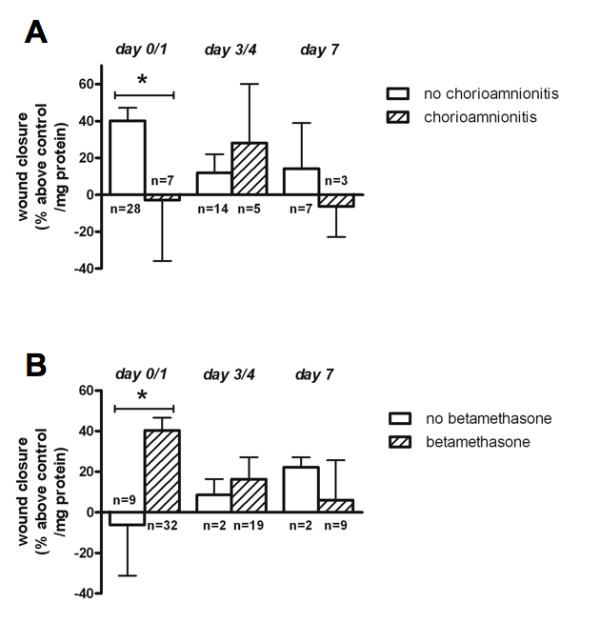
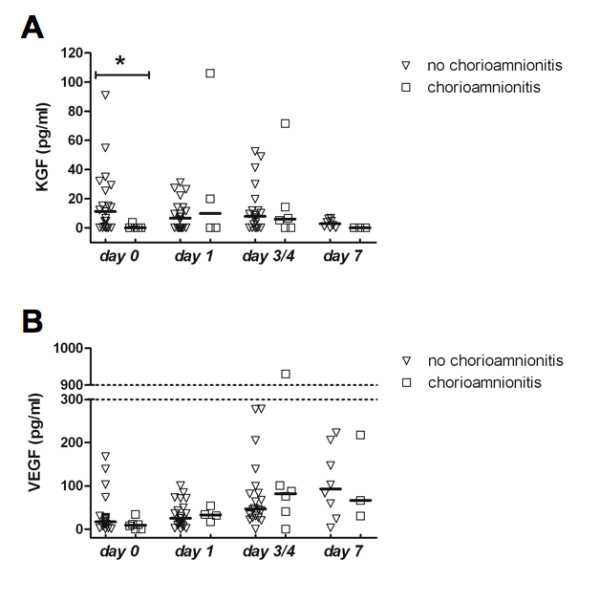
On day 0/1, BALF from infants exposed to antenatal steroids significantly increased epithelial repair (40.3 +/- 35.5 vs. -6.3 +/- 75.0% above control/mg protein), while chorioamnionitis decreased wound-healing capacity of BALF (-2.9 +/- 87.1 vs. 40.2 +/- 36.9% above control/mg protein). BALF from patients with chorioamnionitis contained less KGF (11 (0-27) vs. 0 (0-4) pg/ml) and less detectable VEGF (66 vs. 95%) on day 0. BALF levels of VEGF and KGF correlated with its ability to induce wound repair. Moreover, KGF stimulated epithelial repair dose-dependently, although the low levels in BALF suggest KGF is not a major modulator of BALF-induced wound repair. VEGF also stimulated alveolar epithelial repair, an effect that was blocked by addition of soluble VEGF receptor-1 (sVEGFr1/Flt-1). However, BALF-induced wound repair was not significantly affected by addition of sVEGFr1.
Antenatal steroids improve the ability of BALF derived from preterm infants to stimulate alveolar epithelial repair in vitro. Conversely, chorioamnionitis is associated with decreased wound-healing capacity of BALF. A definite role for KGF and VEGF in either process could not be established. Decreased ability to induce alveolar epithelial repair after injury may contribute to the association between chorioamnionitis and adverse lung development in mechanically ventilated preterm infants.
早产儿极易受到肺损伤的影响。虽然绒毛膜羊膜炎和产前类固醇都能诱导肺成熟,但绒毛膜羊膜炎也与不良的肺发育有关。我们研究了来自接受通气治疗的早产儿的支气管肺泡灌洗液(BALF)在体外受伤后恢复肺泡上皮完整性的能力,具体取决于它们是否接触过绒毛膜羊膜炎或产前类固醇。为此,我们开发并描述了一种用于肺泡上皮修复的转化模型。
BALF 被添加到机械性损伤的 A549 细胞单层中。随着时间的推移,伤口闭合情况被量化,并在接触或未接触绒毛膜羊膜炎和产前类固醇(≥1 剂)的早产儿(胎龄<32 周)之间进行比较。此外,在 BALF 中定量了角质细胞生长因子(KGF)和血管内皮生长因子(VEGF),并在模型中评估了它们诱导肺泡上皮修复的能力。
在第 0/1 天,接触产前类固醇的婴儿的 BALF 显著增加了上皮修复(与对照/毫克蛋白相比,增加了 40.3±35.5%),而绒毛膜羊膜炎降低了 BALF 的伤口愈合能力(与对照/毫克蛋白相比,增加了-2.9±87.1%)。在第 0 天,患有绒毛膜羊膜炎的患者的 BALF 中 KGF 含量较少(11(0-27)与 0(0-4)pg/ml),并且可检测到的 VEGF 较少(66 与 95%)。BALF 中 VEGF 和 KGF 的水平与其诱导伤口修复的能力相关。此外,KGF 呈剂量依赖性地刺激上皮修复,尽管 BALF 中的低水平表明 KGF 不是 BALF 诱导的伤口修复的主要调节剂。VEGF 也刺激肺泡上皮修复,这种作用可被添加可溶性 VEGF 受体-1(sVEGFr1/Flt-1)阻断。然而,添加 sVEGFr1 并没有显著影响 BALF 诱导的伤口修复。
产前类固醇可提高来自早产儿的 BALF 刺激体外肺泡上皮修复的能力。相反,绒毛膜羊膜炎与 BALF 的伤口愈合能力降低有关。在这两个过程中,KGF 和 VEGF 的明确作用尚未确定。受伤后诱导肺泡上皮修复的能力下降可能导致绒毛膜羊膜炎与机械通气早产儿不良肺发育之间的关联。