Division of Rheumatology, New York University Hospital for Joint Diseases, New York, NY 10003, USA.
Ann Rheum Dis. 2010 May;69(5):856-61. doi: 10.1136/ard.2009.113043. Epub 2009 Nov 23.
A lack of biomarkers that identify patients at risk for severe osteoarthritis (OA) complicates development of disease-modifying OA drugs.
To determine whether inflammatory genetic markers could stratify patients with knee OA into high and low risk for destructive disease.
Genotype associations with knee OA severity were assessed in two Caucasian populations. Fifteen single nucleotide polymorphisms (SNPs) in six inflammatory genes were evaluated for association with radiographic severity and with synovial fluid mediators in a subset of the patients.
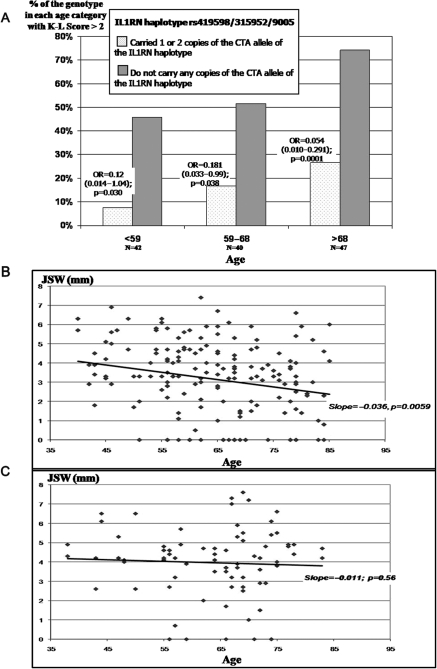
Interleukin 1 receptor antagonist (IL1RN) SNPs (rs419598, rs315952 and rs9005) predicted Kellgren-Lawrence scores independently in each population. One IL1RN haplotype was associated with lower odds of radiographic severity (OR=0.15; 95% CI 0.065 to 0.349; p<0.0001), greater joint space width and lower synovial fluid cytokine levels. Carriage of the IL1RN haplotype influenced the age relationship with severity.
IL1RN polymorphisms reproducibly contribute to disease severity in knee OA and may be useful biomarkers for patient selection in disease-modifying OA drug trials.
缺乏能够识别患有严重骨关节炎(OA)风险患者的生物标志物,这使得治疗 OA 的药物的研发变得复杂。
确定炎症遗传标志物是否可以将膝骨关节炎患者分为高风险和低风险破坏性疾病。
在两个白种人群中评估了与膝 OA 严重程度相关的基因型关联。在患者的亚组中,评估了六个炎症基因中的 15 个单核苷酸多态性(SNP)与放射学严重程度以及滑液介质的关联。
白介素 1 受体拮抗剂(IL1RN)SNP(rs419598、rs315952 和 rs9005)在每个人群中均独立预测 Kellgren-Lawrence 评分。一种 IL1RN 单倍型与较低的放射学严重程度(OR=0.15;95%CI 0.065 至 0.349;p<0.0001)、更大的关节间隙宽度和更低的滑液细胞因子水平相关。携带 IL1RN 单倍型会影响严重程度与年龄的关系。
IL1RN 多态性可重复导致膝骨关节炎的严重程度增加,并且可能是治疗 OA 的药物临床试验中患者选择的有用生物标志物。