Institute of Molecular Medicine, College of Medicine, National Taiwan University, Taipei, Taiwan.
Nucleic Acids Res. 2010 Jan;38(3):764-77. doi: 10.1093/nar/gkp1034. Epub 2009 Nov 24.
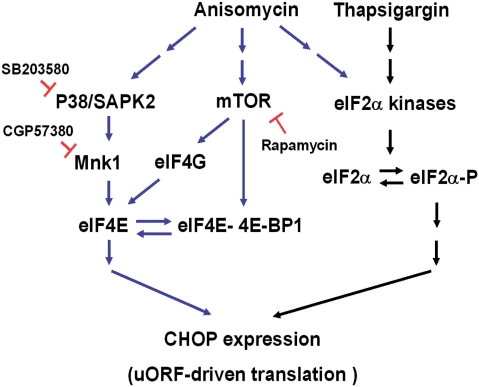
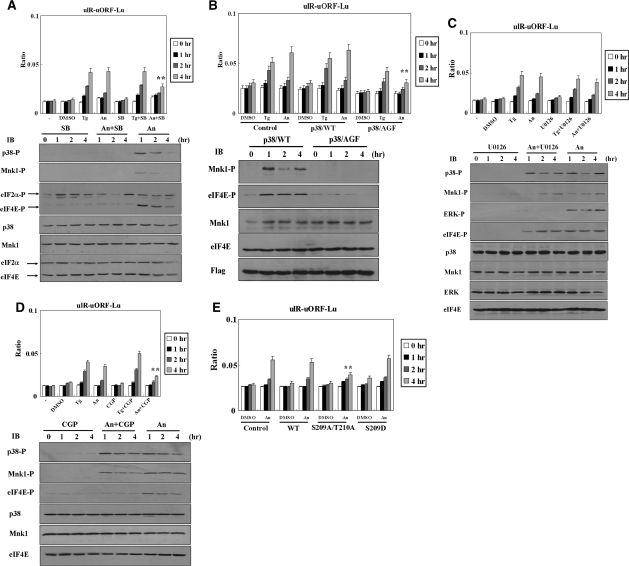
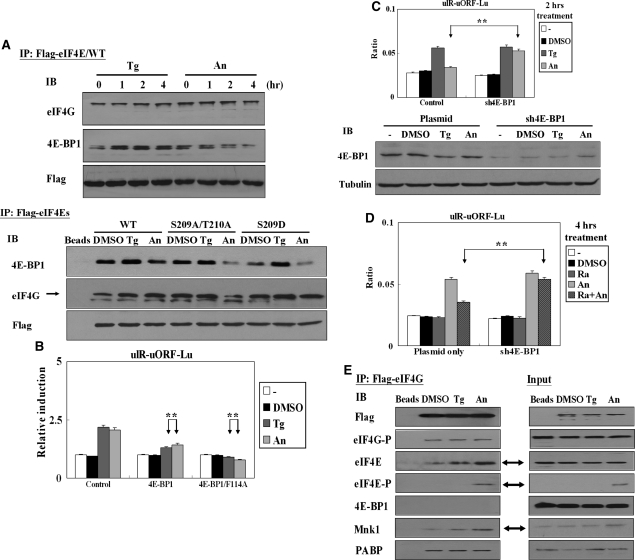
Cells respond to environmental stress by inducing translation of a subset of mRNAs important for survival or apoptosis. CHOP, a downstream transcriptional target of stress-induced ATF4, is also regulated translationally in a uORF-dependent manner under stress. Low concentration of anisomycin induces CHOP expression at both transcriptional and translational levels. To study specifically the translational aspect of CHOP expression, and further clarify the regulatory mechanisms underlying stress-induced translation initiation, we developed a CMV promoter-regulated, uORF(chop)-driven reporter platform. Here we show that anisomycin-induced CHOP expression depends on phosphorylated eIF4E/S209 and eIF2alpha/S51. Contrary to phospho-eIF2alpha/S51, phospho-eIF4E/S209 is not involved in thapsigargin-induced CHOP expression. Studies using various kinase inhibitors and mutants uncovered that both the p38MAPK-Mnk and mTOR signaling pathways contribute to stress-responsive reporter and CHOP expression. We also demonstrated that anisomycin-induced translation is tightly regulated by partner binding preference of eIF4E. Furthermore, mutating the uORF sequence abolished the anisomycin-induced association of chop mRNA with phospho-eIF4E and polysomes, thus demonstrating the significance of this cis-regulatory element in conferring on the transcript a stress-responsive translational inducibility. Strikingly, although insulin treatment activated ERK-Mnk and mTOR pathways, and consequently eIF4E/S209 phosphorylation, it failed to induce phospho-eIF2alpha/S51 and reporter translation, thus pinpointing a crucial determinant in stress-responsive translation.
细胞通过诱导对生存或凋亡重要的 mRNA 子集的翻译来响应环境应激。CHOP 是应激诱导的 ATF4 的下游转录靶标,在应激下也通过 uORF 依赖性方式进行翻译调控。低浓度的放线菌酮在转录和翻译水平上诱导 CHOP 表达。为了专门研究 CHOP 表达的翻译方面,并进一步阐明应激诱导翻译起始的调节机制,我们开发了一个 CMV 启动子调控、uORF(chop)-驱动的报告平台。在这里,我们表明,放线菌酮诱导的 CHOP 表达依赖于磷酸化的 eIF4E/S209 和 eIF2alpha/S51。与磷酸化的 eIF2alpha/S51 相反,磷酸化的 eIF4E/S209 不参与他普西龙诱导的 CHOP 表达。使用各种激酶抑制剂和突变体的研究表明,p38MAPK-Mnk 和 mTOR 信号通路都有助于应激反应报告基因和 CHOP 表达。我们还表明,放线菌酮诱导的翻译受到 eIF4E 结合偏好的伙伴的紧密调控。此外,突变 uORF 序列消除了 anisomycin 诱导的 chop mRNA 与磷酸化 eIF4E 和多核糖体的结合,从而证明了该顺式调节元件在赋予该转录物应激反应性翻译诱导能力方面的重要性。引人注目的是,尽管胰岛素处理激活了 ERK-Mnk 和 mTOR 途径,从而导致 eIF4E/S209 磷酸化,但它未能诱导磷酸化的 eIF2alpha/S51 和报告基因翻译,从而确定了应激反应性翻译中的一个关键决定因素。