
小鼠视网膜中的小胶质细胞改变视网膜色素上皮细胞的结构和功能:与 AMD 相关的潜在细胞相互作用。
Microglia in the mouse retina alter the structure and function of retinal pigmented epithelial cells: a potential cellular interaction relevant to AMD.
机构信息
Unit on Neuron-Glia Interactions in Retinal Disease, National Eye Institute, National Institutes of Health, Bethesda, Maryland, United States of America.
出版信息
PLoS One. 2009 Nov 20;4(11):e7945. doi: 10.1371/journal.pone.0007945.
BACKGROUND
Age-related macular degeneration (AMD) is a leading cause of legal blindness in the elderly in the industrialized word. While the immune system in the retina is likely to be important in AMD pathogenesis, the cell biology underlying the disease is incompletely understood. Clinical and basic science studies have implicated alterations in the retinal pigment epithelium (RPE) layer as a locus of early change. Also, retinal microglia, the resident immune cells of the retina, have been observed to translocate from their normal position in the inner retina to accumulate in the subretinal space close to the RPE layer in AMD eyes and in animal models of AMD.
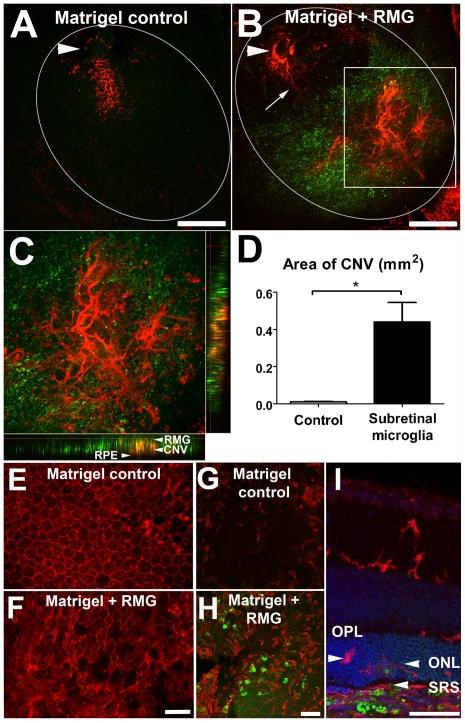
METHODOLOGY/PRINCIPAL FINDINGS: In this study, we examined the effects of retinal microglia on RPE cells using 1) an in vitro model where activated retinal microglia are co-cultured with primary RPE cells, and 2) an in vivo mouse model where retinal microglia are transplanted into the subretinal space. We found that retinal microglia induced in RPE cells 1) changes in RPE structure and distribution, 2) increased expression and secretion of pro-inflammatory, chemotactic, and pro-angiogenic molecules, and 3) increased extent of in vivo choroidal neovascularization in the subretinal space.
CONCLUSIONS/SIGNIFICANCE: These findings share similarities with important pathological features found in AMD and suggest the relevance of microglia-RPE interactions in AMD pathogenesis. We speculate that the migration of retinal microglia into the subretinal space in early stages of the disease induces significant changes in RPE cells that perpetuate further microglial accumulation, increase inflammation in the outer retina, and fosters an environment conducive for the formation of neovascular changes responsible for much of vision loss in advanced AMD.
背景
年龄相关性黄斑变性(AMD)是工业化国家导致老年人失明的主要原因。虽然视网膜中的免疫系统可能在 AMD 的发病机制中很重要,但该疾病的细胞生物学尚不完全清楚。临床和基础科学研究表明,视网膜色素上皮(RPE)层的改变是早期变化的一个部位。此外,视网膜小胶质细胞是视网膜的常驻免疫细胞,已观察到它们从内视网膜的正常位置迁移到 AMD 眼和 AMD 动物模型中靠近 RPE 层的视网膜下空间积聚。
方法/主要发现:在这项研究中,我们使用 1)体外模型,其中激活的视网膜小胶质细胞与原代 RPE 细胞共培养,和 2)体内小鼠模型,其中视网膜小胶质细胞被移植到视网膜下空间,研究了视网膜小胶质细胞对 RPE 细胞的影响。我们发现,视网膜小胶质细胞在 RPE 细胞中诱导 1)RPE 结构和分布的改变,2)促炎、趋化和促血管生成分子的表达和分泌增加,以及 3)体内视网膜下空间脉络膜新生血管形成的程度增加。
结论/意义:这些发现与 AMD 中发现的重要病理特征相似,表明小胶质细胞-RPE 相互作用与 AMD 的发病机制有关。我们推测,疾病早期视网膜小胶质细胞迁移到视网膜下空间会引起 RPE 细胞的显著变化,从而导致进一步的小胶质细胞积聚、增加外视网膜炎症,并促进有利于负责晚期 AMD 大部分视力丧失的新生血管变化形成的环境。


 Zotero 插件