Department of Pathology, Johns Hopkins Medical Institutions, Baltimore, MD, USA.
Gene Ther. 2010 Apr;17(4):531-40. doi: 10.1038/gt.2009.152. Epub 2009 Nov 26.
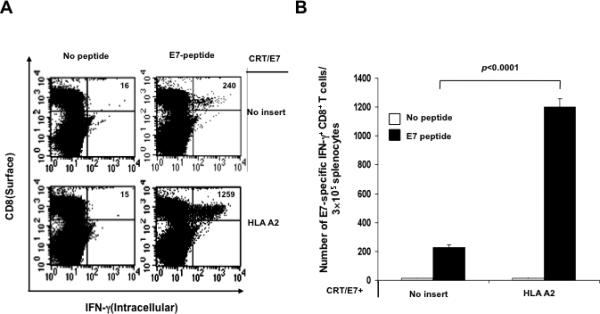
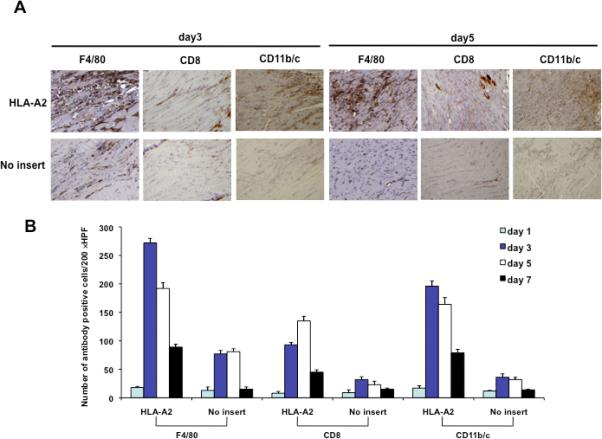
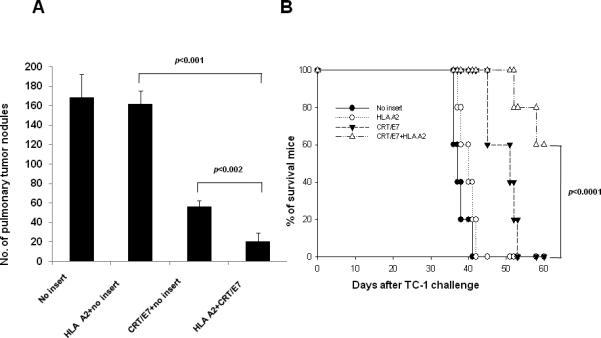
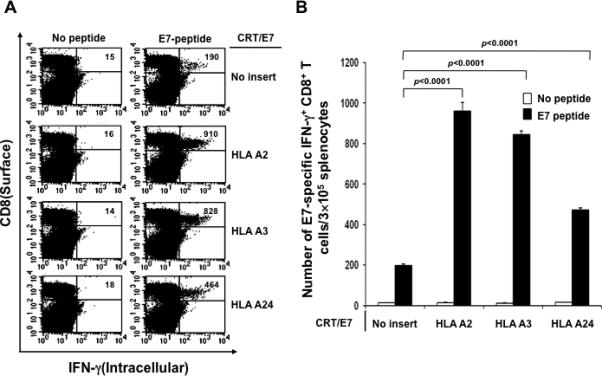
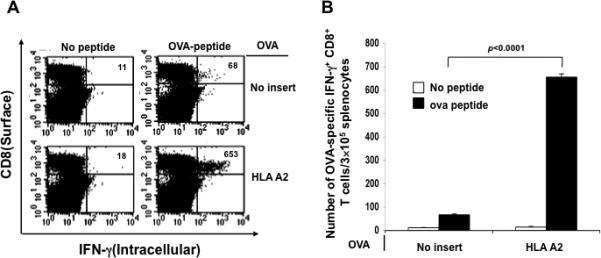
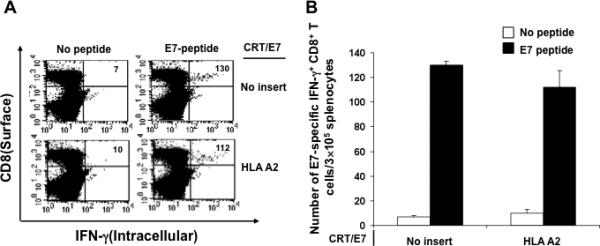
Intramuscular administration of DNA vaccines can lead to the generation of antigen-specific immune responses through cross-priming mechanisms. We propose a strategy that is capable of leading to local inflammation and enhancing cross-priming, thus resulting in improved antigen-specific immune responses. Therefore, in this study, we evaluated the immunological responses elicited through electroporation-mediated intramuscular administration of a DNA vaccine encoding calreticulin (CRT) linked to human papillomavirus type 16 E7 (CRT-E7) in combination with DNA expressing HLA-A2 as compared with CRT-E7 DNA vaccination alone. We found that the co-administration of a DNA vaccine in conjunction with a DNA encoding a xenogenic major histocompatibility complex (MHC) molecule could significantly enhance the E7-specific CD8+ T-cell immune responses and antitumor effects against an E7-expressing tumor, TC-1, in C57BL/6 tumor-bearing mice. Furthermore, a similar enhancement in E7-specific immune responses was observed by the co-administration of CRT-E7 DNA with DNA encoding other types of xenogenic MHC class-I molecules. This strategy was also applicable to another antigenic system, ovalbumin. Further characterization of the injection site revealed that the co-administration of HLA-A2 DNA led to a significant increase in the number of infiltrating CD8+ T lymphocytes and CD11b/c+ antigen-presenting cells. Furthermore, the E7-specific immune responses generated by intramuscular co-administration of CRT-E7 with HLA-A2 DNA were reduced in HLA-A2 transgenic mice. Thus, our data suggest that intramuscular co-administration of DNA encoding xenogenic MHC class-I can further improve the antigen-specific immune responses, as well as antitumor effects generated by DNA vaccines through enhancement of cross-priming mechanisms.
肌肉内给予 DNA 疫苗可以通过交叉引发机制产生抗原特异性免疫反应。我们提出了一种策略,能够导致局部炎症和增强交叉引发,从而导致改善的抗原特异性免疫反应。因此,在这项研究中,我们评估了通过电穿孔介导的肌肉内给予与人乳头瘤病毒 16 型 E7 (CRT-E7)连接的钙网蛋白(CRT)编码 DNA 疫苗与表达 HLA-A2 的 DNA 联合给予的免疫反应,与 CRT-E7 DNA 疫苗单独给予相比。我们发现,与编码异种主要组织相容性复合体(MHC)分子的 DNA 联合给予 DNA 疫苗可以显著增强 C57BL/6 荷瘤小鼠中 E7 特异性 CD8+T 细胞免疫反应和对表达 E7 的肿瘤 TC-1 的抗肿瘤作用。此外,通过 CRT-E7 DNA 与编码其他类型异种 MHC 类 I 分子的 DNA 联合给予,也观察到 E7 特异性免疫反应的类似增强。这种策略也适用于另一个抗原系统,卵清蛋白。对注射部位的进一步特征分析表明,HLA-A2 DNA 的联合给予导致浸润性 CD8+T 淋巴细胞和 CD11b/c+抗原呈递细胞数量的显著增加。此外,在 HLA-A2 转基因小鼠中,CRT-E7 与 HLA-A2 DNA 肌肉内联合给予导致 E7 特异性免疫反应减少。因此,我们的数据表明,异种 MHC 类 I 编码 DNA 的肌肉内联合给予可以通过增强交叉引发机制进一步改善 DNA 疫苗产生的抗原特异性免疫反应和抗肿瘤作用。