Institute for Neurodegenerative Diseases, University of California, San Francisco, California, United States of America.
PLoS Pathog. 2009 Nov;5(11):e1000673. doi: 10.1371/journal.ppat.1000673. Epub 2009 Nov 26.
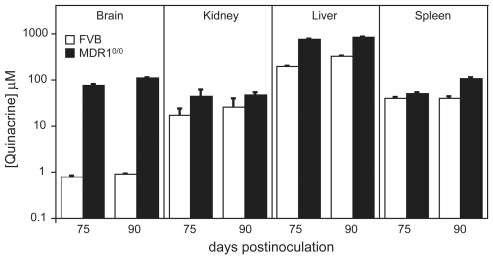
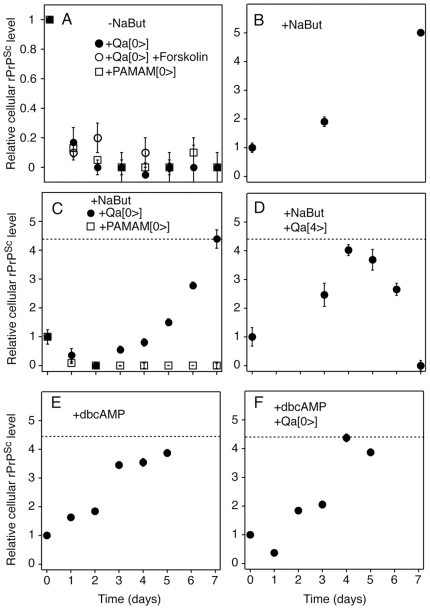
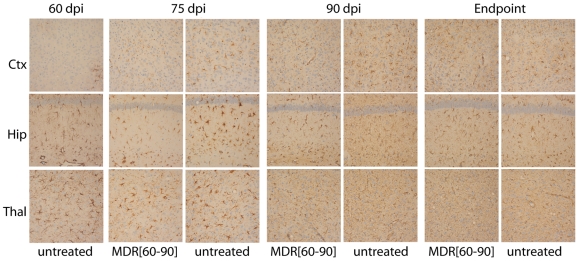
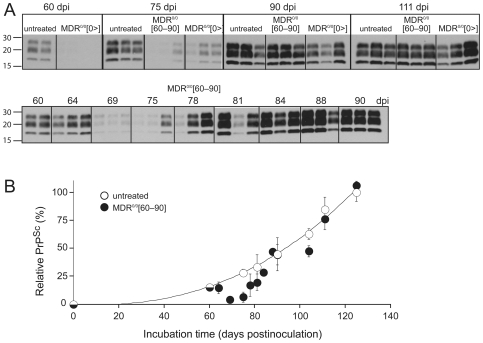
Quinacrine is a potent antiprion compound in cell culture models of prion disease but has failed to show efficacy in animal bioassays and human clinical trials. Previous studies demonstrated that quinacrine inefficiently penetrates the blood-brain barrier (BBB), which could contribute to its lack of efficacy in vivo. As quinacrine is known to be a substrate for P-glycoprotein multi-drug resistance (MDR) transporters, we circumvented its poor BBB permeability by utilizing MDR(0/0) mice that are deficient in mdr1a and mdr1b genes. Mice treated with 40 mg/kg/day of quinacrine accumulated up to 100 microM of quinacrine in their brains without acute toxicity. PrP(Sc) levels in the brains of prion-inoculated MDR(0/0) mice diminished upon the initiation of quinacrine treatment. However, this reduction was transient and PrP(Sc) levels recovered despite the continuous administration of quinacrine. Treatment with quinacrine did not prolong the survival times of prion-inoculated, wild-type or MDR(0/0) mice compared to untreated mice. A similar phenomenon was observed in cultured differentiated prion-infected neuroblastoma cells: PrP(Sc) levels initially decreased after quinacrine treatment then rapidly recovered after 3 d of continuous treatment. Biochemical characterization of PrP(Sc) that persisted in the brains of quinacrine-treated mice had a lower conformational stability and different immunoaffinities compared to that found in the brains of untreated controls. These physical properties were not maintained upon passage in MDR(0/0) mice. From these data, we propose that quinacrine eliminates a specific subset of PrP(Sc) conformers, resulting in the survival of drug-resistant prion conformations. Transient accumulation of this drug-resistant prion population provides a possible explanation for the lack of in vivo efficacy of quinacrine and other antiprion drugs.
盐酸奎宁是一种在朊病毒病的细胞培养模型中具有强大抗朊病毒作用的化合物,但在动物生物测定和人类临床试验中均未能显示出疗效。先前的研究表明,盐酸奎宁不能有效地穿透血脑屏障(BBB),这可能是其在体内无效的原因之一。由于盐酸奎宁已知是 P-糖蛋白多药耐药(MDR)转运蛋白的底物,因此我们利用缺乏 mdr1a 和 mdr1b 基因的 MDR(0/0) 小鼠来规避其 BBB 通透性差的问题。每天用 40mg/kg 的盐酸奎宁处理的小鼠,其大脑中可积累高达 100μM 的盐酸奎宁,而没有急性毒性。在开始用盐酸奎宁治疗后,感染朊病毒的 MDR(0/0) 小鼠大脑中的 PrP(Sc)水平降低。然而,这种减少是短暂的,尽管持续给予盐酸奎宁,PrP(Sc)水平仍会恢复。与未治疗的小鼠相比,用盐酸奎宁治疗并未延长感染朊病毒的野生型或 MDR(0/0) 小鼠的存活时间。在培养的分化朊病毒感染的神经母细胞瘤细胞中也观察到类似的现象:在用盐酸奎宁治疗后,PrP(Sc)水平最初下降,然后在连续治疗 3 天后迅速恢复。与未处理对照的大脑中发现的相比,在用盐酸奎宁治疗的小鼠大脑中持续存在的 PrP(Sc)的生化特征具有较低的构象稳定性和不同的免疫亲和力。这些物理特性在 MDR(0/0) 小鼠中传递时并未得到维持。根据这些数据,我们提出盐酸奎宁消除了特定的 PrP(Sc)构象亚型,从而导致耐药性朊病毒构象的存活。这种耐药性朊病毒群体的短暂积累可能解释了盐酸奎宁和其他抗朊病毒药物在体内无效的原因。