Bacterial Toxins and Therapeutics Section, Laboratory of Bacterial Diseases, National Institute of Allergy and Infectious Diseases, National Institutes of Health, Bethesda, Maryland, United States of America.
PLoS One. 2009 Nov 23;4(11):e7946. doi: 10.1371/journal.pone.0007946.
To initiate infection, Bacillus anthracis needs to overcome the host innate immune system. Anthrax toxin, a major virulence factor of B. anthracis, impairs both the innate and adaptive immune systems and is important in the establishment of anthrax infections.
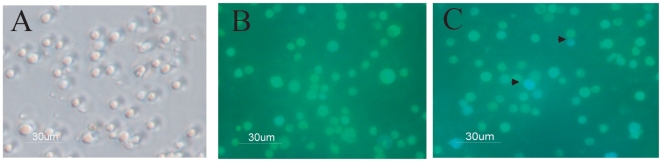
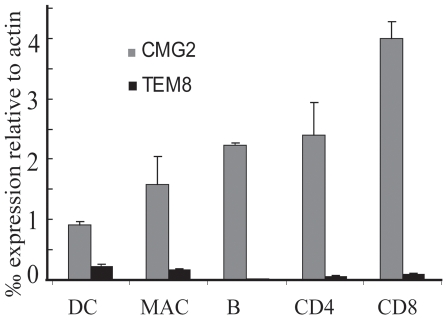
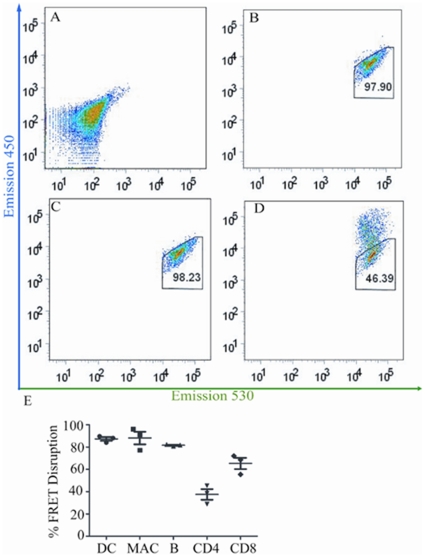
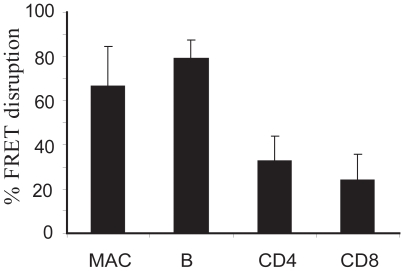
METHODOLOGY/PRINCIPAL FINDINGS: To measure the ability of anthrax toxin to target immune cells, studies were performed using a fusion of the anthrax toxin lethal factor (LF) N-terminal domain (LFn, aa 1-254) with beta-lactamase (LFnBLA). This protein reports on the ability of the anthrax toxin protective antigen (PA) to mediate LF delivery into cells. Primary immune cells prepared from mouse spleens were used in conjunction with flow cytometry to assess cleavage and resulting FRET disruption of a fluorescent beta-lactamase substrate, CCF2/AM. In spleen cell suspensions, the macrophages, dendritic cells, and B cells showed about 75% FRET disruption of CCF2/AM due to cleavage by the PA-delivered LFnBLA. LFnBLA delivery into CD4+ and CD8+ T cells was lower, with 40% FRET disruption. When the analyses were done on purified samples of individual cell types, similar results were obtained, with T cells again having lower LFnBLA delivery than macrophages, dendritic cells, and B cells. Relative expression levels of the toxin receptors CMG2 and TEM8 on these cells were determined by real-time PCR. Expression of CMG2 was about 1.5-fold higher in CD8+ cells than in CD4+ and B cells, and 2.5-fold higher than in macrophages.
CONCLUSIONS/SIGNIFICANCE: Anthrax toxin entry and activity differs among immune cells. Macrophages, dendritic cells, and B cells displayed higher LFnBLA activity than CD4+ and CD8+ T cells in both spleen cell suspension and the purified samples of individual cell types. Expression of anthrax toxin receptor CMG2 is higher in CD4+ and CD8+ T cells, which is not correlated to the intracellular LFnBLA activity.
为了引发感染,炭疽杆菌需要克服宿主的先天免疫系统。炭疽毒素是炭疽杆菌的主要毒力因子,它会损害先天和适应性免疫系统,对于炭疽感染的建立非常重要。
方法/主要发现:为了衡量炭疽毒素靶向免疫细胞的能力,研究使用炭疽毒素致死因子(LF)N 端结构域(LFn,aa1-254)与β-内酰胺酶(LFnBLA)的融合蛋白进行研究。这种蛋白质可以报告炭疽毒素保护性抗原(PA)介导 LF 进入细胞的能力。使用来自小鼠脾脏的原代免疫细胞与流式细胞术结合,评估荧光β-内酰胺酶底物 CCF2/AM 的裂解和由此产生的荧光共振能量转移(FRET)中断。在脾细胞悬浮液中,巨噬细胞、树突状细胞和 B 细胞由于 PA 介导的 LFnBLA 裂解,导致 CCF2/AM 的 FRET 中断约 75%。CD4+和 CD8+T 细胞中 LFnBLA 的传递较低,FRET 中断约 40%。当在单个细胞类型的纯化样本上进行分析时,得到了类似的结果,T 细胞中 LFnBLA 的传递再次低于巨噬细胞、树突状细胞和 B 细胞。通过实时 PCR 测定这些细胞上毒素受体 CMG2 和 TEM8 的相对表达水平。CD8+细胞中 CMG2 的表达比 CD4+和 B 细胞高 1.5 倍,比巨噬细胞高 2.5 倍。
结论/意义:炭疽毒素的进入和活性在免疫细胞之间存在差异。在脾细胞悬浮液和单个细胞类型的纯化样本中,巨噬细胞、树突状细胞和 B 细胞的 LFnBLA 活性均高于 CD4+和 CD8+T 细胞。炭疽毒素受体 CMG2 的表达在 CD4+和 CD8+T 细胞中更高,但与细胞内 LFnBLA 活性无关。