Nottingham University Hospitals NHS Trust, Nottingham, UK.
Clin Interv Aging. 2009;4:445-9. doi: 10.2147/cia.s8200. Epub 2009 Nov 18.
There is limited evidence to support the efficacy of current pharmaceutical agents in reducing the risk of hip fracture in older postmenopausal women with established osteoporosis.
To clarify the efficacy of risedronate in reducing the risk of hip fracture in elderly postmenopausal women aged > or = 70 years with established osteoporosis, i.e., those with bone mineral density-defined osteoporosis and a prevalent vertebral fracture.
Post hoc analysis of the Hip Intervention Program (HIP) study, a randomized controlled trial comparing risedronate with placebo for reducing the risk of hip fracture in elderly women. Women aged 70 to 100 years with established osteoporosis (baseline femoral neck T-score < or = -2.5 and > or =1 prior vertebral fracture) were included. The main outcome measure was 3-year hip fracture incidence in the risedronate and placebo groups.
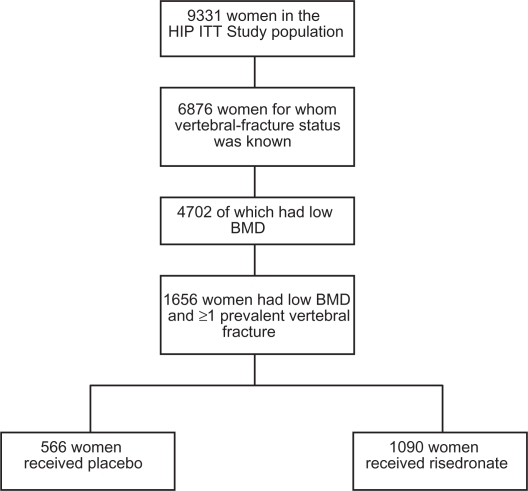
A total of 1656 women met the inclusion criteria. After 3 years, hip fracture had occurred in 3.8% of risedronate-treated patients and 7.4% of placebo-treated patients (relative risk 0.54; 95% confidence interval 0.32-0.91; P = 0.019).
Risedronate significantly reduced the risk of hip fracture in women aged up to 100 years with established osteoporosis.
目前的药物在降低已确诊骨质疏松症的老年绝经后女性髋部骨折风险方面的疗效证据有限。
明确利塞膦酸钠在降低 70 岁及以上已确诊骨质疏松症(即骨密度诊断骨质疏松症和现有椎体骨折)老年绝经后女性髋部骨折风险方面的疗效。
对髋部干预计划(HIP)研究进行事后分析,该研究为一项随机对照试验,比较了利塞膦酸钠与安慰剂在降低老年女性髋部骨折风险方面的疗效。纳入年龄在 70 至 100 岁之间、已确诊骨质疏松症(基线股骨颈 T 评分<-2.5 且>=1 次既往椎体骨折)的女性。主要观察指标为利塞膦酸钠组和安慰剂组 3 年髋部骨折发生率。
共有 1656 名符合纳入标准的女性。3 年后,利塞膦酸钠治疗组髋部骨折发生率为 3.8%,安慰剂治疗组髋部骨折发生率为 7.4%(相对风险 0.54;95%置信区间 0.32-0.91;P=0.019)。
利塞膦酸钠可显著降低年龄达 100 岁的已确诊骨质疏松症女性髋部骨折风险。