Program in Translational Biology & Molecular Medicine, Baylor College of Medicine, Houston, TX 77030, USA.
BMC Cancer. 2009 Dec 14;9:438. doi: 10.1186/1471-2407-9-438.
Coregulator proteins are "master regulators", directing transcriptional and posttranscriptional regulation of many target genes, and are critical in many normal physiological processes, but also in hormone driven diseases, such as breast cancer. Little is known on how genetic changes in these genes impact disease development and progression. Thus, we set out to identify novel single nucleotide polymorphisms (SNPs) within SRC-1 (NCoA1), SRC-3 (NCoA3, AIB1), NCoR (NCoR1), and SMRT (NCoR2), and test the most promising SNPs for associations with breast cancer risk.
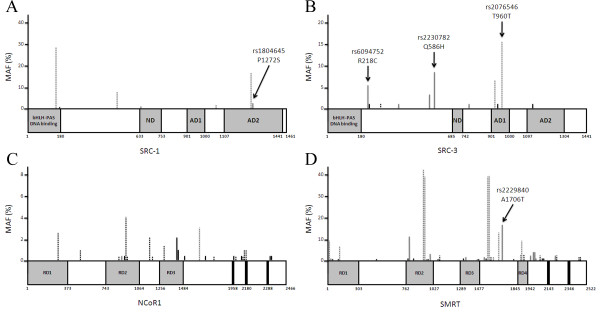
The identification of novel SNPs was accomplished by sequencing the coding regions of these genes in 96 apparently normal individuals (48 Caucasian Americans, 48 African Americans). To assess their association with breast cancer risk, five SNPs were genotyped in 1218 familial BRCA1/2-mutation negative breast cancer cases and 1509 controls (rs1804645, rs6094752, rs2230782, rs2076546, rs2229840).
Through our resequencing effort, we identified 74 novel SNPs (30 in NCoR, 32 in SMRT, 10 in SRC-3, and 2 in SRC-1). Of these, 8 were found with minor allele frequency (MAF) >5% illustrating the large amount of genetic diversity yet to be discovered. The previously shown protective effect of rs2230782 in SRC-3 was strengthened (OR = 0.45 [0.21-0.98], p = 0.04). No significant associations were found with the other SNPs genotyped.
This data illustrates the importance of coregulators, especially SRC-3, in breast cancer development and suggests that more focused studies, including functional analyses, should be conducted.
共激活蛋白是“主调控因子”,指导许多靶基因的转录和转录后调控,在许多正常生理过程中至关重要,但在激素驱动的疾病中也是如此,例如乳腺癌。人们对这些基因的遗传变化如何影响疾病的发展和进展知之甚少。因此,我们着手确定 SRC-1(NCoA1)、SRC-3(NCoA3、AIB1)、NCoR(NCoR1)和 SMRT(NCoR2)中新型单核苷酸多态性(SNP),并测试与乳腺癌风险最相关的最有前途的 SNP。
通过对 96 名明显正常个体(48 名白种人,48 名非裔美国人)的这些基因编码区进行测序,确定新型 SNP。为了评估它们与乳腺癌风险的关联,在 1218 名家族性 BRCA1/2 突变阴性乳腺癌病例和 1509 名对照者中对 5 个 SNP(rs1804645、rs6094752、rs2230782、rs2076546、rs2229840)进行了基因分型。
通过我们的重测序工作,我们确定了 74 个新型 SNP(NCoR 中有 30 个,SMRT 中有 32 个,SRC-3 中有 10 个,SRC-1 中有 2 个)。其中 8 个 SNP 的次要等位基因频率(MAF)>5%,表明还有大量的遗传多样性有待发现。先前在 SRC-3 中显示出的保护性作用 rs2230782 得到了加强(OR=0.45[0.21-0.98],p=0.04)。未发现与其他基因分型 SNP 有显著关联。
这些数据说明了共激活因子(特别是 SRC-3)在乳腺癌发生发展中的重要性,并表明应该进行更有针对性的研究,包括功能分析。