Department of Biological Sciences, University of Montreal, QC, Canada.
BMC Neurosci. 2009 Dec 14;10:147. doi: 10.1186/1471-2202-10-147.
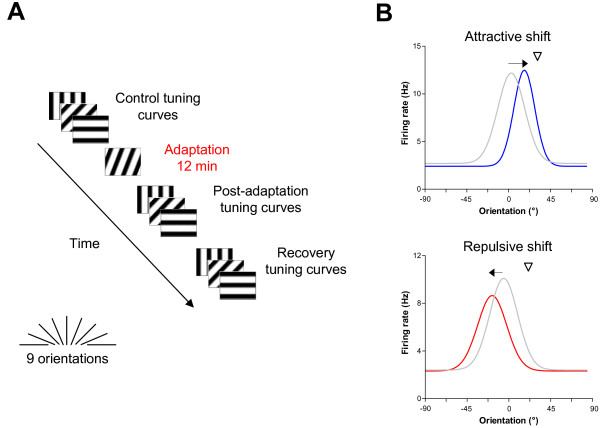
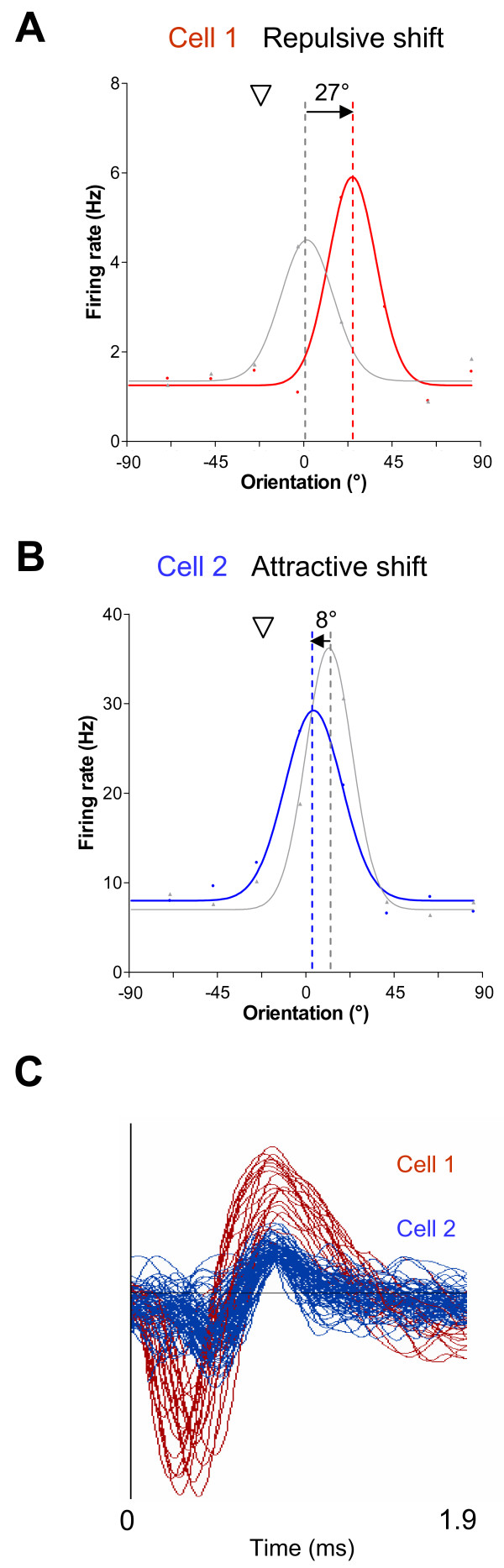
Sensory neurons display transient changes of their response properties following prolonged exposure to an appropriate stimulus (adaptation). In adult cat primary visual cortex, orientation-selective neurons shift their preferred orientation after being adapted to a non-preferred orientation. The direction of those shifts, towards (attractive) or away (repulsive) from the adapter depends mostly on adaptation duration. How the adaptive behavior of a neuron is related to that of its neighbors remains unclear.
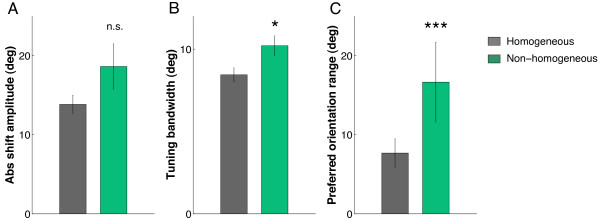
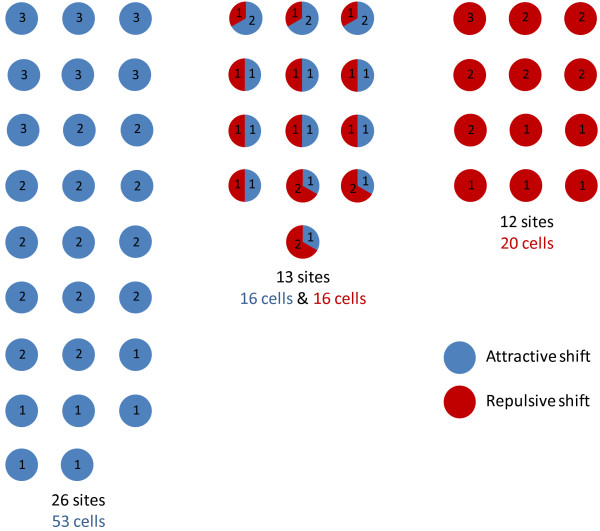
Here we show that in most cases (75%), cells shift their preferred orientation in the same direction as their neighbors. We also found that cells shifting preferred orientation differently from their neighbors (25%) display three interesting properties: (i) larger variance of absolute shift amplitude, (ii) wider tuning bandwidth and (iii) larger range of preferred orientations among the cluster of cells. Several response properties of V1 neurons depend on their location within the cortical orientation map. Our results suggest that recording sites with both attractive and repulsive shifts following adaptation may be located in close proximity to iso-orientation domain boundaries or pinwheel centers. Indeed, those regions have a more diverse orientation distribution of local inputs that could account for the three properties above. On the other hand, sites with all cells shifting their preferred orientation in the same direction could be located within iso-orientation domains.
Our results suggest that the direction and amplitude of orientation preference shifts in V1 depend on location within the orientation map. This anisotropy of adaptation-induced plasticity, comparable to that of the visual cortex itself, could have important implications for our understanding of visual adaptation at the psychophysical level.
感觉神经元在长时间暴露于适当刺激(适应)后,其反应特性会发生短暂变化。在成年猫的初级视觉皮层中,朝向选择性神经元在适应非优势朝向后会改变其优势朝向。这些变化的方向,是朝向(吸引性)还是远离(排斥性)适应器,主要取决于适应持续时间。神经元的适应行为如何与其邻居的行为相关,目前仍不清楚。
我们发现,在大多数情况下(75%),细胞的优势朝向变化方向与邻居一致。我们还发现,与邻居的优势朝向变化方向不同的细胞(25%)表现出三个有趣的特性:(i)绝对偏移幅度的方差更大,(ii)调谐带宽更宽,(iii)在细胞簇中具有更广泛的优势朝向范围。V1 神经元的几个反应特性取决于其在皮层朝向图中的位置。我们的结果表明,适应后具有吸引性和排斥性偏移的记录位点可能位于等朝向域边界或涡旋中心附近。事实上,这些区域具有更具多样性的局部输入朝向分布,这可以解释上述三个特性。另一方面,所有细胞的优势朝向变化方向一致的位点可能位于等朝向域内。
我们的结果表明,V1 中朝向偏好偏移的方向和幅度取决于在朝向图中的位置。这种适应诱导可塑性的各向异性与视觉皮层本身的各向异性相似,可能对我们在心理物理水平上理解视觉适应具有重要意义。