Brautbar Ariel, Ballantyne Christie M, Lawson Kim, Nambi Vijay, Chambless Lloyd, Folsom Aaron R, Willerson James T, Boerwinkle Eric
Department of Molecular and Human Genetics, Baylor College of Medicine, Houston, TX 77030, USA.
Circ Cardiovasc Genet. 2009 Jun;2(3):279-85. doi: 10.1161/CIRCGENETICS.108.817338. Epub 2009 Apr 21.
A single-nucleotide polymorphism on chromosome 9p21, rs10757274 (9p21 allele), has been shown to predict coronary heart disease (CHD) in whites. We evaluated whether adding the 9p21 allele to traditional risk factors (RFs) improved CHD risk prediction in whites from the Atherosclerosis Risk in Communities study and whether changes in risk prediction would modify lipid therapy recommendations.
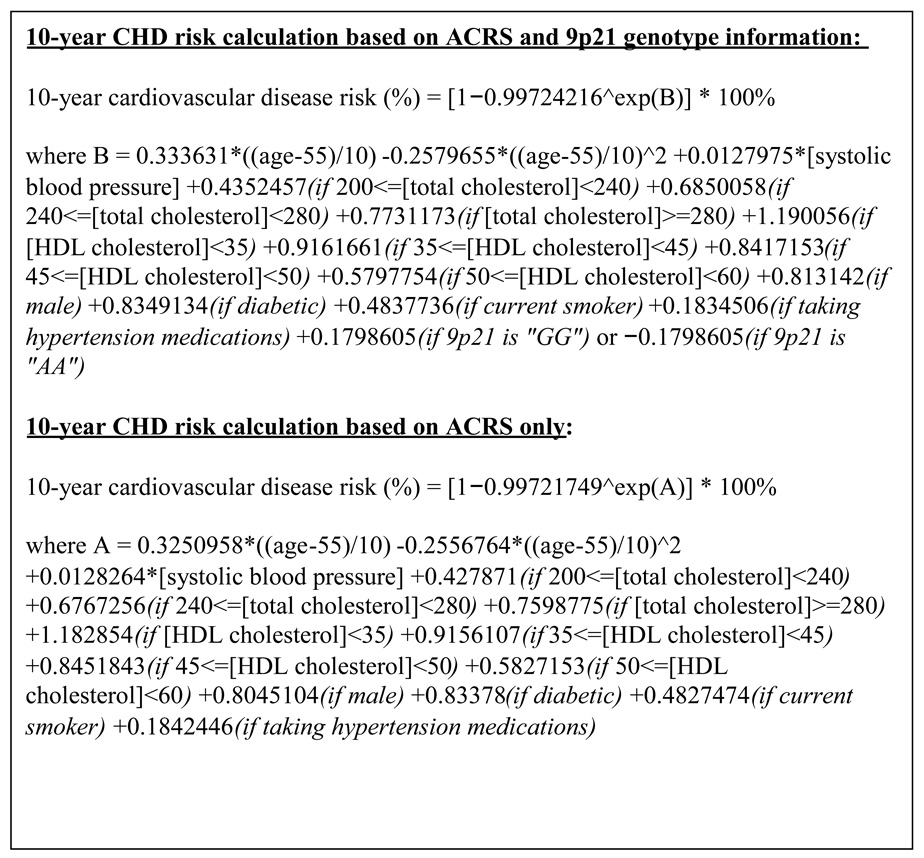
Whites (n=9998) in the Atherosclerosis Risk in Communities study for whom the 9p21 genotype and traditional RF information was available were included. Using Cox proportional hazards models, the Atherosclerosis Risk in Communities Cardiovascular Risk Score, which is based on traditional RFs, was determined. A total of 1349 individuals (13.5%) developed incident CHD events during a period of 14.6 years. Adding the 9p21 allele to traditional RFs was associated with a hazard ratio of incident CHD of 1.2 per allele (P<0.000003) and a significant increase in the area under the curve of the receiver operating characteristic from 0.782 to 0.786 (95% CI, 0.001, 0.007). The 9p21 allele's greatest influence to the Atherosclerosis Risk in Communities Cardiovascular Risk Score was observed in the intermediate-low (>5% to <or=10% 10-year CHD risk) and intermediate-high (>10% to <or=20% 10-year CHD risk) categories, with 12.1% and 12.6% reclassified, respectively. This may impact therapy because 90% of these reclassified individuals had low-density lipoprotein cholesterol >100 mg/dL.
Adding the 9p21 allele to traditional RFs in whites in the Atherosclerosis Risk in Communities study modestly improved CHD risk prediction in the intermediate categories.
9号染色体短臂2区1带的单核苷酸多态性rs10757274(9p21等位基因)已被证明可预测白人患冠心病(CHD)的风险。我们评估了在社区动脉粥样硬化风险研究中,将9p21等位基因添加到传统风险因素(RFs)中是否能改善白人患冠心病风险的预测,以及风险预测的变化是否会改变脂质治疗建议。
纳入社区动脉粥样硬化风险研究中可获得9p21基因型和传统RF信息的白人(n = 9998)。使用Cox比例风险模型,确定基于传统RFs的社区动脉粥样硬化风险心血管风险评分。在14.6年的时间里,共有1349名个体(13.5%)发生了冠心病事件。将9p21等位基因添加到传统RFs中,每增加一个等位基因,冠心病事件的风险比为1.2(P < 0.000003),受试者工作特征曲线下面积从0.782显著增加到了0.786(95%CI,0.001,0.007)。在中低(10年冠心病风险>5%至≤10%)和中高(10年冠心病风险>10%至≤20%)类别中观察到9p21等位基因对社区动脉粥样硬化风险心血管风险评分的影响最大,重新分类的比例分别为12.1%和12.6%。这可能会影响治疗,因为这些重新分类的个体中有90%的低密度脂蛋白胆固醇>100mg/dL。
在社区动脉粥样硬化风险研究中,将9p21等位基因添加到白人的传统RFs中,可适度改善中风险类别中冠心病风险的预测。