Harvard-MIT Division of Health Sciences and Technology, Massachusetts Institute of Technology, Cambridge, Massachusetts 02139, USA.
J Heart Lung Transplant. 2010 Apr;29(4):479-86. doi: 10.1016/j.healun.2009.11.006. Epub 2009 Dec 24.
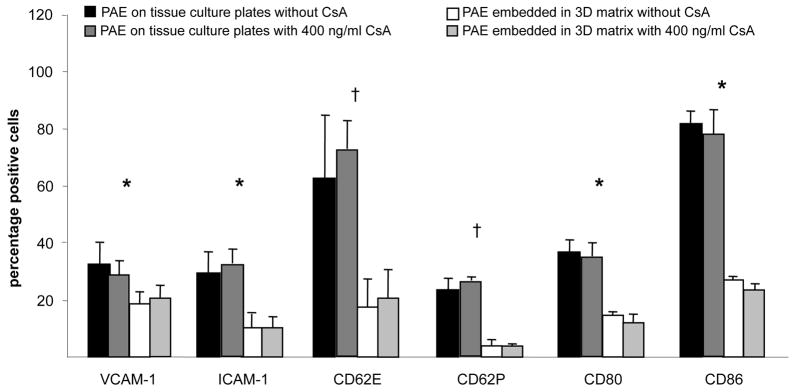
Endothelial cells (ECs) embedded within 3-dimensional matrices (MEEC) control lumenal inflammation and intimal hyperplasia when placed in the vascular adventitia. Matrix embedding alters endothelial immunogenicity in vitro. T-helper (Th) cell-driven host immunity is an impediment of allogeneic grafts. We aimed to identify if modulation of Th balance would affect immune compatibility and endothelial regulation of vascular repair in vivo.
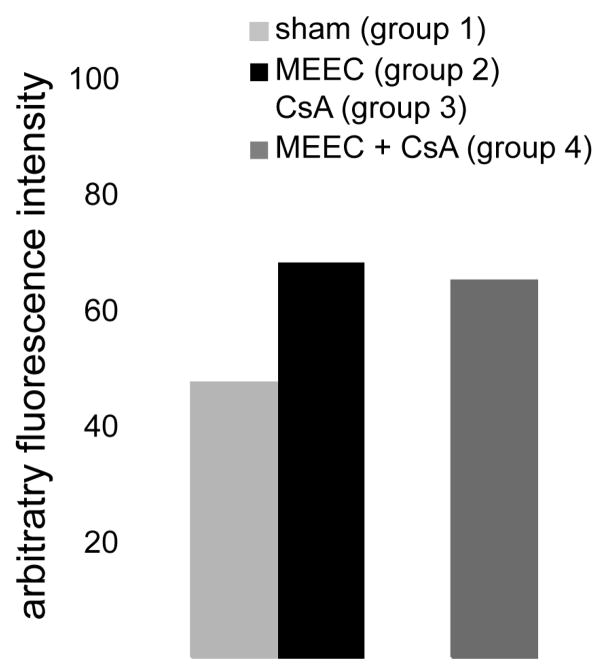
Pigs (n = 4/group) underwent carotid artery balloon injury and were left untreated (Group 1) or received perivascular porcine MEEC implants (Group 2), 12 days of cyclosporine A (CsA; Group 3), or MEEC and CsA (Group 4). Host immune reactivity was analyzed after 28 and 90 days.
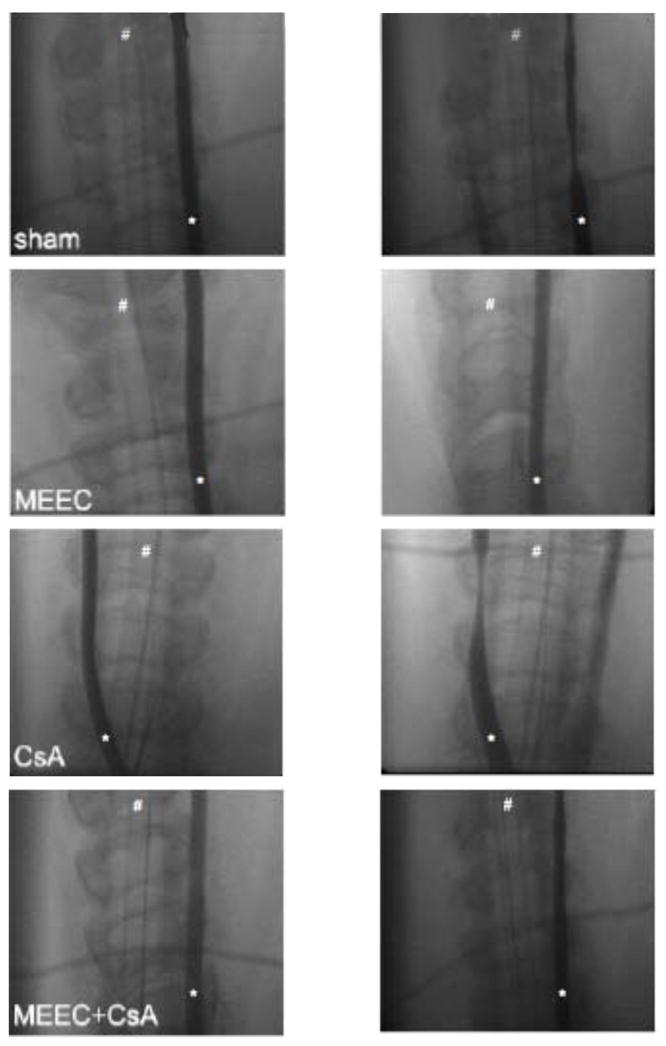
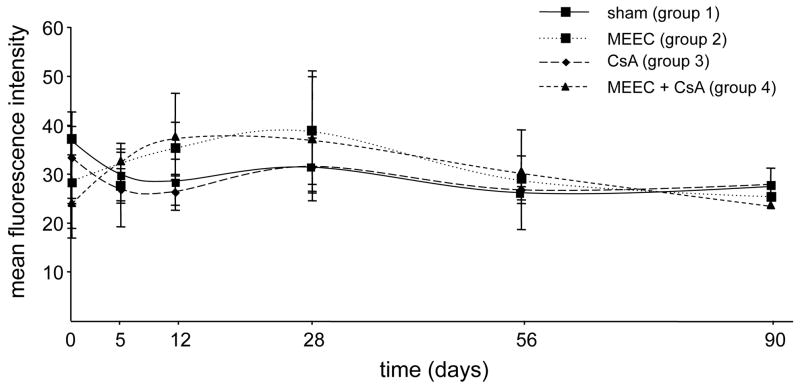
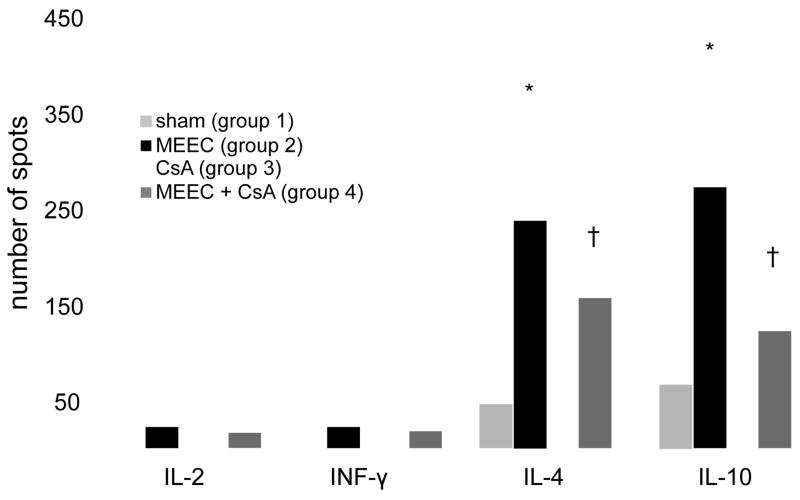
MEEC treatment induced formation of EC-specific immunoglobulin (Ig) G(1) antibodies (41 +/- 6 mean fluorescence intensity [MFI]) and differentiation of host splenocytes into Th2, but not Th1, cytokine-producing cells (interleukin [IL]-4, 242 +/- 102; IL-10, 273 +/- 114 number of spots). Concomitant CsA therapy reduced IgG(1) antibody frequency (25 +/- 2 MFI; p < 0.02) and Th2-cytokine producing splenocytes upon MEEC treatment (IL-4, 157 +/- 19; IL-10, 124 +/- 26 number of spots; p < 0.05). MEECs inhibited luminal occlusion 28 and 90 days after balloon injury (12 +/- 7%) vs untreated controls (68 +/- 14%; p < 0.001) but to a lesser extent with concomitant CsA treatment (34 +/- 13%; p < 0.02 vs Group 2).
MEECs do not induce a significant Th1-driven immune response but do enhance differentiation of splenocytes into cells producing Th2 cytokine. Reduction in this Th2 response reduces the vasoregulatory effects of allogeneic ECs after injury.
内皮细胞(ECs)嵌入三维基质(MEEC)中,当放置在血管外膜时,可控制管腔炎症和内膜增生。基质嵌入会改变体外内皮细胞的免疫原性。辅助性 T 细胞(Th)细胞驱动的宿主免疫是同种异体移植物的障碍。我们旨在确定 Th 平衡的调节是否会影响体内免疫相容性和内皮对血管修复的调节。
猪(每组 4 只)接受颈总动脉球囊损伤,未治疗(第 1 组)或接受血管周围猪 MEEC 植入(第 2 组)、12 天环孢素 A(CsA;第 3 组)或 MEEC 和 CsA(第 4 组)。在 28 和 90 天后分析宿主免疫反应性。
MEEC 治疗诱导 EC 特异性免疫球蛋白(Ig)G1 抗体形成(41±6 平均荧光强度 [MFI])和宿主脾细胞分化为 Th2,而不是 Th1,细胞因子产生细胞(白细胞介素 [IL]-4,242±102;IL-10,273±114 斑点数)。同时 CsA 治疗降低了 MEEC 治疗时 IgG1 抗体频率(25±2 MFI;p<0.02)和 Th2 细胞因子产生的脾细胞(IL-4,157±19;IL-10,124±26 斑点数;p<0.05)。MEEC 抑制球囊损伤后 28 和 90 天的管腔闭塞(12±7%),与未治疗对照组(68±14%;p<0.001)相比,但同时 CsA 治疗的程度较小(34±13%;p<0.02 与第 2 组相比)。
MEEC 不会引起明显的 Th1 驱动的免疫反应,但确实增强了脾细胞分化为产生 Th2 细胞因子的细胞。这种 Th2 反应的减少降低了同种异体 EC 损伤后的血管调节作用。