Department of Biochemistry and Molecular Biology, Indiana University School of Medicine, 635 Barnhill Drive, Indianapolis, Indiana 46202, USA.
J Med Chem. 2010 Feb 11;53(3):1329-37. doi: 10.1021/jm901624n.
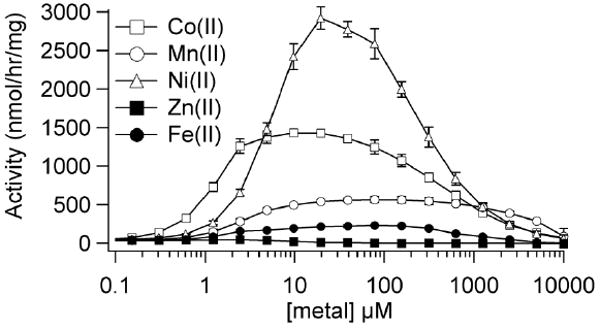
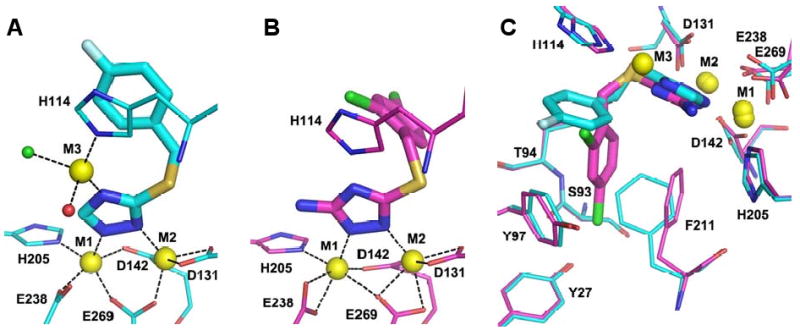
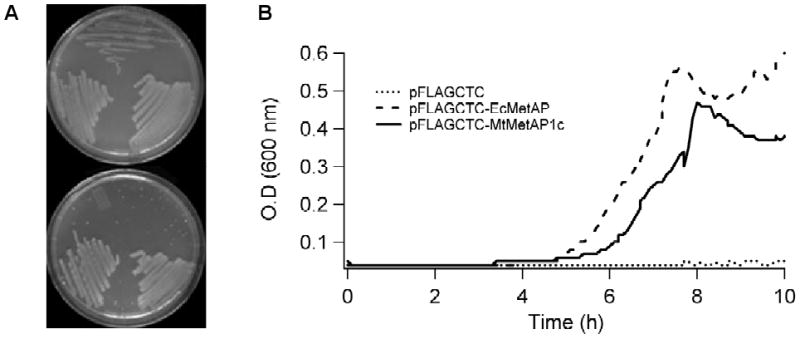
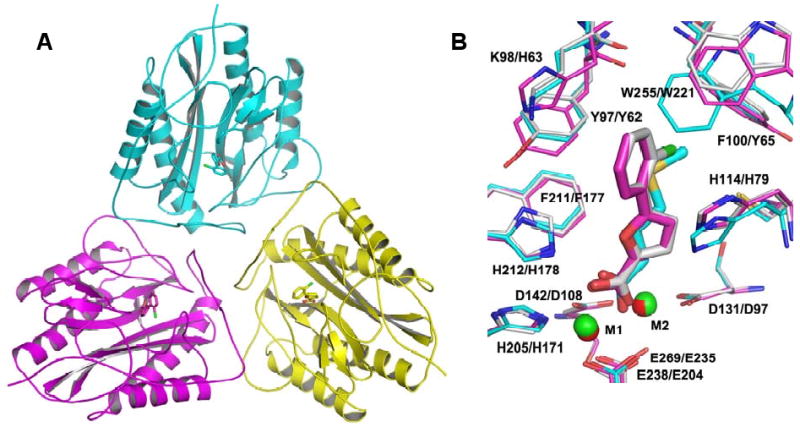
Methionine aminopeptidase (MetAP) carries out an important cotranslational N-terminal methionine excision of nascent proteins and represents a potential target to develop antibacterial and antitubercular drugs. We cloned one of the two MetAPs in Mycobacterium tuberculosis (MtMetAP1c from the mapB gene) and purified it to homogeneity as an apoenzyme. Its activity required a divalent metal ion, and Co(II), Ni(II), Mn(II), and Fe(II) were among activators of the enzyme. Co(II) and Fe(II) had the tightest binding, while Ni(II) was the most efficient cofactor for the catalysis. MtMetAP1c was also functional in E. coli cells because a plasmid-expressed MtMetAP1c complemented the essential function of MetAP in E. coli and supported the cell growth. A set of potent MtMetAP1c inhibitors were identified, and they showed high selectivity toward the Fe(II)-form, the Mn(II)-form, or the Co(II) and Ni(II) forms of the enzyme, respectively. These metalloform selective inhibitors were used to assign the metalloform of the cellular MtMetAP1c. The fact that only the Fe(II)-form selective inhibitors inhibited the cellular MtMetAP1c activity and inhibited the MtMetAP1c-complemented cell growth suggests that Fe(II) is the native metal used by MtMetAP1c in an E. coli cellular environment. Finally, X-ray structures of MtMetAP1c in complex with three metalloform-selective inhibitors were analyzed, which showed different binding modes and different interactions with metal ions and active site residues.
甲硫氨酸氨肽酶(MetAP)在新生蛋白质的共翻译 N 端甲硫氨酸切除中发挥重要作用,是开发抗菌和抗结核药物的潜在靶点。我们克隆了结核分枝杆菌(mapB 基因的 MtMetAP1c)中的两个 MetAP 之一,并将其纯化为apo 酶。其活性需要二价金属离子,Co(II)、Ni(II)、Mn(II)和 Fe(II)是酶的激活剂。Co(II)和 Fe(II)具有最紧密的结合,而 Ni(II)是最有效的酶催化辅因子。MtMetAP1c 在大肠杆菌细胞中也具有功能,因为表达在质粒上的 MtMetAP1c 补充了 MetAP 在大肠杆菌中的必需功能,并支持细胞生长。一组有效的 MtMetAP1c 抑制剂被鉴定出来,它们对 Fe(II)形式、Mn(II)形式或酶的 Co(II)和 Ni(II)形式分别表现出高选择性。这些金属形式选择性抑制剂被用于确定细胞内 MtMetAP1c 的金属形式。只有 Fe(II)形式选择性抑制剂抑制细胞内 MtMetAP1c 活性并抑制 MtMetAP1c 互补细胞生长的事实表明,Fe(II)是 MtMetAP1c 在大肠杆菌细胞环境中使用的天然金属。最后,分析了 MtMetAP1c 与三种金属形式选择性抑制剂复合物的 X 射线结构,显示了不同的结合模式和与金属离子和活性位点残基的不同相互作用。