Division of Gastroenterology, Department of Microbiology and Immunology, University of North Carolina, Chapel Hill, North Carolina, USA.
Curr Opin Gastroenterol. 2010 Mar;26(2):88-94. doi: 10.1097/MOG.0b013e3283361927.
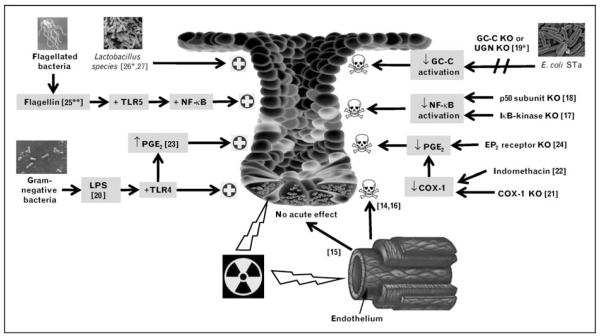
Injury to the small bowel from ionizing radiation occurs commonly in patients undergoing cancer therapy and less commonly in instances of accidental radiation overexposure. Several lines of evidence now suggest that dynamic interactions between the host's enteric microbiota and innate immune system are important in modulating the intestinal response to radiation. Here, we will review recent developments in the area of acute radiation enteropathy and examine the current state of knowledge regarding the impact of host-microbial interactions in the process.
There is promise in the development and testing of new clinical biomarkers including serum citrulline. Toll-like receptor agonists and innate immune system signaling pathways including nuclear factor-kappa B profoundly alter intestinal epithelial cell apoptosis and crypt survival after radiation exposure. Germ-free conditions, probiotics and antibiotics are each identified as modifiers of disease development and course. A human study suggested that luminal microbiota composition may influence the host's intestinal response to radiation and may change in those developing postradiation diarrhea.
New knowledge implies that investigations aimed at deciphering the microbiome-host interactions before and after small bowl radiation injury may eventually allow prediction of disease course and offer opportunities for the development of novel therapeutic or prophylactic strategies.
癌症治疗过程中患者的小肠会受到电离辐射损伤,偶尔也会发生辐射过度暴露的意外情况。目前有几条证据表明,宿主的肠道微生物群和先天免疫系统之间的动态相互作用对于调节肠道对辐射的反应非常重要。在这里,我们将回顾急性放射性肠炎领域的最新进展,并研究目前关于宿主-微生物相互作用在该过程中影响的知识状况。
包括血清瓜氨酸在内的新型临床生物标志物的开发和测试具有一定的前景。Toll 样受体激动剂和先天免疫系统信号通路(包括核因子-κB)在辐射暴露后极大地改变了肠上皮细胞凋亡和隐窝存活。无菌条件、益生菌和抗生素都被确定为疾病发展和病程的调节剂。一项人体研究表明,腔微生物组成可能影响宿主对辐射的肠道反应,并且可能在发生放射性腹泻的患者中发生变化。
新知识表明,在小肠辐射损伤前后对微生物组-宿主相互作用进行的研究可能最终能够预测疾病进程,并为开发新的治疗或预防策略提供机会。