Division of Medicine, Department of Public Health and Clinical Medicine, Umeå University Hospital, Umeå, Sweden.
PLoS One. 2009 Dec 29;4(12):e8475. doi: 10.1371/journal.pone.0008475.
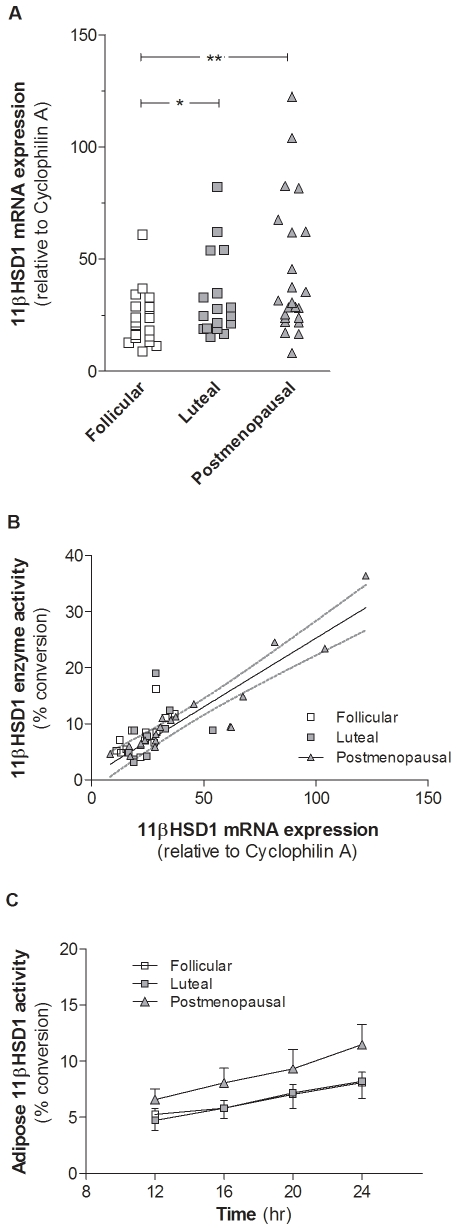
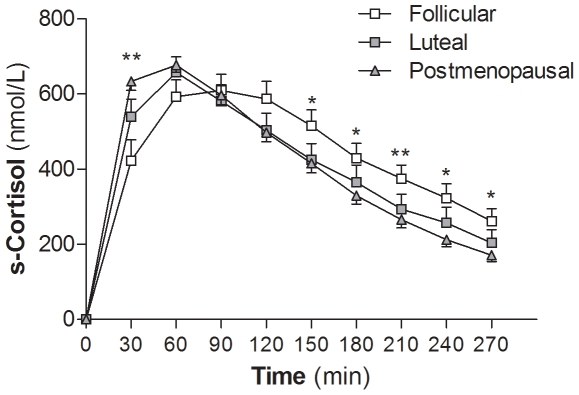
With age and menopause there is a shift in adipose distribution from gluteo-femoral to abdominal depots in women. Associated with this redistribution of fat are increased risks of type 2 diabetes and cardiovascular disease. Glucocorticoids influence body composition, and 11beta-hydroxysteroid dehydrogenase type 1 (11betaHSD1) which converts inert cortisone to active cortisol is a putative key mediator of metabolic complications in obesity. Increased 11betaHSD1 in adipose tissue may contribute to postmenopausal central obesity. We hypothesized that tissue-specific 11betaHSD1 gene expression and activity are up-regulated in the older, postmenopausal women compared to young, premenopausal women. Twenty-three pre- and 23 postmenopausal, healthy, normal weight women were recruited. The participants underwent a urine collection, a subcutaneous adipose tissue biopsy and the hepatic 11betaHSD1 activity was estimated by the serum cortisol response after an oral dose of cortisone. Urinary (5alpha-tetrahydrocortisol+5beta-tetrahydrocortisol)/tetrahydrocortisone ratios were higher in postmenopausal women versus premenopausal women in luteal phase (P<0.05), indicating an increased whole-body 11betaHSD1 activity. Postmenopausal women had higher 11betaHSD1 gene expression in subcutaneous fat (P<0.05). Hepatic first pass conversion of oral cortisone to cortisol was also increased in postmenopausal women versus premenopausal women in follicular phase of the menstrual cycle (P<0.01, at 30 min post cortisone ingestion), suggesting higher hepatic 11betaHSD1 activity. In conclusion, our results indicate that postmenopausal normal weight women have increased 11betaHSD1 activity in adipose tissue and liver. This may contribute to metabolic dysfunctions with menopause and ageing in women.
随着年龄的增长和绝经,女性的脂肪分布从臀股部位向腹部转移。这种脂肪重新分布伴随着 2 型糖尿病和心血管疾病风险的增加。糖皮质激素会影响身体成分,而将无活性的可的松转化为有活性的皮质醇的 11β-羟类固醇脱氢酶 1(11βHSD1)是肥胖代谢并发症的潜在关键介质。脂肪组织中 11βHSD1 的增加可能导致绝经后中心性肥胖。我们假设与年轻的绝经前女性相比,老年绝经后女性的组织特异性 11βHSD1 基因表达和活性更高。招募了 23 名绝经前和 23 名绝经后、健康、体重正常的女性。参与者进行了尿液收集、皮下脂肪活检,并通过口服皮质醇后血清皮质醇反应来估计肝 11βHSD1 活性。绝经后女性的尿(5α-四氢皮质醇+5β-四氢皮质醇)/四氢皮质醇比值在黄体期高于绝经前女性(P<0.05),表明全身 11βHSD1 活性增加。绝经后女性的皮下脂肪中 11βHSD1 基因表达更高(P<0.05)。在卵泡期,口服皮质醇在肝内转化为皮质醇的首过效应也在绝经后女性中增加,与绝经前女性相比(P<0.01,在皮质醇摄入后 30 分钟),这表明肝 11βHSD1 活性更高。总之,我们的研究结果表明,绝经后体重正常的女性脂肪组织和肝脏中 11βHSD1 活性增加。这可能导致女性绝经和衰老时代谢功能障碍。