Comprehensive Cancer Center, University of Alabama at Birmingham, Birmingham, AL, USA.
Cancer Chemother Pharmacol. 2010 Sep;66(4):669-80. doi: 10.1007/s00280-009-1209-0. Epub 2009 Dec 31.
Sunitinib in combination with docetaxel enhances antitumor activity in xenograft models of human breast and non-small cell lung cancer. We assessed the maximum tolerated doses (MTDs), safety, pharmacokinetic profiles, and preliminary efficacy of sunitinib plus docetaxel in patients with advanced solid tumors.
In this phase I study, successive patient cohorts received sunitinib 25, 37.5, or 50 mg/day for 4 weeks of a 6-week cycle (Schedule 4/2, 4 weeks on, 2 weeks off) or for 2 weeks of a 3-week cycle (Schedule 2/1, 2 weeks on, 1 week off) with docetaxel 60 or 75 mg/m(2) IV q21d to determine the MTDs of this treatment combination.
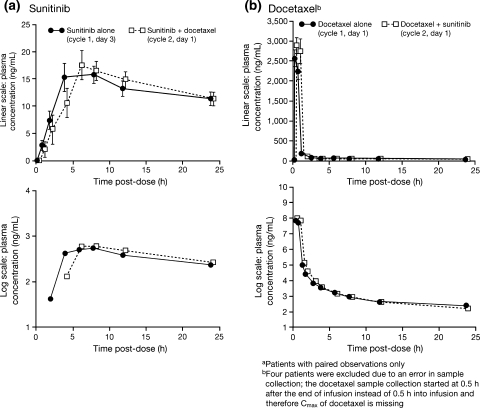
Fifty patients enrolled: 10 on Schedule 4/2 and 40 on Schedule 2/1. MTDs were established as sunitinib 25 mg on Schedule 4/2 with docetaxel 60 mg/m(2) q21d, and as sunitinib 37.5 mg on Schedule 2/1 with docetaxel 75 mg/m(2) q21d. On Schedule 2/1, the most frequent dose-limiting toxicity was neutropenia (+/-fever; grade [G]3/4, n = 5) and the most common G3/4 non-hematologic adverse event (AE) was fatigue (G3, n = 8). Hematologic AEs were managed with growth factor support in 11 of 23 (48%) patients treated at Schedule 2/1 MTD. Three patients achieved a partial response at the Schedule 2/1 MTD. There were no pharmacokinetic drug-drug interactions with either schedule.
Oral sunitinib 37.5 mg/day on Schedule 2/1 with docetaxel 75 mg/m(2) IV q21d is a clinically feasible regimen with a manageable safety profile, no pharmacokinetic drug-drug interactions, and shows antitumor activity in patients with advanced solid tumors.
舒尼替尼联合多西他赛可增强人乳腺癌和非小细胞肺癌异种移植模型中的抗肿瘤活性。我们评估了晚期实体瘤患者中舒尼替尼联合多西他赛的最大耐受剂量(MTD)、安全性、药代动力学特征和初步疗效。
在这项 I 期研究中,连续的患者队列接受舒尼替尼 25、37.5 或 50mg/天,4 周为一个 6 周周期(方案 4/2,4 周用药,2 周停药)或 3 周周期(方案 2/1,2 周用药,1 周停药),同时给予多西他赛 60 或 75mg/m2 静脉滴注,每 21 天 1 次,以确定该治疗组合的 MTD。
共纳入 50 例患者:10 例接受方案 4/2,40 例接受方案 2/1。MTD 确定为舒尼替尼 25mg/天,方案 4/2,联合多西他赛 60mg/m2,每 21 天 1 次;舒尼替尼 37.5mg/天,方案 2/1,联合多西他赛 75mg/m2,每 21 天 1 次。在方案 2/1 中,最常见的剂量限制性毒性是中性粒细胞减少症(伴/不伴发热;G3/4,n=5),最常见的 G3/4 非血液学不良事件(AE)是疲劳(G3,n=8)。23 例方案 2/1 MTD 治疗患者中有 11 例(48%)接受了生长因子支持治疗以管理血液学 AE。3 例患者在方案 2/1 MTD 时获得部分缓解。两种方案均无药代动力学药物相互作用。
舒尼替尼 37.5mg/天,方案 2/1,联合多西他赛 75mg/m2,静脉滴注,每 21 天 1 次,是一种具有临床可行性的方案,具有可管理的安全性,无药代动力学药物相互作用,并显示出对晚期实体瘤患者的抗肿瘤活性。