School of Oceanography, University of Washington, Seattle WA 98195-7940, USA.
BMC Evol Biol. 2010 Jan 2;10:1. doi: 10.1186/1471-2148-10-1.
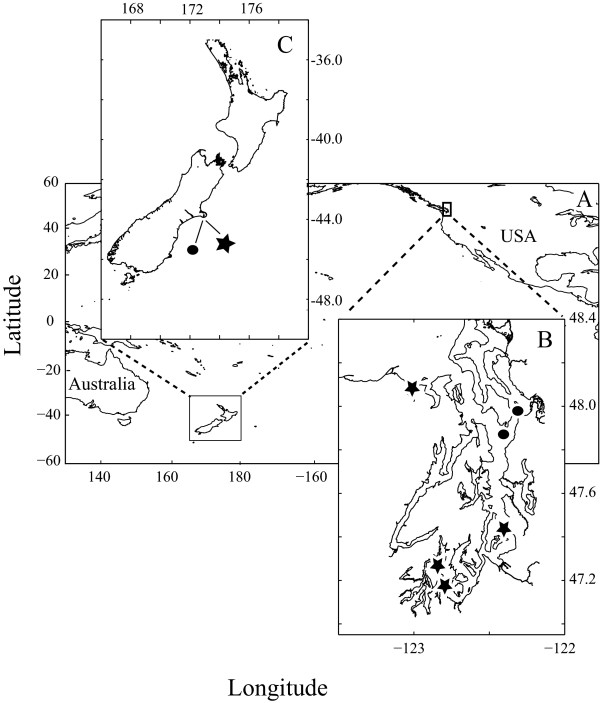
Diatoms are one of the most species-rich groups of eukaryotic microbes known. Diatoms are also the only group of eukaryotic micro-algae with a diplontic life history, suggesting that the ancestral diatom switched to a life history dominated by a duplicated genome. A key mechanism of speciation among diatoms could be a propensity for additional stable genome duplications. Across eukaryotic taxa, genome size is directly correlated to cell size and inversely correlated to physiological rates. Differences in relative genome size, cell size, and acclimated growth rates were analyzed in isolates of the diatom Ditylum brightwellii. Ditylum brightwellii consists of two main populations with identical 18s rDNA sequences; one population is distributed globally at temperate latitudes and the second appears to be localized to the Pacific Northwest coast of the USA. These two populations co-occur within the Puget Sound estuary of WA, USA, although their peak abundances differ depending on local conditions.
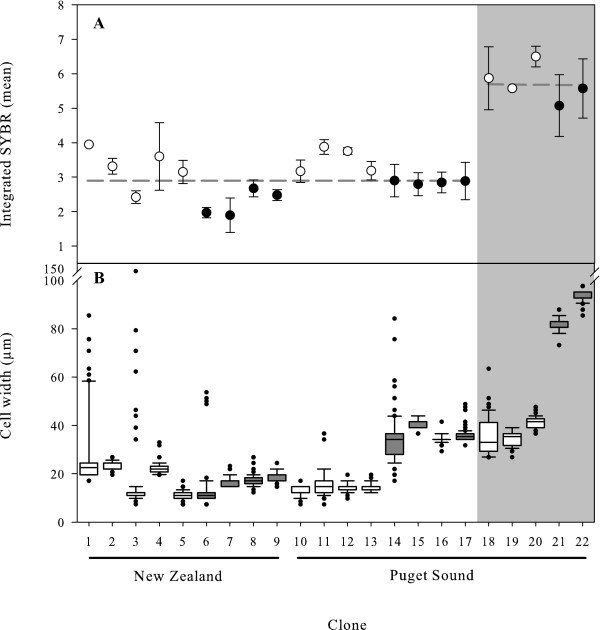
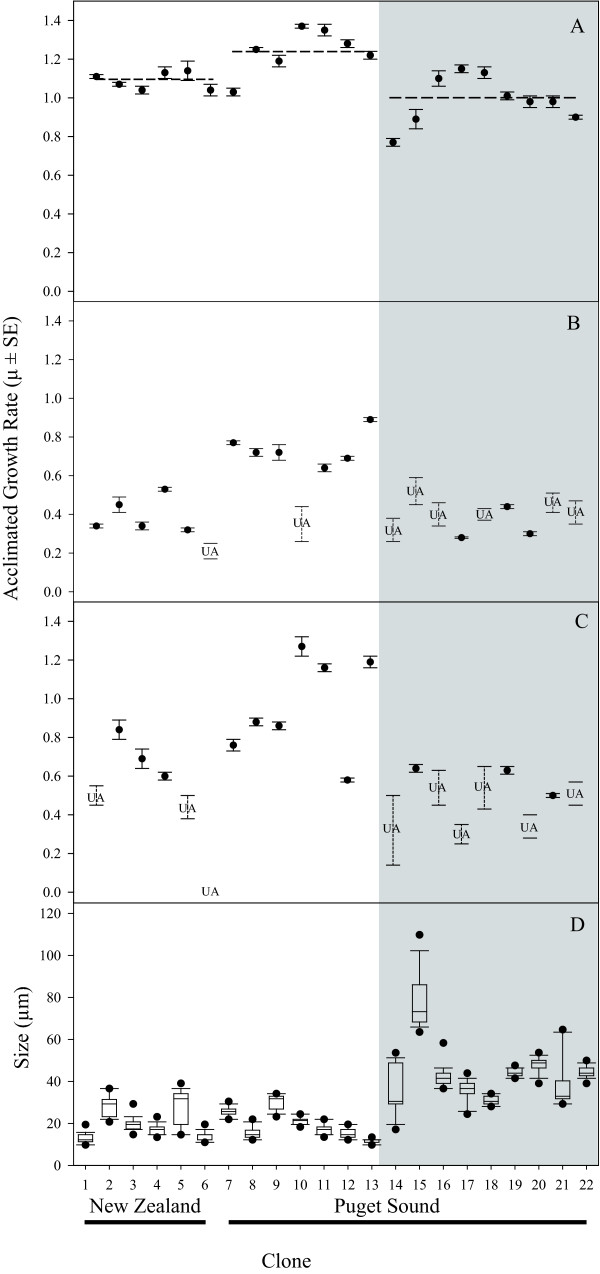
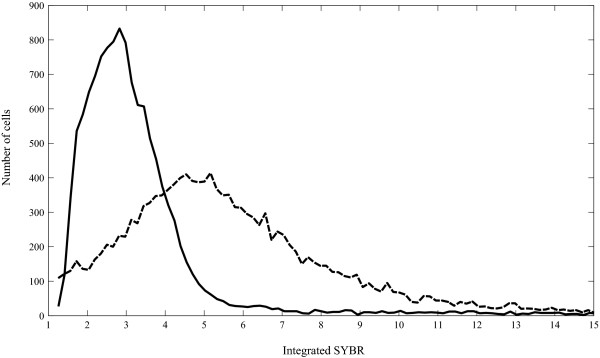
All isolates from the more regionally-localized population (population 2) possessed 1.94 +/- 0.74 times the amount of DNA, grew more slowly, and were generally larger than isolates from the more globally distributed population (population 1). The ITS1 sequences, cell sizes, and genome sizes of isolates from New Zealand were the same as population 1 isolates from Puget Sound, but their growth rates were within the range of the slower-growing population 2 isolates. Importantly, the observed genome size difference between isolates from the two populations was stable regardless of time in culture or the changes in cell size that accompany the diatom life history.
The observed two-fold difference in genome size between the D. brightwellii populations suggests that whole genome duplication occurred within cells of population 1 ultimately giving rise to population 2 cells. The apparent regional localization of population 2 is consistent with a recent divergence between the populations, which are likely cryptic species. Genome size variation is known to occur in other diatom genera; we hypothesize that genome duplication may be an active and important mechanism of genetic and physiological diversification and speciation in diatoms.
硅藻是已知的最具物种多样性的真核微生物之一。硅藻也是唯一具有二倍体生活史的真核微藻群,这表明硅藻的祖先生活史从基因组单倍体转变为基因组二倍体。硅藻物种形成的一个关键机制可能是基因组额外稳定加倍的倾向。在真核生物分类群中,基因组大小与细胞大小直接相关,与生理速率成反比。对硅藻 Ditylum brightwellii 的分离株进行了相对基因组大小、细胞大小和适应生长速率的差异分析。Ditylum brightwellii 由两个主要种群组成,它们具有相同的 18s rDNA 序列;一个种群分布在全球温带地区,第二个种群似乎局限于美国太平洋西北海岸。这两个种群在美国华盛顿州的普吉特湾共存,尽管它们的峰值丰度因当地条件而异。
来自区域本地化种群(种群 2)的所有分离株都具有 1.94 +/- 0.74 倍的 DNA 含量,生长较慢,通常比来自更广泛分布种群(种群 1)的分离株更大。来自新西兰的分离株的 ITS1 序列、细胞大小和基因组大小与来自普吉特湾的种群 1 分离株相同,但它们的生长速率在较慢生长种群 2 分离株的范围内。重要的是,无论在培养时间或伴随硅藻生活史的细胞大小变化如何,观察到的两个种群之间的基因组大小差异都是稳定的。
在 D. brightwellii 种群之间观察到的基因组大小两倍差异表明,整个基因组复制发生在种群 1 的细胞内,最终产生了种群 2 的细胞。种群 2 的明显区域本地化与种群之间的近期分化一致,这些种群可能是隐种。在其他硅藻属中已知存在基因组大小变异;我们假设基因组复制可能是硅藻遗传和生理多样化以及物种形成的一个活跃而重要的机制。