• 文献检索
  • 文档翻译
  • 深度研究
  • 学术资讯
  • Suppr Zotero 插件Zotero 插件
  • 邀请有礼
  • 套餐&价格
  • 历史记录
应用&插件
Suppr Zotero 插件Zotero 插件浏览器插件Mac 客户端Windows 客户端微信小程序
定价
高级版会员购买积分包购买API积分包
服务
文献检索文档翻译深度研究API 文档MCP 服务
关于我们
关于 Suppr公司介绍联系我们用户协议隐私条款
关注我们

Suppr 超能文献

核心技术专利:CN118964589B侵权必究
粤ICP备2023148730 号-1Suppr @ 2026

文献检索

告别复杂PubMed语法,用中文像聊天一样搜索,搜遍4000万医学文献。AI智能推荐,让科研检索更轻松。

立即免费搜索

文件翻译

保留排版,准确专业,支持PDF/Word/PPT等文件格式,支持 12+语言互译。

免费翻译文档

深度研究

AI帮你快速写综述,25分钟生成高质量综述,智能提取关键信息,辅助科研写作。

立即免费体验

急诊有精神科主诉的患者比对照组的患者返回率更高。

Emergency department patients with psychiatric complaints return at higher rates than controls.

机构信息

University of Utah, Division of Emergency Medicine, Salt Lake City, UT.

出版信息

West J Emerg Med. 2009 Nov;10(4):268-72.

PMID:20046248
原文链接:https://pmc.ncbi.nlm.nih.gov/articles/PMC2791732/
Abstract

STUDY OBJECTIVE

At our 35,000 visit/year emergency department (ED), we studied whether patients presenting to the ED with psychiatric complaints were admitted to the hospital at a higher rate than non-psychiatric patients, and whether these patients had a higher rate of reevaluation in the ED within 30 days following the index visit.

METHODS

We reviewed the electronic records of all ED patients receiving a psychiatric evaluation from January to February 2007 and compared these patients to 300 randomly selected patients presenting during the study period for non-psychiatric complaints. Patients were followed for 30 days, and admission rates and return visits were compared.

RESULTS

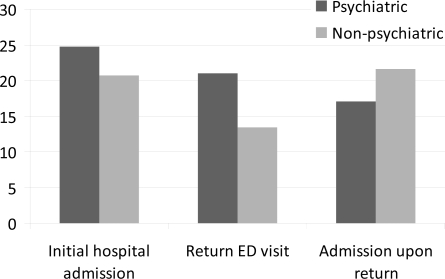
Two hundred thirty-four patients presented to the ED and were evaluated for psychiatric complaints during the study period. Twenty-four point seven percent of psychiatric patients were admitted upon initial presentation versus 20.7% of non-psychiatric patients (p = 0.258). Twenty-one percent of discharged psychiatric patients returned to the ED within 30 days versus 13.4% of discharged non-psychiatric patients (p=0.041). Patients returning to the ED within 30 days had a 17.1% versus 21.6% admission rate for the psychiatric and non-psychiatric groups, respectively (p=0.485).

CONCLUSION

Patients presenting to this ED with psychiatric complaints were not admitted at a significantly higher rate than non-psychiatric patients. These psychiatric patients did, however, have a significantly higher return rate to the ED when compared to non-psychiatric patients.

摘要

研究目的

在我们每年接诊 35000 人次的急诊部(ED),我们研究了以精神科主诉就诊的患者的住院率是否高于非精神科患者,以及这些患者在指数就诊后 30 天内 ED 再评估的比率是否更高。

方法

我们回顾了 2007 年 1 月至 2 月期间所有在 ED 接受精神科评估的患者的电子记录,并将这些患者与同期就诊的 300 名患有非精神科疾病的随机选择患者进行了比较。患者随访 30 天,比较入院率和复诊率。

结果

在研究期间,有 234 名患者因精神科主诉就诊 ED 并接受评估。24.7%的精神科患者在初次就诊时入院,而非精神科患者为 20.7%(p=0.258)。21%出院的精神科患者在 30 天内返回 ED,而非精神科患者为 13.4%(p=0.041)。在 30 天内返回 ED 的患者中,精神科和非精神科组的入院率分别为 17.1%和 21.6%(p=0.485)。

结论

与非精神科患者相比,以精神科主诉就诊的患者的住院率并没有显著更高。然而,与非精神科患者相比,这些精神科患者返回 ED 的比率显著更高。
https://cdn.ncbi.nlm.nih.gov/pmc/blobs/5d66/2791732/bb5c273c0e87/wjem-10-268f1.jpg

相似文献

1
Emergency department patients with psychiatric complaints return at higher rates than controls.急诊有精神科主诉的患者比对照组的患者返回率更高。
West J Emerg Med. 2009 Nov;10(4):268-72.
2
In-Hospital Outcomes and Costs Among Patients Hospitalized During a Return Visit to the Emergency Department.急诊科复诊住院患者的院内结局与费用
JAMA. 2016 Feb 16;315(7):663-71. doi: 10.1001/jama.2016.0649.
3
The recidivism characteristics of an emergency department observation unit.急诊科观察单元的累犯特征。
Ann Emerg Med. 2010 Jul;56(1):34-41. doi: 10.1016/j.annemergmed.2010.02.012. Epub 2010 Mar 29.
4
Reasons for readmissions: what are the reasons for 90-day readmissions of psychiatric patients from the ED?再入院原因:急诊室精神科患者90天再入院的原因有哪些?
Am J Emerg Med. 2015 Oct;33(10):1489-91. doi: 10.1016/j.ajem.2015.06.056. Epub 2015 Jun 24.
5
Return to the emergency department after ventricular shunt evaluation.心室分流评估后返回急诊科。
J Neurosurg Pediatr. 2016 Apr;17(4):397-402. doi: 10.3171/2015.8.PEDS15309. Epub 2015 Dec 18.
6
Characterization of Young Children Presenting to the Emergency Department for Mental Health Complaints.因心理健康问题前往急诊科就诊的幼儿特征。
South Med J. 2020 Mar;113(3):116-118. doi: 10.14423/SMJ.0000000000001076.
7
In-Hospital Outcomes in Patients Admitted to the Intensive Care Unit after a Return Visit to the Emergency Department.急诊复诊后入住重症监护病房患者的院内结局
Healthcare (Basel). 2021 Apr 7;9(4):431. doi: 10.3390/healthcare9040431.
8
Short-term unscheduled return visits of adult patients to the emergency department.成年患者短期非计划重返急诊科就诊情况。
J Emerg Med. 2014 Aug;47(2):131-9. doi: 10.1016/j.jemermed.2014.01.016. Epub 2014 Mar 15.
9
90-Day Return Visit to the Emergency Department After an Initial Neurosurgical Evaluation.初次神经外科评估后 90 天返回急诊科就诊。
World Neurosurg. 2022 Feb;158:e283-e286. doi: 10.1016/j.wneu.2021.10.175. Epub 2021 Oct 31.
10
Low Adverse Event Rates But High Emergency Department Utilization in Chest Pain Patients Treated in an Emergency Department Observation Unit.急诊科观察单元治疗的胸痛患者不良事件发生率低但急诊科利用率高。
Crit Pathw Cardiol. 2017 Mar;16(1):15-21. doi: 10.1097/HPC.0000000000000099.

引用本文的文献

1
A Case of Neuroleptic Malignant Syndrome Presenting as Anxiety.一例以焦虑为表现的抗精神病药恶性综合征
Cureus. 2023 Mar 8;15(3):e35892. doi: 10.7759/cureus.35892. eCollection 2023 Mar.
2
A Machine Learning Model for Predicting Unscheduled 72 h Return Visits to the Emergency Department by Patients with Abdominal Pain.一种用于预测腹痛患者非计划72小时内返回急诊科就诊情况的机器学习模型。
Diagnostics (Basel). 2021 Dec 30;12(1):82. doi: 10.3390/diagnostics12010082.
3
Unscheduled return visits to a Dutch inner-city emergency department.

本文引用的文献

1
Factors associated with frequent use of emergency services in a medical center.与医疗中心频繁使用急诊服务相关的因素。
J Formos Med Assoc. 2003 Apr;102(4):222-8.
2
Frequent attenders to an emergency department: a study of primary health care use, medical profile, and psychosocial characteristics.急诊科的频繁就诊者:一项关于初级卫生保健利用、医疗状况及社会心理特征的研究
Ann Emerg Med. 2003 Mar;41(3):309-18. doi: 10.1067/mem.2003.68.
3
Describing and predicting frequent users of an emergency department.描述和预测急诊科的频繁使用者。
荷兰市中心急诊科的非计划复诊
Int J Emerg Med. 2014 Jul 5;7:23. doi: 10.1186/s12245-014-0023-6. eCollection 2014.
4
Does targeted education of emergency physicians improve their comfort level in treating psychiatric patients?对急诊医师进行针对性教育是否能提高他们治疗精神病患者的舒适度?
West J Emerg Med. 2012 Dec;13(6):453-7. doi: 10.5811/westjem.2012.3.6899.
J Assoc Acad Minor Phys. 2001 Mar;12(1-2):119-23.
4
Repeated use of the emergency department: qualitative study of the patient's perspective.急诊科的重复使用:从患者角度进行的定性研究
Emerg Med J. 2001 Nov;18(6):430-4. doi: 10.1136/emj.18.6.430.
5
Long-term risk factors for suicide mortality after attempted suicide--findings of a 14-year follow-up study.
Acta Psychiatr Scand. 2001 Aug;104(2):117-21. doi: 10.1034/j.1600-0447.2001.00243.x.
6
Frequent use of the hospital emergency department is indicative of high use of other health care services.频繁使用医院急诊科表明对其他医疗服务的高使用率。
Ann Emerg Med. 2001 Jun;37(6):561-7. doi: 10.1067/mem.2001.111762.
7
Excess mortality of suicide attempters.自杀未遂者的超额死亡率。
Soc Psychiatry Psychiatr Epidemiol. 2001 Jan;36(1):29-35. doi: 10.1007/s001270050287.
8
Characteristics of attenders and their attendances at an urban accident and emergency department over a one year period.城市急诊科一年期间就诊者的特征及其就诊情况。
J Accid Emerg Med. 1999 Nov;16(6):425-7. doi: 10.1136/emj.16.6.425.
9
Attempted suicide: repetition and survival--findings of a follow-up study.
Acta Psychiatr Scand. 1999 Sep;100(3):205-11. doi: 10.1111/j.1600-0447.1999.tb10847.x.
10
Suicide attempts preceding completed suicide.
Br J Psychiatry. 1998 Dec;173:531-5. doi: 10.1192/bjp.173.6.531.