Department of General, Transplant, and Liver Surgery, Warsaw Medical University, Banacha 1A, Warsaw, Poland.
Arch Immunol Ther Exp (Warsz). 2010 Feb;58(1):77-80. doi: 10.1007/s00005-009-0056-3. Epub 2010 Jan 5.
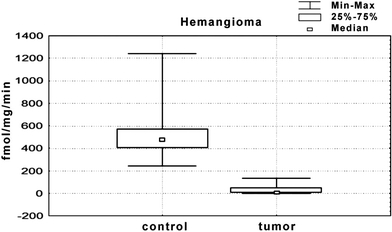
Type 1 iodothyronine deiodinase (D1) is a crucial enzyme which converts the prohormone thyroxine (T4) into active tri-iodothyronine (T3). There has been strong evidence that the metabolism of thyroid hormones is disturbed in some neoplastic tissues such as thyroid, renal, and breast cancer. However, there are few available data about D1 enzyme activity in benign tumors such as hemangioma, which is the most common primary liver tumor. Hence this study aimed to determine the enzymatic activity of D1 in hemangiomas in relation to healthy liver tissue. Seven tumors and healthy control tissues were obtained from patients who had liver resection due to hemangioma. The activity was assessed by measurement of radioactive iodine released by deiodination catalyzed by D1. It was found that D1 activity was significantly lower in the hemangiomas than in the healthy surrounding tissue (p = 0.0017). The results indicated that thyroid hormones play important roles not only in the regulation of cell metabolism, but also in cell growth, division, and apoptosis. The active form T3 acts through its nuclear receptors and influences the up- and down-regulation of target genes. Healthy liver tissue expresses a high level of D1, but disturbed D1 activity may result in changes in the local concentration of T3 which may impair gene transcription. These finding demonstrate a low enzymatic activity of D1 in liver hemangioma and suggest an as yet unknown role of thyroid hormones in this type of benign liver tumor.
类型 1 碘甲状腺原氨酸脱碘酶 (D1) 是一种关键的酶,可将前激素甲状腺素 (T4) 转化为活性三碘甲状腺原氨酸 (T3)。有强有力的证据表明,甲状腺激素的代谢在某些肿瘤组织中受到干扰,如甲状腺、肾和乳腺癌。然而,关于良性肿瘤(如血管瘤)中 D1 酶活性的可用数据很少,血管瘤是最常见的原发性肝肿瘤。因此,本研究旨在确定 D1 在血管瘤中的酶活性与健康肝组织的关系。从因血管瘤而行肝切除术的患者中获得了 7 个肿瘤和健康对照组织。通过测量 D1 催化的脱碘作用释放的放射性碘来评估活性。结果发现,D1 活性在血管瘤中明显低于周围健康组织(p = 0.0017)。结果表明,甲状腺激素不仅在细胞代谢调节中起着重要作用,而且在细胞生长、分裂和凋亡中也起着重要作用。活性形式 T3 通过其核受体发挥作用,并影响靶基因的上调和下调。健康肝组织表达高水平的 D1,但 D1 活性的紊乱可能导致 T3 的局部浓度发生变化,从而损害基因转录。这些发现表明肝血管瘤中 D1 的酶活性较低,并提示甲状腺激素在这种良性肝肿瘤中具有未知的作用。