Monash University, Accident Research Centre, Clayton, Victoria, 3800, Australia.
BMC Musculoskelet Disord. 2010 Jan 5;11:6. doi: 10.1186/1471-2474-11-6.
To determine factors predicting the duration of time away from work following acute orthopaedic non life threatening trauma
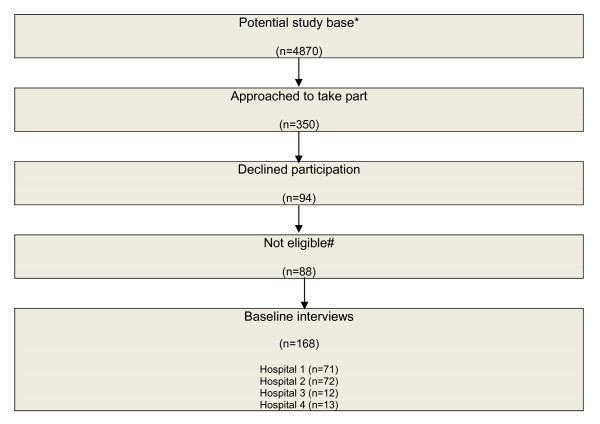
Prospective cohort study conducted at four hospitals in Victoria, Australia. The cohort comprised 168 patients aged 18-64 years who were working prior to the injury and sustained a range of acute unintentional orthopaedic injuries resulting in hospitalization. Baseline data was obtained by survey and medical record review. Multivariate Cox proportional hazards regression analysis was used to examine the association between potential predictors and the duration of time away from work during the six month study. The study achieved 89% follow-up.
Of the 168 participants recruited to the study, 68% returned to work during the six month study. Multivariate Cox proportional hazards regression analysis identified that blue collar work, negative pain attitudes with respect to work, high initial pain intensity, injury severity, older age, initial need for surgery, the presence of co-morbid health conditions at study entry and an orthopaedic injury to more than one region were associated with extended duration away from work following the injury. Participants in receipt of compensation who reported high social functioning at two weeks were 2.58 times more likely to have returned to work than similar participants reporting low social functioning. When only those who had returned to work were considered, the participant reported reason for return to work " to fill the day" was a significant predictor of earlier RTW [RR 2.41 (95% C.I 1.35-4.30)] whereas "financial security" and "because they felt able to" did not achieve significance.
Many injury-related and psycho social factors affect the duration of time away from work following orthopaedic injury. Some of these are potentially modifiable and may be amenable to intervention. Further consideration of the reasons provided by participants for returning to work may provide important opportunities for social marketing approaches designed to alleviate the financial and social burden associated with work disability.
确定预测急性骨科非生命威胁性创伤后缺勤时间的因素
在澳大利亚维多利亚州的四家医院进行的前瞻性队列研究。该队列包括 168 名年龄在 18-64 岁之间的患者,他们在受伤前正在工作,并因各种急性意外骨科损伤导致住院。通过调查和病历回顾获得基线数据。使用多变量 Cox 比例风险回归分析来检查潜在预测因素与研究期间六个月的工作缺勤时间之间的关联。该研究实现了 89%的随访。
在研究中招募的 168 名参与者中,有 68%在六个月的研究期间重返工作岗位。多变量 Cox 比例风险回归分析确定,蓝领工作、对工作的消极疼痛态度、初始疼痛强度高、损伤严重程度、年龄较大、初始需要手术、研究时存在合并健康状况以及一处以上的骨科损伤与受伤后延长的缺勤时间相关。在两周时报告高社会功能的接受赔偿的参与者比报告低社会功能的类似参与者更有可能重返工作岗位,其可能性是 2.58 倍。当仅考虑已返回工作的参与者时,参与者报告返回工作的原因“充实一天”是更早返回工作的重要预测因素[RR 2.41(95%置信区间 1.35-4.30)],而“经济保障”和“因为他们觉得自己有能力”则没有达到显著水平。
许多与损伤相关和心理社会因素会影响骨科损伤后缺勤时间的长短。其中一些是潜在可改变的,可能适合干预。进一步考虑参与者返回工作的原因可能为旨在减轻与工作残疾相关的经济和社会负担的社会营销方法提供重要机会。