Astbury Centre for Structural Molecular Biology, University of Leeds, Leeds LS2 9JT, UK.
J Mol Biol. 2010 Mar 12;396(5):1329-45. doi: 10.1016/j.jmb.2009.12.048. Epub 2010 Jan 4.
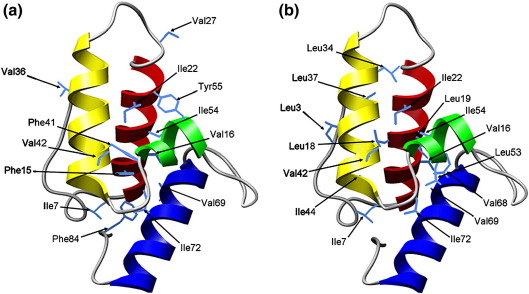
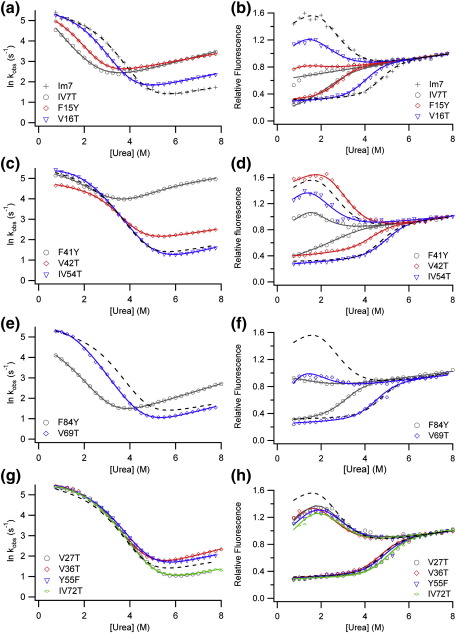
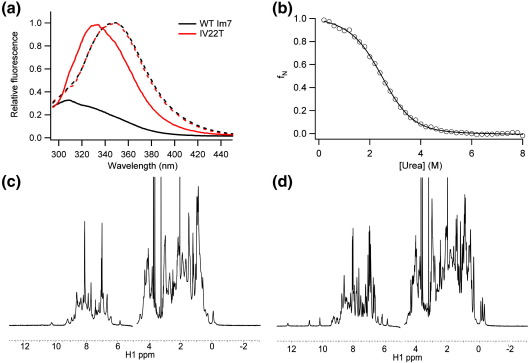
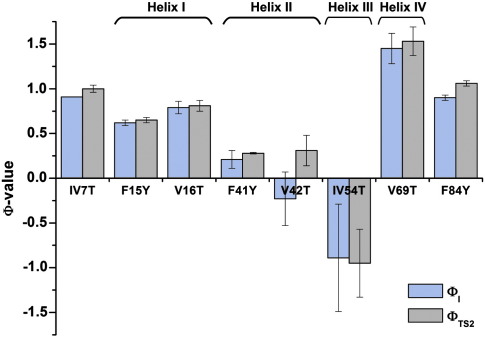
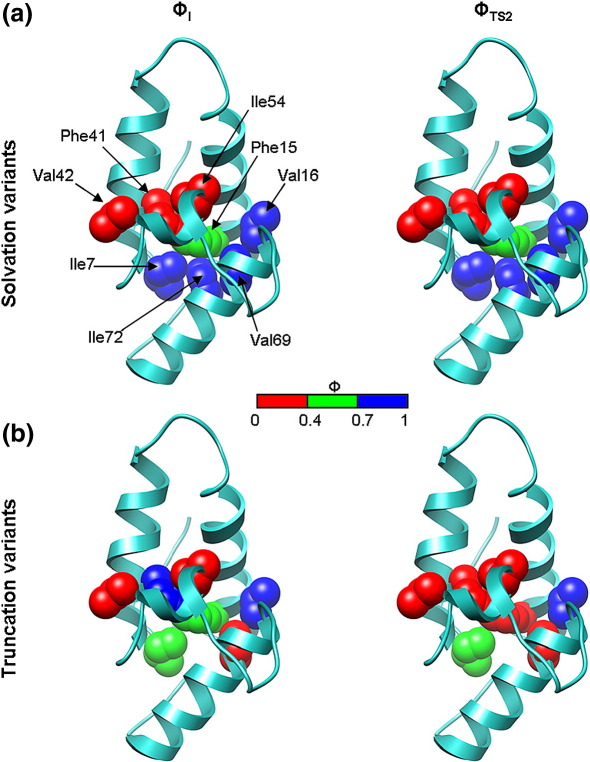
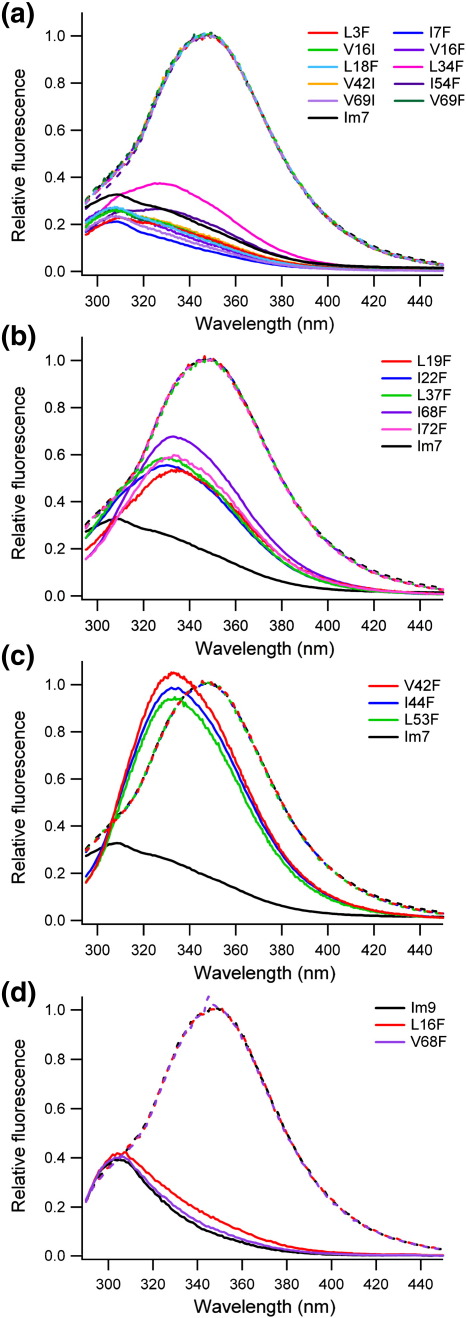
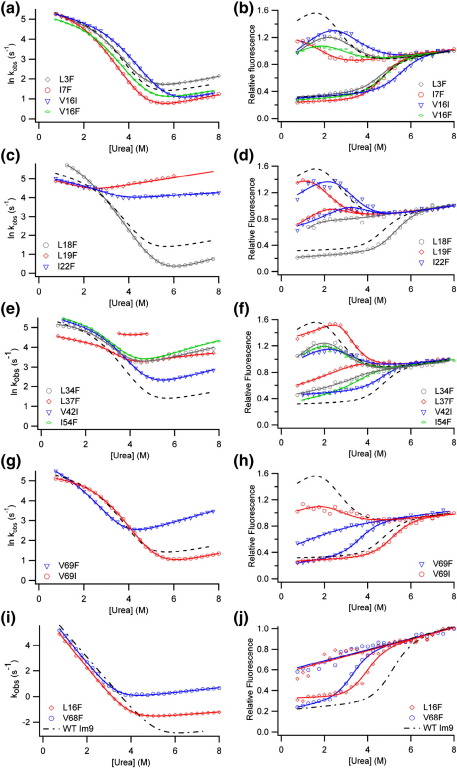
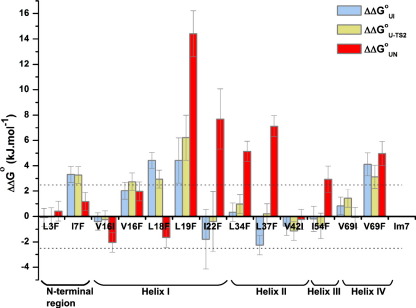
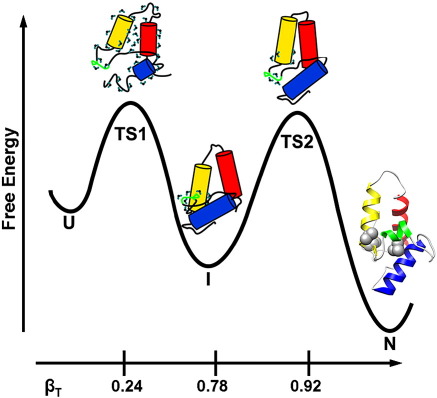
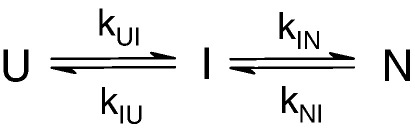
Development of a tightly packed hydrophobic core drives the folding of water-soluble globular proteins and is a key determinant of protein stability. Despite this, there remains much to be learnt about how and when the hydrophobic core becomes desolvated and tightly packed during protein folding. We have used the bacterial immunity protein Im7 to examine the specificity of hydrophobic core packing during folding. This small, four-helix protein has previously been shown to fold via a compact three-helical intermediate state. Here, overpacking substitutions, in which residue side-chain size is increased, were used to examine the specificity and malleability of core packing in the folding intermediate and rate-limiting transition state. In parallel, polar groups were introduced into the Im7 hydrophobic core via Val-->Thr or Phe-->Tyr substitutions and used to determine the solvation status of core residues at different stages of folding. Over 30 Im7 variants were created allowing both series of substitutions to cover all regions of the protein structure. Phi-value analysis demonstrated that the major changes in Im7 core solvation occur prior to the population of the folding intermediate, with key regions involved in docking of the short helix III remaining solvent-exposed until after the rate-limiting transition state has been traversed. In contrast, overpacking core residues revealed that some regions of the native Im7 core are remarkably malleable to increases in side-chain volume. Overpacking residues in other regions of the Im7 core result in substantial (>2.5 kJ mol(-1)) destabilisation of the native structure or even prevents efficient folding to the native state. This study provides new insights into Im7 folding; demonstrating that whilst desolvation occurs early during folding, adoption of a specifically packed core is achieved only at the very last step in the folding mechanism.
发展紧密堆积的疏水性核心驱动水溶性球状蛋白质的折叠,是蛋白质稳定性的关键决定因素。尽管如此,对于疏水性核心在蛋白质折叠过程中何时以及如何去溶剂化并紧密堆积,仍有许多需要了解。我们使用细菌免疫蛋白 Im7 来研究折叠过程中疏水性核心堆积的特异性。这种小的四螺旋蛋白先前已被证明通过紧凑的三螺旋中间状态折叠。在这里,使用残基侧链大小增加的过包装取代物来检查折叠中间态和限速转变态中核心堆积的特异性和可变形性。同时,通过 Val-->Thr 或 Phe-->Tyr 取代将极性基团引入 Im7 疏水性核心,并用于确定折叠过程中不同阶段核心残基的溶剂化状态。创建了 30 多个 Im7 变体,使这两个系列的取代物都能覆盖蛋白质结构的所有区域。Phi 值分析表明,Im7 核心溶剂化的主要变化发生在折叠中间态出现之前,涉及短螺旋 III 对接的关键区域在穿过限速转变态后仍然暴露于溶剂中。相比之下,过包装核心残基表明,天然 Im7 核心的一些区域对侧链体积的增加具有显著的可变形性。在 Im7 核心的其他区域过包装残基会导致天然结构的大幅(>2.5 kJ mol(-1)) 失稳,甚至阻止其有效地折叠到天然状态。这项研究为 Im7 折叠提供了新的见解;表明尽管去溶剂化发生在折叠的早期阶段,但只有在折叠机制的最后一步才能实现特定包装的核心。