King's College London, Department of Twin Research and Genetic Epidemiology, UK.
Genes Immun. 2010 Apr;11(3):209-18. doi: 10.1038/gene.2009.104. Epub 2010 Jan 7.
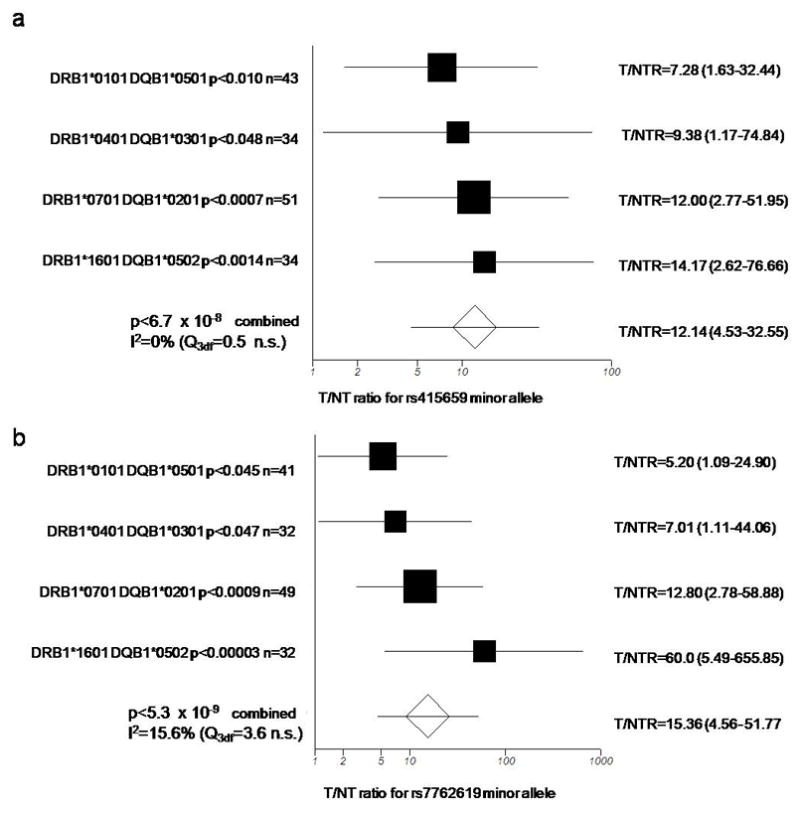
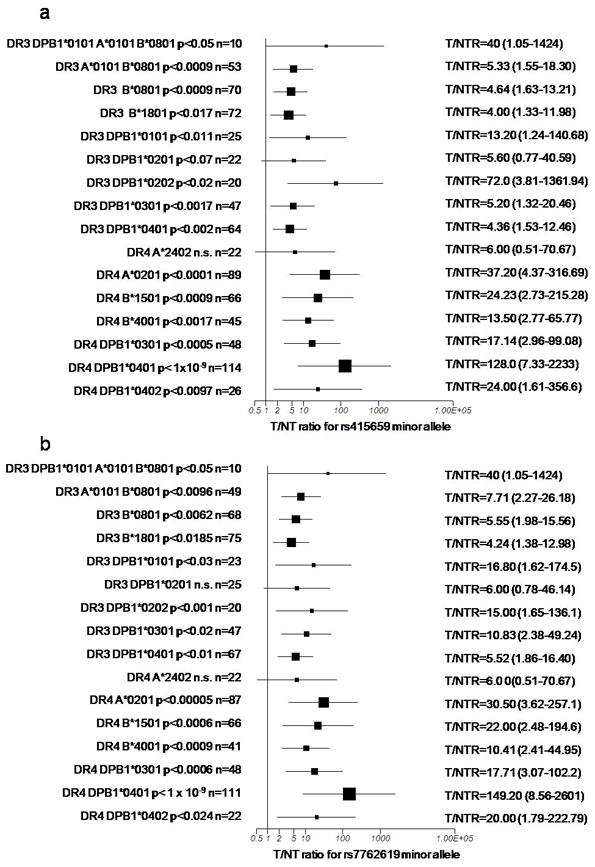
Human leukocyte antigen (HLA) class II DRB1 and DQB1 represent the major type I diabetes (T1D) genetic susceptibility loci; however, other genes in the HLA region are also involved in T1D risk. We analyzed 1411 pedigrees (2865 affected individuals) from the type I diabetes genetics consortium genotyped for HLA classical loci and for 12 single-nucleotide polymorphisms (SNPs) in the class III region previously shown to be associated with T1D in a subset of 886 pedigrees. Using the transmission disequilibrium test, we compared the proportion of SNP alleles transmitted from within the high-risk DR3 and DR4 haplotypes to affected offspring. Markers rs4151659 (mapping to CFB) and rs7762619 (mapping 5' of LTA) were the most strongly associated with T1D on DR3 (P=1.2 x 10(-9) and P=2 x 10(-12), respectively) and DR4 (P=4 x 10(-15) and P=8 x 10(-8), respectively) haplotypes. They remained significantly associated after stratifying individuals in analyses for B1801, A0101-B0801, DPB10301, DPB10202, DPB10401 or DPB1*0402. Rs7762619 and rs4151659 are in strong linkage disequilibrium (LD) (r(2)=0.82) with each other, but a joint analysis showed that the association for each SNP was not solely because of LD. Our data support a role for more than one locus in the class III region contributing to risk of T1D.
人类白细胞抗原 (HLA) Ⅱ类 DRB1 和 DQB1 代表主要的 1 型糖尿病 (T1D) 遗传易感性位点;然而,HLA 区域的其他基因也参与 T1D 风险。我们分析了 1411 个家系(2865 个受影响个体),这些家系来自于 I 型糖尿病遗传学联合会,它们在 HLA 经典基因座上进行了基因分型,并且在之前在 886 个家系的亚组中与 T1D 相关的 12 个单核苷酸多态性 (SNP) 进行了基因分型。使用传递不平衡检验,我们比较了从高风险 DR3 和 DR4 单倍型内传递的 SNP 等位基因与受影响后代的比例。标记物 rs4151659(映射到 CFB)和 rs7762619(映射到 LTA 的 5')与 DR3(P=1.2 x 10(-9) 和 P=2 x 10(-12))和 DR4(P=4 x 10(-15) 和 P=8 x 10(-8))单倍型的 T1D 关联最强。在分析 B1801、A0101-B0801、DPB10301、DPB10202、DPB10401 或 DPB1*0402 个体时,它们在分层分析中仍然显著相关。rs7762619 和 rs4151659 彼此之间存在强烈的连锁不平衡(LD)(r(2)=0.82),但联合分析表明,每个 SNP 的关联不仅仅是因为 LD。我们的数据支持 III 类区域的多个位点在 T1D 风险中发挥作用。