Department of Orthopaedic Surgery, Academic Medical Center, Amsterdam, The Netherlands.
Skeletal Radiol. 2010 Nov;39(11):1103-8. doi: 10.1007/s00256-009-0857-9. Epub 2010 Jan 9.
Hindfoot malalignment is a recognized cause of foot and ankle disability. For preoperative planning and clinical follow-up, reliable radiographic assessment of hindfoot alignment is important. The long axial radiographic view and the hindfoot alignment view are commonly used for this purpose. However, their comparative reliabilities are unknown. As hindfoot varus or valgus malalignment is most pronounced during mid-stance of gait, a unilateral weight-bearing stance, in comparison with a bilateral stance, could increase measurement reliability. The purpose of this study was to compare the intra- and interobserver reliability of hindfoot alignment measurements of both radiographic views in bilateral and unilateral stance.
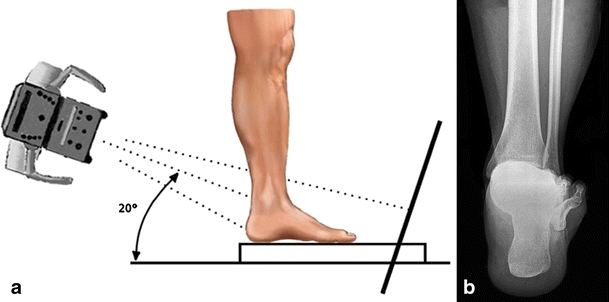
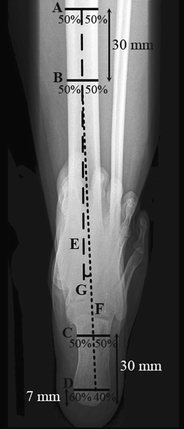
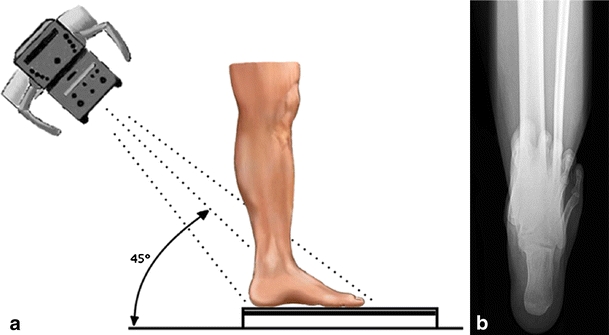
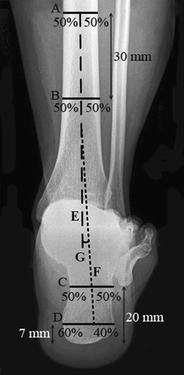
A hindfoot alignment view and a long axial view were acquired from 18 healthy volunteers in bilateral and unilateral weight-bearing stances. Hindfoot alignment was defined as the angular deviation between the tibial anatomical axis and the calcaneus longitudinal axis from the radiographs. Repeat measurements of hindfoot alignment were performed by nine orthopaedic examiners.
Measurements from the hindfoot alignment view gave intra- and interclass correlation coefficients (CCs) of 0.72 and 0.58, respectively, for bilateral stance and 0.91 and 0.49, respectively, for unilateral stance. The long axial view showed, respectively, intra- and interclass CCs of 0.93 and 0.79 for bilateral stance and 0.91 and 0.58 for unilateral stance.
The long axial view is more reliable than the hindfoot alignment view or the angular measurement of hindfoot alignment. Although intra-observer reliability is good/excellent for both methods, only the long axial view leads to good interobserver reliability. A unilateral weight-bearing stance does not lead to greater reliability of measurement.
后足对线不良是足部和踝关节功能障碍的公认原因。为了术前规划和临床随访,可靠的后足对线放射学评估非常重要。长轴位和后足对线位常用于此目的。然而,它们的比较可靠性尚不清楚。由于后足内翻或外翻对线不良在步态的中间支撑期最为明显,与双侧支撑相比,单侧负重支撑可能会增加测量的可靠性。本研究的目的是比较双侧和单侧负重支撑时两种影像学视图后足对线测量的内部和观察者间可靠性。
从 18 名健康志愿者的双侧和单侧负重支撑中获得后足对线位和长轴位。后足对线定义为从影像学图像上胫骨解剖轴和跟骨长轴之间的角度偏差。由 9 名矫形检查者重复进行后足对线测量。
后足对线位测量的组内和组间相关系数(CC)分别为双侧支撑时 0.72 和 0.58,单侧支撑时 0.91 和 0.49。长轴位分别显示双侧支撑时的组内和组间 CC 为 0.93 和 0.79,单侧支撑时为 0.91 和 0.58。
长轴位比后足对线位或后足对线角度测量更可靠。虽然两种方法的观察者内可靠性都很好/优秀,但只有长轴位才能产生良好的观察者间可靠性。单侧负重支撑不会导致测量的可靠性更高。