Rahman Nader Abdel, Fruchter Oren, Shitrit David, Fox Benjamin D, Kramer Mordechai R
The Pulmonary Institute, Rabin Medical Center, Beilinson Campus, Petah Tiqwa, Israel.
J Cardiothorac Surg. 2010 Jan 17;5:2. doi: 10.1186/1749-8090-5-2.
Management of benign tracheal stenosis (BTS) varies with the type and extent of the disease and influenced by the patient's age and general health status, hence we sought to investigate the long-term outcome of patients with BTS that underwent minimally invasive bronchoscopic treatment.
Patients with symptomatic BTS were treated with flexible bronchoscopy therapeutic modalities that included the following: balloon dilatation, laser photo-resection, self-expanding metal stent placement, and High-dose rate endobronchial brachytherapy used in cases of refractory stent-related granulation tissue formation.
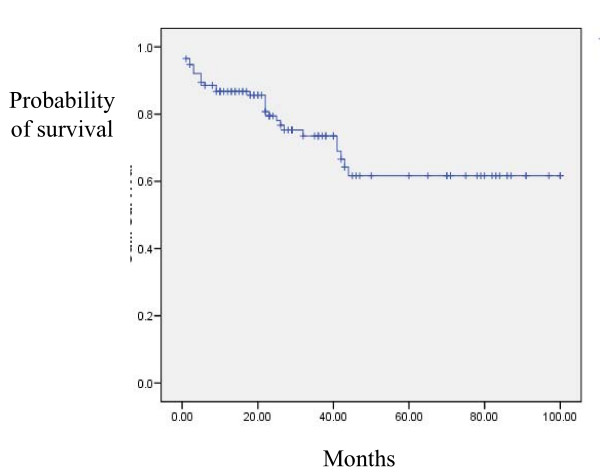
A total of 115 patients with BTS and various cardiac and respiratory co-morbidities with a mean age of 61 (range 40-88) were treated between January 2001 and January 2009. The underlining etiologies for BTS were post - endotracheal intubation (N = 76) post-tracheostomy (N = 30), Wegener's granulomatosis (N = 2), sarcoidosis (N = 2), amyloidosis (N = 2) and idiopathic BTS (N = 3). The modalities used were: balloon dilatation and laser treatment (N = 98). Stent was placed in 33 patients of whom 28 also underwent brachytherapy. Complications were minor and mostly included granulation tissue formation. The overall success rate was 87%. Over a median follow-up of 51 months (range 10-100 months), 30 patients (26%) died, mostly due to exacerbation of their underlying conditions.
BTS in elderly patients with co-morbidities can be safely and effectively treated by flexible bronchoscopic treatment modalities. The use of HDR brachytherapy to treat granulation tissue formation following successful airway restoration is promising.
良性气管狭窄(BTS)的治疗方法因疾病类型和程度而异,并受患者年龄和总体健康状况的影响,因此我们试图研究接受微创支气管镜治疗的BTS患者的长期预后。
有症状的BTS患者接受了柔性支气管镜治疗方式,包括以下几种:球囊扩张、激光光切术、自膨式金属支架置入,以及在难治性支架相关肉芽组织形成的病例中使用高剂量率支气管内近距离放射治疗。
2001年1月至2009年1月期间,共治疗了115例患有各种心脏和呼吸系统合并症的BTS患者,平均年龄为61岁(范围40 - 88岁)。BTS的潜在病因包括气管插管后(N = 76)、气管切开术后(N = 30)、韦格纳肉芽肿(N = 2)、结节病(N = 2)、淀粉样变性(N = 2)和特发性BTS(N = 3)。使用的治疗方式包括:球囊扩张和激光治疗(N = 98)。33例患者置入了支架,其中28例还接受了近距离放射治疗。并发症轻微,主要包括肉芽组织形成。总体成功率为87%。在中位随访51个月(范围10 - 100个月)期间,30例患者(26%)死亡,主要是由于基础疾病加重。
合并症的老年患者的BTS可以通过柔性支气管镜治疗方式安全有效地治疗。在成功恢复气道后使用高剂量率近距离放射治疗肉芽组织形成前景良好。