Escuela Andaluza de Salud Pública, Granada, Spain.
BMC Public Health. 2010 Jan 20;10:26. doi: 10.1186/1471-2458-10-26.
Most mortality atlases show static maps from count data aggregated over time. This procedure has several methodological problems and serious limitations for decision making in Public Health. The evaluation of health outcomes, including mortality, should be approached from a dynamic time perspective that is specific for each gender and age group. At the moment, researches in Spain do not provide a dynamic image of the population's mortality status from a spatio-temporal point of view. The aim of this paper is to describe the spatial distribution of mortality from all causes in small areas of Andalusia (Southern Spain) and evolution over time from 1981 to 2006.
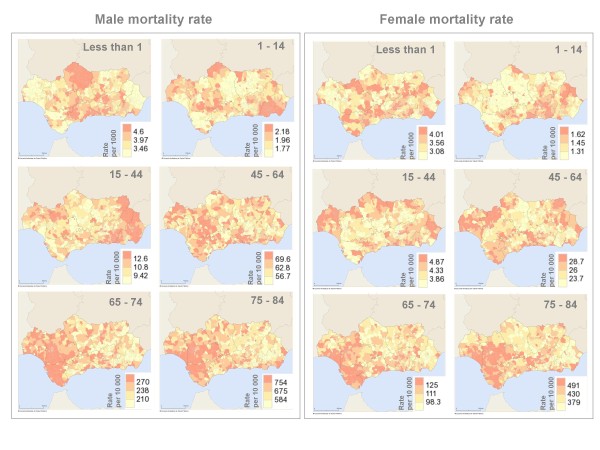
A small-area ecological study was devised using the municipality as the unit for analysis. Two spatio-temporal hierarchical Bayesian models were estimated for each age group and gender. One of these was used to estimate the specific mortality rate, together with its time trends, and the other to estimate the specific rate ratio for each municipality compared with Spain as a whole.
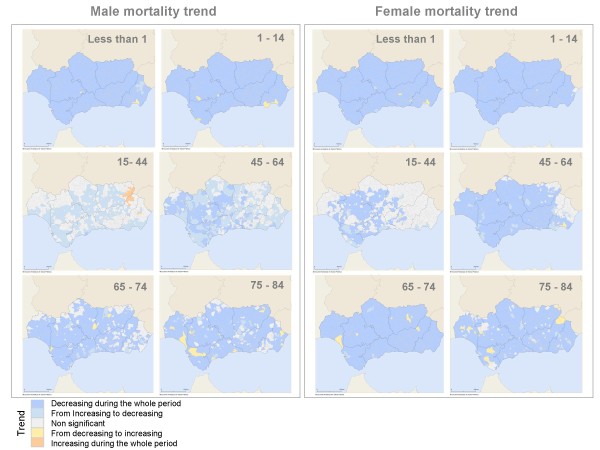
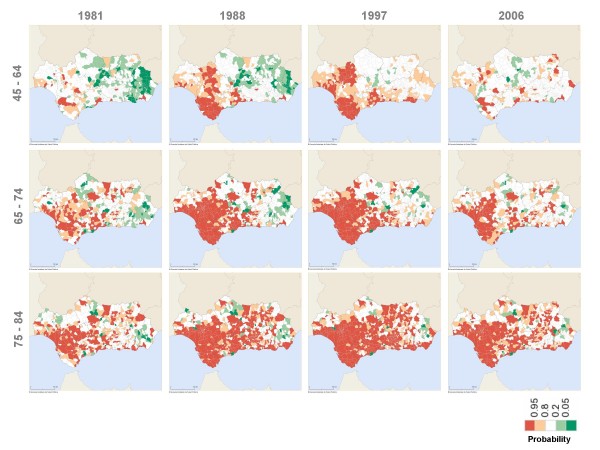
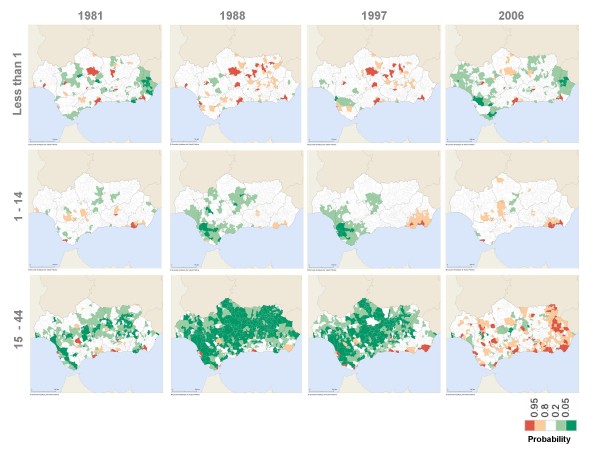
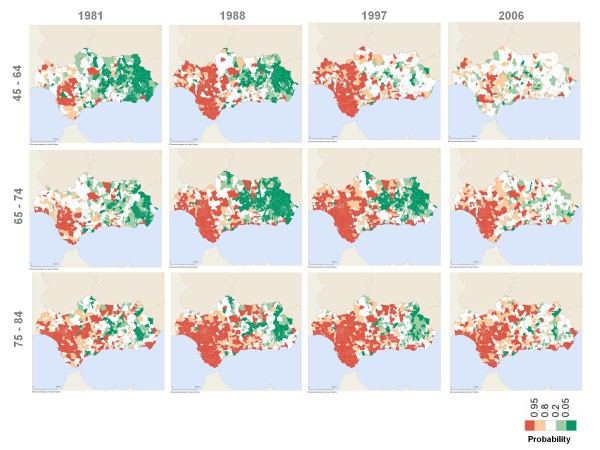
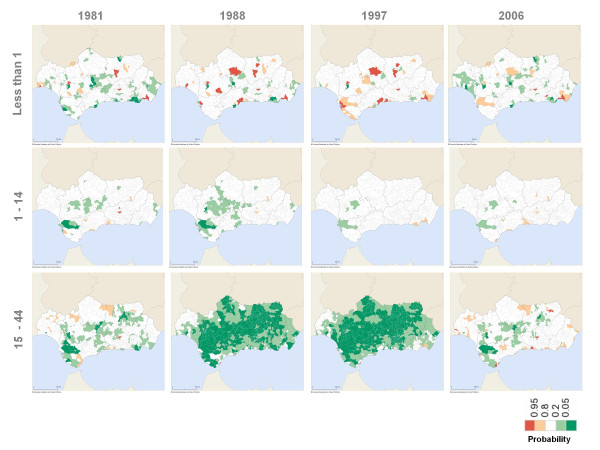
More than 97% of the municipalities showed a diminishing or flat mortality trend in all gender and age groups. In 2006, over 95% of municipalities showed male and female mortality specific rates similar or significantly lower than Spanish rates for all age groups below 65. Systematically, municipalities in Western Andalusia showed significant male and female mortality excess from 1981 to 2006 only in age groups over 65.
The study shows a dynamic geographical distribution of mortality, with a different pattern for each year, gender and age group. This information will contribute towards a reflection on the past, present and future of mortality in Andalusia.
大多数死亡率地图集显示的是时间上聚合的计数数据的静态地图。这种方法存在几个方法学问题,并且对公共卫生决策有严重的限制。健康结果的评估,包括死亡率,应该从特定于每个性别和年龄组的动态时间角度来考虑。目前,西班牙的研究没有从时空角度提供人口死亡率状况的动态图像。本文的目的是描述 1981 年至 2006 年期间安达卢西亚(西班牙南部)小地区所有原因死亡率的空间分布和随时间的演变。
采用以市为分析单位的小区域生态研究设计。为每个年龄组和性别估计了两个时空层次贝叶斯模型。其中之一用于估计特定死亡率及其时间趋势,另一个用于估计每个市与西班牙整体相比的特定比率。
超过 97%的市在所有性别和年龄组中显示出死亡率下降或持平的趋势。在 2006 年,超过 95%的市的男性和女性死亡率特定率与所有 65 岁以下年龄组的西班牙比率相似或明显较低。系统地说,1981 年至 2006 年期间,安达卢西亚西部的市只有在 65 岁以上的年龄组中显示出男性和女性死亡率明显偏高的情况。
该研究显示了死亡率的动态地理分布,每年、每个性别和年龄组的模式都不同。这些信息将有助于对安达卢西亚过去、现在和未来的死亡率进行反思。