Microbial Evolutionary Genomics, Institut Pasteur, CNRS, URA2171, Paris, France.
PLoS Genet. 2010 Jan 15;6(1):e1000808. doi: 10.1371/journal.pgen.1000808.
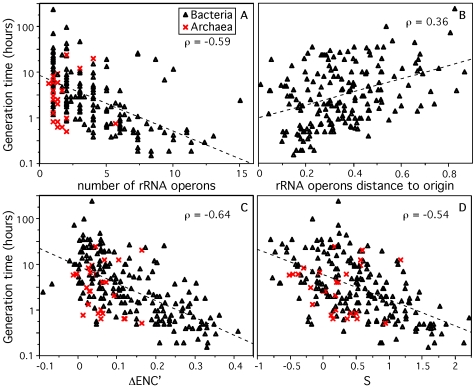
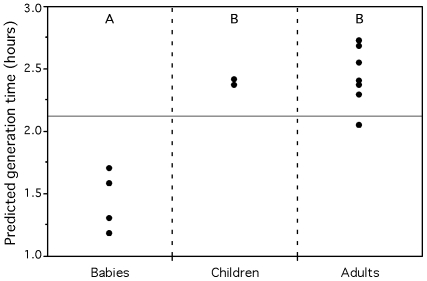
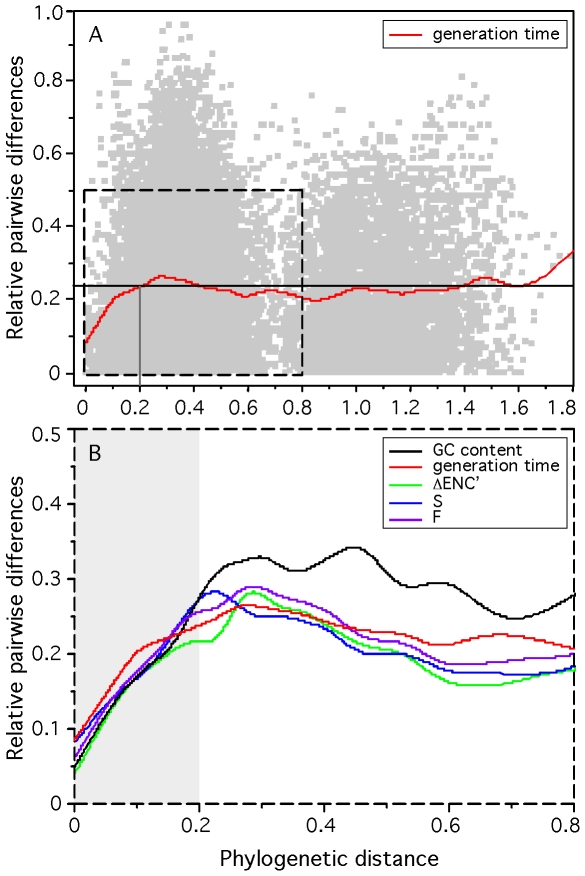
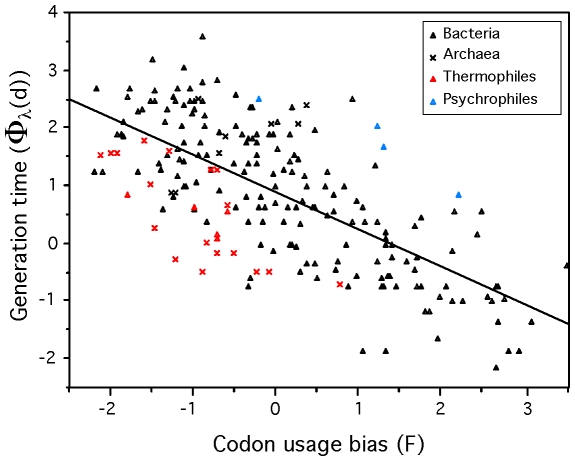
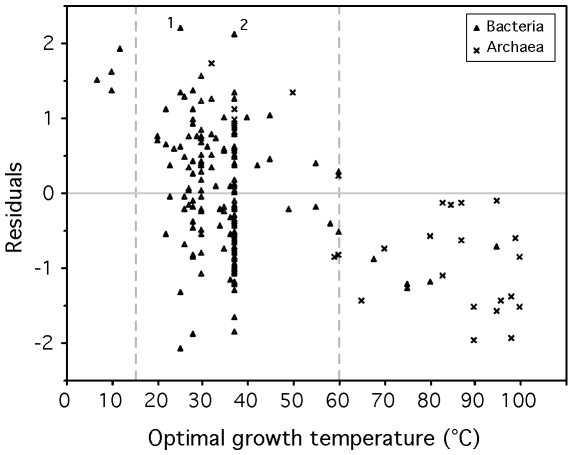
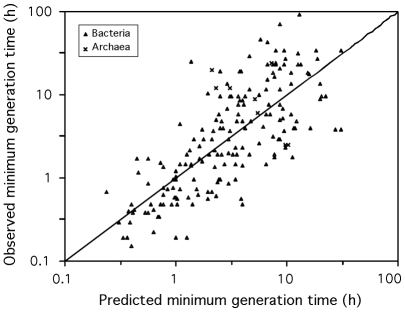
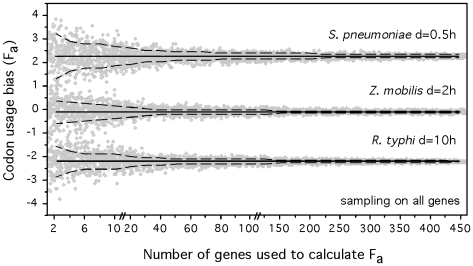
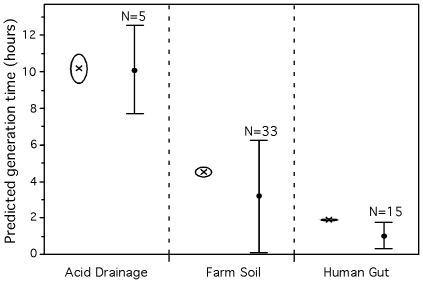
Microbial minimal generation times range from a few minutes to several weeks. They are evolutionarily determined by variables such as environment stability, nutrient availability, and community diversity. Selection for fast growth adaptively imprints genomes, resulting in gene amplification, adapted chromosomal organization, and biased codon usage. We found that these growth-related traits in 214 species of bacteria and archaea are highly correlated, suggesting they all result from growth optimization. While modeling their association with maximal growth rates in view of synthetic biology applications, we observed that codon usage biases are better correlates of growth rates than any other trait, including rRNA copy number. Systematic deviations to our model reveal two distinct evolutionary processes. First, genome organization shows more evolutionary inertia than growth rates. This results in over-representation of growth-related traits in fast degrading genomes. Second, selection for these traits depends on optimal growth temperature: for similar generation times purifying selection is stronger in psychrophiles, intermediate in mesophiles, and lower in thermophiles. Using this information, we created a predictor of maximal growth rate adapted to small genome fragments. We applied it to three metagenomic environmental samples to show that a transiently rich environment, as the human gut, selects for fast-growers, that a toxic environment, as the acid mine biofilm, selects for low growth rates, whereas a diverse environment, like the soil, shows all ranges of growth rates. We also demonstrate that microbial colonizers of babies gut grow faster than stabilized human adults gut communities. In conclusion, we show that one can predict maximal growth rates from sequence data alone, and we propose that such information can be used to facilitate the manipulation of generation times. Our predictor allows inferring growth rates in the vast majority of uncultivable prokaryotes and paves the way to the understanding of community dynamics from metagenomic data.
微生物的最小世代时间从几分钟到几周不等。它们是由环境稳定性、营养物质可用性和群落多样性等变量进化决定的。快速生长的选择适应性地印记基因组,导致基因扩增、适应的染色体组织和偏倚的密码子使用。我们发现,在 214 种细菌和古菌中,这些与生长相关的特征高度相关,这表明它们都是生长优化的结果。在考虑合成生物学应用的情况下,对它们与最大生长速率的关联进行建模时,我们观察到密码子使用偏倚比任何其他特征(包括 rRNA 拷贝数)更好地与生长速率相关。对我们模型的系统偏差揭示了两个不同的进化过程。首先,基因组组织比生长速率显示出更多的进化惰性。这导致在快速降解的基因组中,与生长相关的特征过度表达。其次,这些特征的选择取决于最佳生长温度:对于类似的世代时间,在嗜冷生物中纯化选择更强,在中温生物中中等,在嗜热生物中较弱。利用这些信息,我们创建了一个适用于小基因组片段的最大生长速率预测器。我们将其应用于三个宏基因组环境样本,以表明富含营养的瞬态环境,如人类肠道,选择快速生长的微生物,有毒环境,如酸性矿山生物膜,选择生长缓慢的微生物,而多样化的环境,如土壤,则显示出所有范围的生长速率。我们还证明了婴儿肠道的微生物定植者比稳定的人类成年人肠道群落生长得更快。总之,我们表明可以仅从序列数据预测最大生长速率,并且我们提出可以使用此类信息来促进世代时间的操纵。我们的预测器允许推断出绝大多数不可培养原核生物的生长速率,并为从宏基因组数据中理解群落动态铺平了道路。