Center for Biomedical Research, University of Texas Health Science Center, Tyler, Texas, United States of America.
PLoS One. 2010 Jan 18;5(1):e8756. doi: 10.1371/journal.pone.0008756.
Major histocompatibility complex (MHC) antigens are important for alloimmune responses as well as immune tolerance. Previous studies have shown that presentation of donor MHC antigens by donor-specific transfusion prior to or upon transplantation promotes transplant tolerance induced by other agents. However, it is unclear whether presentation of donor MHC antigens by DNA vaccination induces long-term allograft survival.
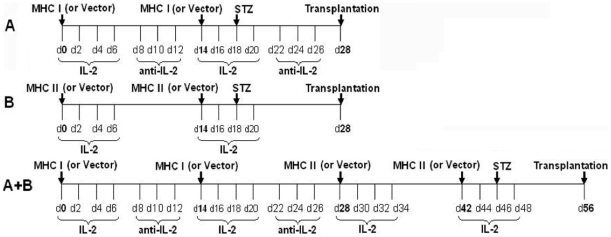
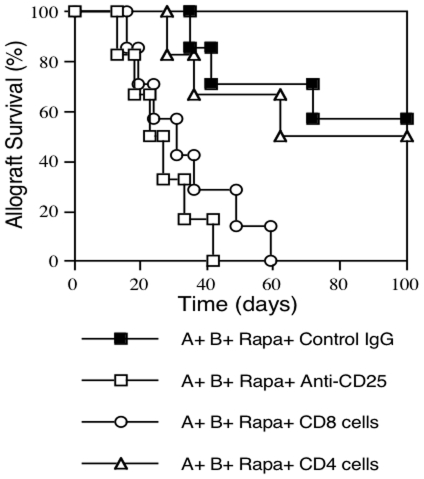
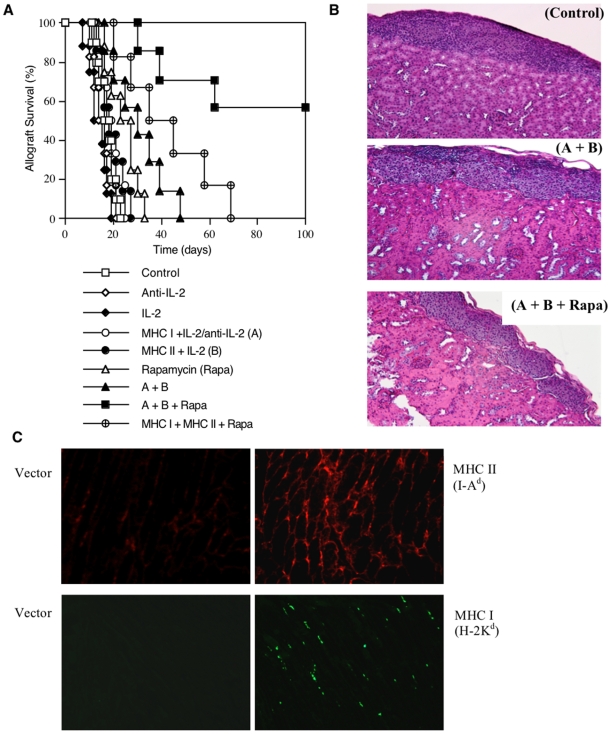
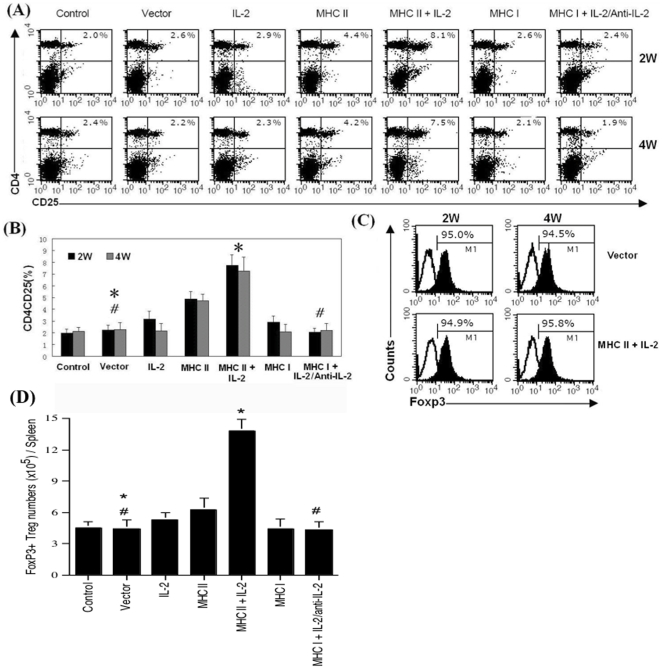
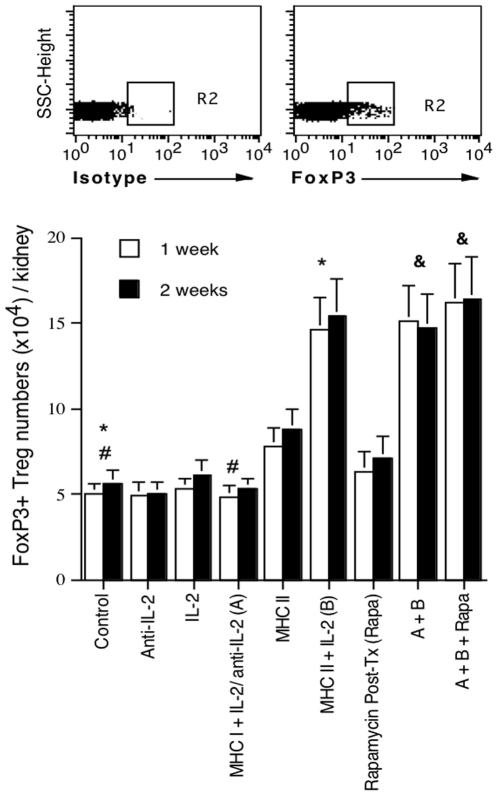
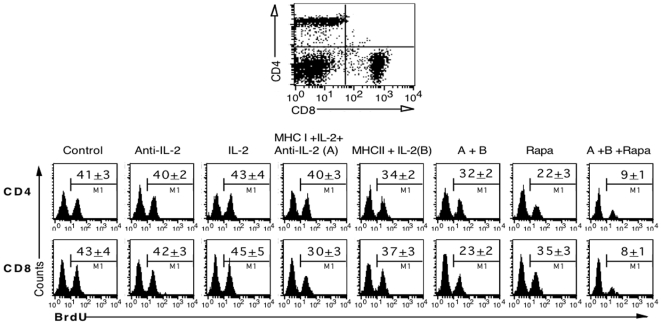
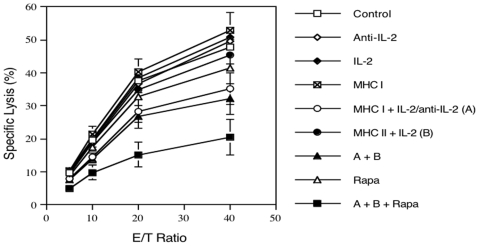
METHODOLOGY/PRINCIPAL FINDINGS: We investigated whether presentation of MHC class-II and/or class-I donor antigens by DNA vaccination suppresses alloimmune responses and promotes long-term allograft acceptance. We initially found that presentation of both MHC donor antigens by DNA vaccination itself prior to transplantation fails to significantly prolong islet allograft survival in otherwise untreated mice. However, islet allograft survival was significantly prolonged when MHC class-II DNA vaccination was accompanied with IL-2 administration (MHCII + IL-2) while MHC class-I DNA vaccination was followed by IL-2 and subsequent neutralizing anti-IL-2 treatments (MHCI + IL-2/anti-IL-2). Especially, this protocol promoted long-term allograft survival in the majority of recipients (57%) when combined with low doses of rapamycin post-transplantation. Importantly, MHCII + IL-2 induced FoxP3+ Treg cells in both spleens and grafts and suppressed graft-infiltrating CD4+ cell proliferation, whereas MHCI + IL-2/anti-IL-2 mainly inhibited graft-infiltrating CD8+ cell proliferation and donor-specific CTL activity. The combined protocol plus rapamycin treatment further reduced both CD4+ and CD8+ T cell proliferation as well as donor-specific CTL activity but spared FoxP3+ Treg cells. Depleting CD25+ Treg cells or adoptive transfer of pre-sensitized CD8+ T cells abolished this long-term allograft survival.
CONCLUSIONS/SIGNIFICANCE: Manipulating IL-2 availability during presentation of MHC class-II and class-I donor antigens by DNA vaccination pre-transplantation induces Treg cells, suppresses alloimmune responses and promotes long-term allograft survival.
主要组织相容性复合体(MHC)抗原对于同种免疫反应和免疫耐受都很重要。先前的研究表明,在移植前或移植时通过供体特异性输血递呈供体 MHC 抗原可促进其他药物诱导的移植耐受。然而,目前尚不清楚通过 DNA 疫苗接种递呈供体 MHC 抗原是否会诱导长期同种移植物存活。
方法/主要发现:我们研究了通过 DNA 疫苗接种递呈 MHC Ⅱ类和/或Ⅰ类供体抗原是否抑制同种免疫反应并促进长期同种移植物接受。我们最初发现,在未进行其他治疗的情况下,移植前 DNA 疫苗接种本身递呈 MHC 供体抗原并不能显著延长胰岛同种移植物的存活时间。然而,当 MHC Ⅱ类 DNA 疫苗接种伴随着白细胞介素-2(IL-2)的给予(MHCII + IL-2),而 MHC Ⅰ类 DNA 疫苗接种随后给予 IL-2 和随后的中和抗 IL-2 治疗(MHCI + IL-2/anti-IL-2)时,胰岛同种移植物的存活时间显著延长。特别是,当与移植后低剂量雷帕霉素联合使用时,该方案在大多数受者(57%)中促进了长期同种移植物的存活。重要的是,MHCII + IL-2 在脾脏和移植物中诱导了 FoxP3+Treg 细胞,并抑制了移植物浸润的 CD4+细胞增殖,而 MHCI + IL-2/anti-IL-2 主要抑制了移植物浸润的 CD8+细胞增殖和供体特异性 CTL 活性。联合方案加雷帕霉素治疗进一步减少了 CD4+和 CD8+T 细胞增殖以及供体特异性 CTL 活性,但保留了 FoxP3+Treg 细胞。耗尽 CD25+Treg 细胞或过继转移预先致敏的 CD8+T 细胞可消除这种长期同种移植物的存活。
结论/意义:在移植前通过 DNA 疫苗接种递呈 MHC Ⅱ类和Ⅰ类供体抗原时操纵 IL-2 的可用性可诱导 Treg 细胞,抑制同种免疫反应并促进长期同种移植物的存活。