
一种计算机辅助模型,用于预测终末期癌症患者入院后 7 天内死亡的概率。
A computer-assisted model for predicting probability of dying within 7 days of hospice admission in patients with terminal cancer.
机构信息
Department of Family Medicine, Tainan Municipal Hospital, Tainan 70173, Taiwan.
出版信息
Jpn J Clin Oncol. 2010 May;40(5):449-55. doi: 10.1093/jjco/hyp188. Epub 2010 Jan 22.
OBJECTIVE
The aim of the present study is to compare the accuracy in using laboratory data or clinical factors, or both, in predicting probability of dying within 7 days of hospice admission in terminal cancer patients.
METHODS
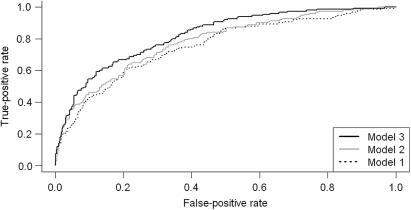
We conducted a prospective cohort study of 727 patients with terminal cancer. Three models for predicting the probability of dying within 7 days of hospice admission were developed: (i) demographic data and laboratory data (Model 1); (ii) demographic data and clinical symptoms (Model 2); and (iii) combination of demographic data, laboratory data and clinical symptoms (Model 3). We compared the models by using the area under the receiver operator curve using stepwise multiple logistic regression.
RESULTS
We estimated the probability dying within 7 days of hospice admission using the logistic function, P = Exp(betax)/[1 + Exp(betax)]. The highest prediction accuracy was observed in Model 3 (82.3%), followed by Model 2 (77.8%) and Model 1 (75.5%). The log[probability of dying within 7 days/(1 - probability of dying within 7 days)] = -6.52 + 0.77 x (male = 1, female = 0) + 0.59 x (cancer, liver = 1, others = 0) + 0.82 x (ECOG score) + 0.59 x (jaundice, yes = 1, no = 0) + 0.54 x (Grade 3 edema = 1, others = 0) + 0.95 x (fever, yes = 1, no = 0) + 0.07 x (respiratory rate, as per minute) + 0.01 x (heart rate, as per minute) - 0.92 x (intervention tube = 1, no = 0) - 0.37 x (mean muscle power).
CONCLUSIONS
We proposed a computer-assisted estimated probability formula for predicting dying within 7 days of hospice admission in terminal cancer patients.
目的
本研究旨在比较使用实验室数据或临床因素,或两者结合,预测临终癌症患者入院后 7 天内死亡概率的准确性。
方法
我们进行了一项前瞻性队列研究,共纳入 727 例临终癌症患者。建立了三种预测临终癌症患者入院后 7 天内死亡概率的模型:(i)人口统计学数据和实验室数据(模型 1);(ii)人口统计学数据和临床症状(模型 2);和(iii)人口统计学数据、实验室数据和临床症状的组合(模型 3)。我们使用逐步多逻辑回归比较了模型,使用接收者操作特征曲线下的面积。
结果
我们使用逻辑函数估计入院后 7 天内死亡的概率,P = Exp(betax)/[1 + Exp(betax)]。模型 3 的预测准确性最高(82.3%),其次是模型 2(77.8%)和模型 1(75.5%)。log[7 天内死亡的概率/(1-7 天内死亡的概率)]=-6.52+0.77x(男性=1,女性=0)+0.59x(癌症,肝脏=1,其他=0)+0.82x(ECOG 评分)+0.59x(黄疸,是=1,否=0)+0.54x(3 级水肿=1,其他=0)+0.95x(发热,是=1,否=0)+0.07x(呼吸频率,每分钟)+0.01x(心率,每分钟)-0.92x(干预管=1,否=0)-0.37x(平均肌肉力量)。
结论
我们提出了一种计算机辅助的预测临终癌症患者入院后 7 天内死亡概率的估计概率公式。
 Zotero 插件