Division of Infectious Diseases, Department of Medicine, University of British Columbia and Vancouver Coastal Health Research Institute, Vancouver, British Columbia, Canada.
PLoS One. 2010 Jan 19;5(1):e8769. doi: 10.1371/journal.pone.0008769.
Microorganisms capable of surviving within macrophages are rare, but represent very successful pathogens. One of them is Mycobacterium tuberculosis (Mtb) whose resistance to early mechanisms of macrophage killing and failure of its phagosomes to fuse with lysosomes causes tuberculosis (TB) disease in humans. Thus, defining the mechanisms of phagosome maturation arrest and identifying mycobacterial factors responsible for it are key to rational design of novel drugs for the treatment of TB. Previous studies have shown that Mtb and the related vaccine strain, M. bovis bacille Calmette-Guérin (BCG), disrupt the normal function of host Rab5 and Rab7, two small GTPases that are instrumental in the control of phagosome fusion with early endosomes and late endosomes/lysosomes respectively.
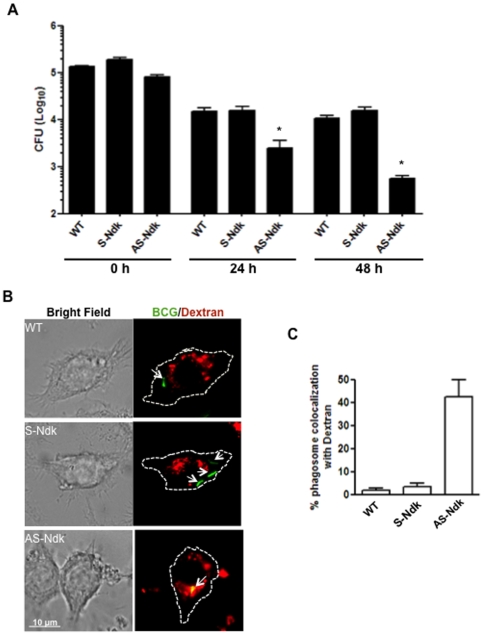
METHODOLOGY/PRINCIPAL FINDINGS: Here we show that recombinant Mtb nucleoside diphosphate kinase (Ndk) exhibits GTPase activating protein (GAP) activity towards Rab5 and Rab7. Then, using a model of latex bead phagosomes, we demonstrated that Ndk inhibits phagosome maturation and fusion with lysosomes in murine RAW 264.7 macrophages. Maturation arrest of phagosomes containing Ndk-beads was associated with the inactivation of both Rab5 and Rab7 as evidenced by the lack of recruitment of their respective effectors EEA1 (early endosome antigen 1) and RILP (Rab7-interacting lysosomal protein). Consistent with these findings, macrophage infection with an Ndk knocked-down BCG strain resulted in increased fusion of its phagosome with lysosomes along with decreased survival of the mutant.
Our findings provide evidence in support of the hypothesis that mycobacterial Ndk is a putative virulence factor that inhibits phagosome maturation and promotes survival of mycobacteria within the macrophage.
能够在巨噬细胞内存活的微生物很少,但它们却是非常成功的病原体。其中之一是结核分枝杆菌(Mtb),它能够抵抗巨噬细胞早期的杀伤机制,并且其吞噬体无法与溶酶体融合,这导致了人类结核病(TB)的发生。因此,确定吞噬体成熟阻滞的机制,并确定负责这一机制的分枝杆菌因子,是合理设计治疗结核病的新型药物的关键。以前的研究表明,Mtb 和相关的疫苗株牛分枝杆菌卡介苗(BCG),破坏了宿主 Rab5 和 Rab7 的正常功能,这两种小分子 GTPase 分别在控制吞噬体与早期内体和晚期内体/溶酶体融合中起着重要作用。
方法/主要发现:在这里,我们展示了重组 Mtb 核苷二磷酸激酶(Ndk)对 Rab5 和 Rab7 具有 GTPase 激活蛋白(GAP)活性。然后,我们使用乳胶珠吞噬体模型,证明了 Ndk 抑制了鼠 RAW 264.7 巨噬细胞中吞噬体的成熟和与溶酶体的融合。含有 Ndk-珠的吞噬体成熟阻滞与 Rab5 和 Rab7 的失活有关,这表现在它们各自的效应物 EEA1(早期内体抗原 1)和 RILP(Rab7 相互作用的溶酶体蛋白)的募集缺失。与这些发现一致的是,感染 Ndk 敲低的 BCG 菌株的巨噬细胞,其吞噬体与溶酶体融合增加,同时突变体的存活率降低。
我们的研究结果为以下假设提供了证据支持,即分枝杆菌 Ndk 是一种潜在的毒力因子,它抑制吞噬体的成熟,并促进分枝杆菌在巨噬细胞内的存活。