Lewis Sigler Institute of Integrative Genomics, Princeton University, Princeton, NJ 08544, USA.
BMC Genet. 2010 Jan 27;11:7. doi: 10.1186/1471-2156-11-7.
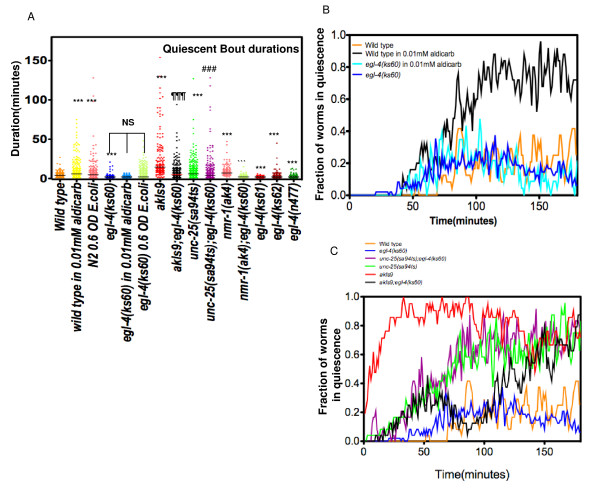
Most rhythmic motor behaviors in nature are episodic i.e. they alternate between different behavioral states, including quiescence. Electrophysiological studies in invertebrate behavioral switching, maintenance and quiescence have elucidated several neuronal mechanisms that generate a temporal pattern in behavior. However, the genetic bases of these processes are less well studied. We have previously uncovered a novel episodic behavior exhibited by C. elegans in liquid media where they alternate between distinct phases of rhythmic swimming and quiescence. Here, we have investigated the effect of several genes and their site of action on the behavioral quiescence exhibited in liquid by the nematode C. elegans.
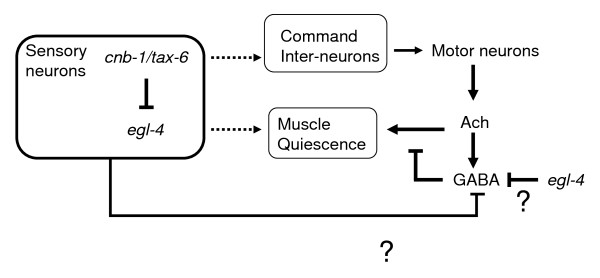
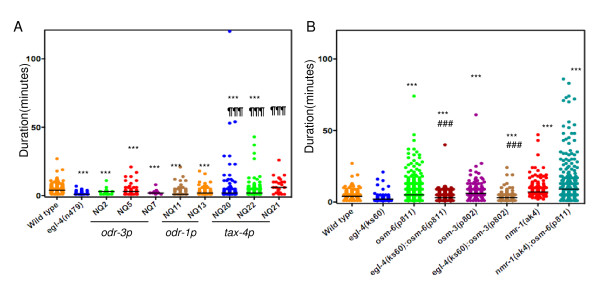
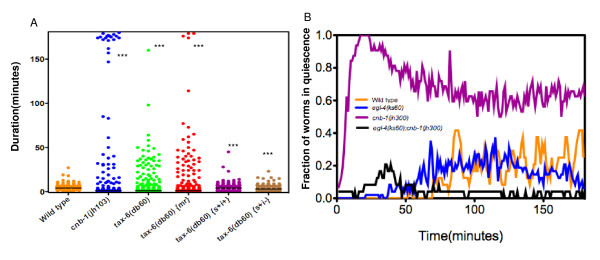
We have previously reported that high cholinergic signaling promotes quiescence and command interneurons are critical for timing the quiescence bout durations. We have found that in addition to command interneurons, sensory neurons are also critical for quiescence. We show that the protein phosphatase calcineurin homolog tax-6 promotes swimming whereas the protein kinase G homolog egl-4 promotes quiescence. tax-6 expression in the sensory neurons is sufficient to account for its effect. egl-4 also acts in multiple sensory neurons to mediate its effect on quiescence. In addition our data is consistent with regulation of quiescence by egl-4 acting functionally downstream of release of acetylcholine (ACh) by motor neurons.
Our study provides genetic evidence for mechanisms underlying the maintenance of a behavioral state operating at multiple neuronal levels through the activities of a kinase and a phosphatase. These results in a genetically tractable organism establish a framework for further dissection of the mechanism of quiescence during episodic behaviors.
自然界中大多数有节奏的运动行为都是间歇性的,即它们在不同的行为状态之间交替,包括静止状态。在无脊椎动物行为转换、维持和静止的电生理研究中,已经阐明了几个产生行为时间模式的神经元机制。然而,这些过程的遗传基础研究得较少。我们之前发现了秀丽隐杆线虫在液体介质中表现出的一种新的间歇性行为,它们在有节奏的游动和静止之间交替。在这里,我们研究了几个基因及其作用位点对线虫 C. elegans 在液体中表现出的行为静止的影响。
我们之前报道过高胆碱能信号促进静止,并且命令中间神经元对于定时静止爆发持续时间至关重要。我们发现,除了命令中间神经元外,感觉神经元对于静止也是至关重要的。我们表明,蛋白磷酸酶钙调神经磷酸酶同源物 tax-6 促进游泳,而蛋白激酶 G 同源物 egl-4 促进静止。感觉神经元中的 tax-6 表达足以解释其作用。egl-4 还作用于多个感觉神经元来介导其对静止的影响。此外,我们的数据与 egl-4 通过运动神经元释放乙酰胆碱 (ACh) 后发挥作用来调节静止的观点一致。
我们的研究提供了遗传证据,证明了在多个神经元水平上维持行为状态的机制,这些机制通过激酶和磷酸酶的活动来运作。这些在遗传上易于处理的生物体中的结果为进一步剖析间歇性行为期间的静止机制建立了框架。