Department of Urology, Section of Female Urology and Neurourology; Assiut University Hospital, Assiut University, Assiut, Egypt.
BMC Womens Health. 2010 Jan 27;10:3. doi: 10.1186/1472-6874-10-3.
Existing questionnaires to assess barriers against consultation for urinary incontinence (UI) are not appropriate for use in the Middle East culture. The aim of this study was to explore barriers against seeking help for UI and introducing a questionnaire that assess these barriers among those women. This is important before proceeding to any educational programs or having interval clinical audits to help incontinent women.
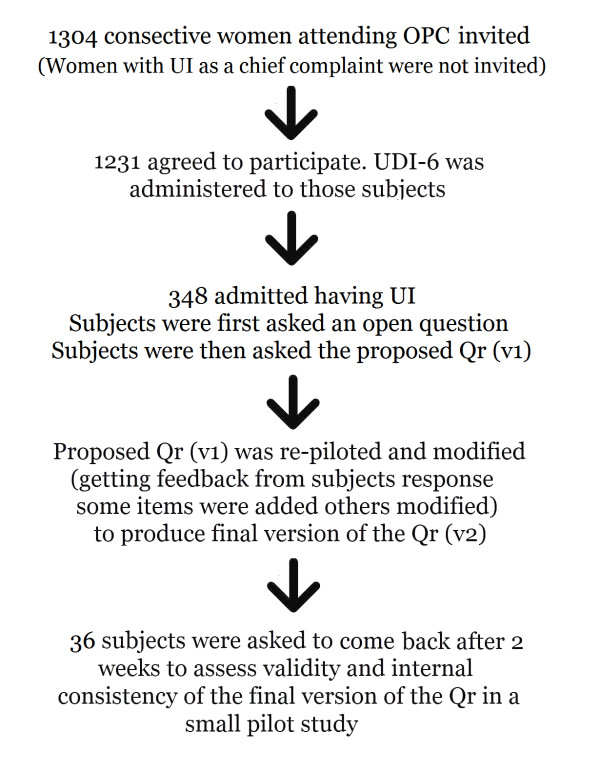
1- Screening for UI. Women - aged 20 years and older, attending the outpatient Urology and Gynaecology clinics were invited to participate and interviewed by a research nurse. The UDI-6 was administered to assess the presence and type of UI. Women with UI as their chief complaint were excluded. 2- Interviewing study subjects for possible barriers. Subjects who had UI - as determined by the UDI-6-were first asked an open question "what prevented you from seeking medical consultation for urine leakage?"." They were then asked the proposed questions to assess possible barriers. We developed a preliminary questionnaire based on a review of reasons for not seeking incontinence care from the literature and the response of UI sufferers to the open question in this study. The questionnaire was modified many times to reach this final form. 3- Pilot Study to assess characteristics of the questionnaire. Validity and reliability of the final version of the questionnaire were assessed in a small pilot study including 36 women who completed questionnaire at initial visit and again after 2 weeks.
Of the 1231 subjects who agreed to participate in the study, 348 reported having UI. About 80% of incontinent women have never sought medical advice. Factors significantly associated with seeking help were husband encouragement, prayer affection and having severe UI. Common barriers were embarrassment and assuming UI as a normal part of aging. A pilot study included 36 women to assess the psychometric properties of the questionnaire after modifying it. The number of missing or not interpretable responses per item ranged from 2.2% to 8.7%. Internal consistency of the items was good. The test-retest reliability of individual items of the questionnaire was variable, with weighted kappa statistics ranging from 0.32 to 0.94 (median, 0.76, p 0.000).
Preliminary data on our proposed questionnaire show that it is an easy to administer, stable and suits the Middle Eastern culture.
现有的评估尿失禁(UI)咨询障碍的问卷不适用于中东文化。本研究旨在探讨寻求 UI 帮助的障碍,并引入一种评估这些障碍的问卷。这对于任何教育计划或进行间隔临床审核以帮助失禁女性之前都很重要。
1- UI 筛查。邀请年龄在 20 岁及以上、在门诊泌尿科和妇科诊所就诊的女性参与并由研究护士进行访谈。采用 UDI-6 评估 UI 的存在和类型。因 UI 为主诉的女性被排除在外。2- 对研究对象进行可能障碍的访谈。根据 UDI-6 确定有 UI 的女性首先被问到一个开放式问题:“是什么阻止你因尿液渗漏而寻求医疗咨询?”。然后询问他们评估可能障碍的建议问题。我们根据文献中未寻求失禁护理的原因和本研究中 UI 患者对开放式问题的反应,制定了一个初步问卷。该问卷经过多次修改,最终形成了目前的形式。3- 初步研究评估问卷的特征。在一项包括 36 名女性的小型初步研究中评估了问卷的最终版本的有效性和可靠性。这些女性在初次就诊时完成问卷,两周后再次完成。
在同意参与研究的 1231 名受试者中,348 名报告有 UI。约 80%的失禁女性从未寻求过医疗建议。与寻求帮助相关的因素有丈夫鼓励、祈祷关爱和严重的 UI。常见的障碍是尴尬和认为 UI 是衰老的正常表现。在对问卷进行修改后,一项包括 36 名女性的初步研究评估了其心理计量学特性。每个项目缺失或无法解释的回答数量范围为 2.2%至 8.7%。项目的内部一致性良好。问卷个别项目的测试重测信度各不相同,加权 kapp 统计值范围为 0.32 至 0.94(中位数为 0.76,p<0.000)。
我们提出的问卷的初步数据表明,它易于管理,稳定且适合中东文化。