Ludwig-Maximilians University Munich, Department of Obstetrics/Gynaecology, Molecular Biology Laboratory, Munich, Germany.
Mol Cancer. 2010 Jan 27;9:19. doi: 10.1186/1476-4598-9-19.
Nelfinavir is an HIV protease inhibitor that has been used for a long period of time to treat HIV-infected individuals. It has recently emerged that nelfinavir could represent a prospective new anti-cancer drug, prompting us to test the effect of nelfinavir on leukemia cells.
By combining in vitro and ex vivo studies, the effect of nelfinavir on leukemia cells and non-malignant, bone marrow-derived tissue cells was analyzed.
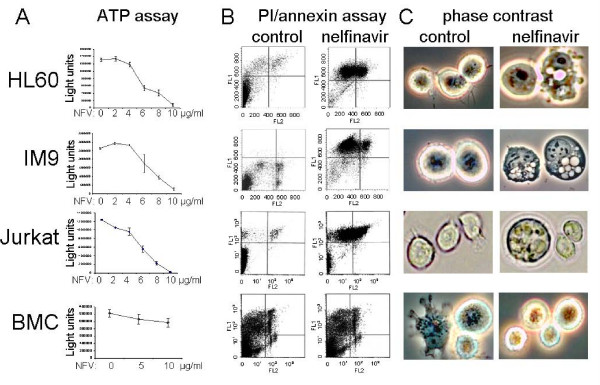
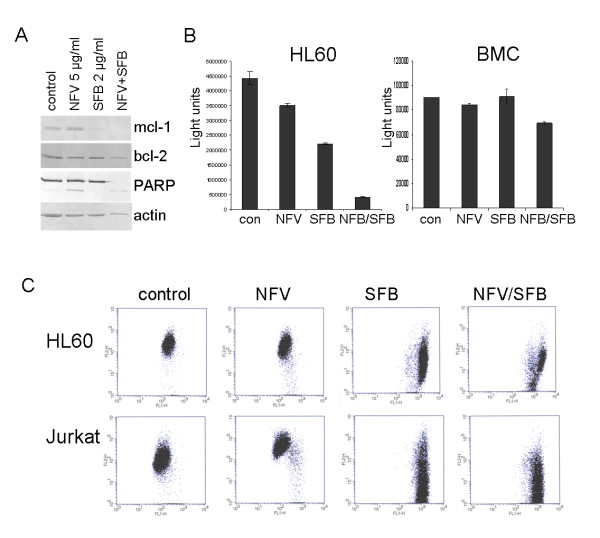
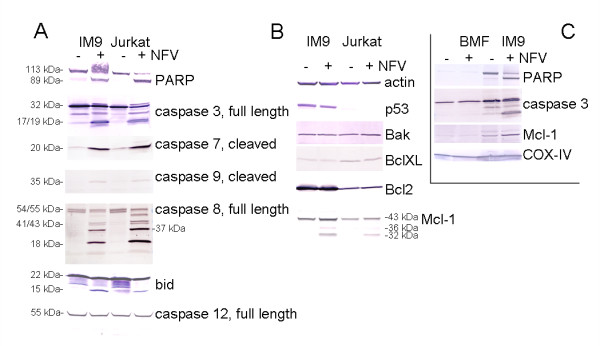
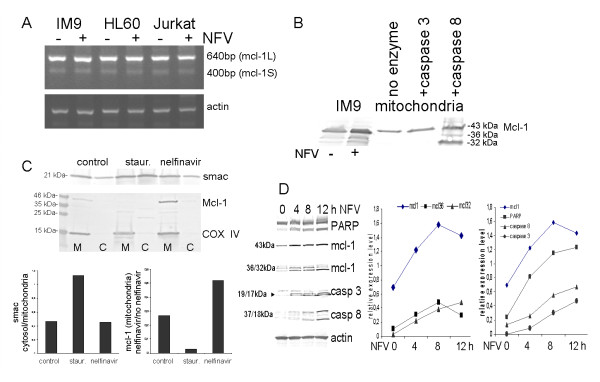
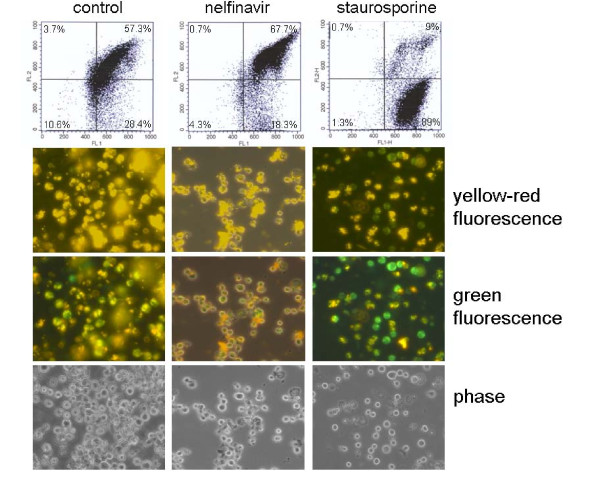
At a concentration of 9 microg/ml, nelfinavir induced death of 90% of HL60, IM9, and Jurkat cells. At the same concentration and treatment conditions, less than 10% of aspirated human bone marrow cells showed nelfinavir-induced cell damage. Nelfinavir-induced death of leukemia cells was accompanied by activation of caspases 3, 7, and 8. Despite caspase activation, the upregulation of the anti-apoptotic bcl-2 family member protein mcl-1 that resulted from nelfinavir treatment stabilized the mitochondrial membrane potential, resulting in primarily mitochondria-independent cell death. Pharmacological downregulation of mcl-1 expression by treatment with sorafenib (2 microg/ml) significantly enhanced nelfinavir-induced apoptosis even at lower nelfinavir concentrations (5 microg/ml), but did not have additional detrimental effects on non-malignant bone marrow cells.
The ability of nelfinavir to induce apoptosis in leukemia cells as a single agent in a mitochondria-independent manner might suggest it could be used as a second or third line of treatment for leukemia patients for whom standard mitochondria-directed treatment strategies have failed. Combination treatment with nelfinavir and sorafenib might further enhance the efficacy of nelfinavir even on chemo-resistant leukemia cells.
奈非那韦是一种 HIV 蛋白酶抑制剂,长期以来一直用于治疗 HIV 感染个体。最近发现奈非那韦可能代表一种有前途的新型抗癌药物,促使我们测试奈非那韦对白血病细胞的影响。
通过结合体外和体内研究,分析了奈非那韦对白血病细胞和非恶性、骨髓来源组织细胞的作用。
在 9μg/ml 的浓度下,奈非那韦诱导 HL60、IM9 和 Jurkat 细胞死亡 90%。在相同的浓度和处理条件下,不到 10%的抽吸人骨髓细胞显示奈非那韦诱导的细胞损伤。奈非那韦诱导的白血病细胞死亡伴随着半胱天冬酶 3、7 和 8 的激活。尽管半胱天冬酶激活,但奈非那韦治疗导致抗凋亡 bcl-2 家族成员蛋白 mcl-1 的上调稳定了线粒体膜电位,导致主要是线粒体非依赖性细胞死亡。用索拉非尼(2μg/ml)处理以药理学下调 mcl-1 表达显著增强奈非那韦诱导的凋亡,即使在较低的奈非那韦浓度(5μg/ml)下也是如此,但对非恶性骨髓细胞没有额外的有害影响。
奈非那韦作为一种单一药物以非线粒体依赖性方式诱导白血病细胞凋亡的能力表明,它可被用作标准线粒体靶向治疗策略失败的白血病患者的二线或三线治疗药物。奈非那韦与索拉非尼联合治疗甚至可能增强耐化疗白血病细胞中奈非那韦的疗效。