Université Paris Sud 11, CNRS, UMR 8621, Institut de Génétique et Microbiologie, Orsay 91405, France.
BMC Microbiol. 2010 Jan 27;10:24. doi: 10.1186/1471-2180-10-24.
Staphylococcus aureus infection in patients with cystic fibrosis (CF) is frequent and may be due to colonization by a few pathogenic lineages. Systematic genotyping of all isolates, methicillin-susceptible S. aureus (MSSA) as well as methicillin-resistant S. aureus (MRSA) is necessary to identify such lineages and follow their evolution in patients. Multiple-locus variable-number tandem repeat analysis (MLVA/VNTR) was used to survey S. aureus clinical isolates in a French paediatric CF centre.
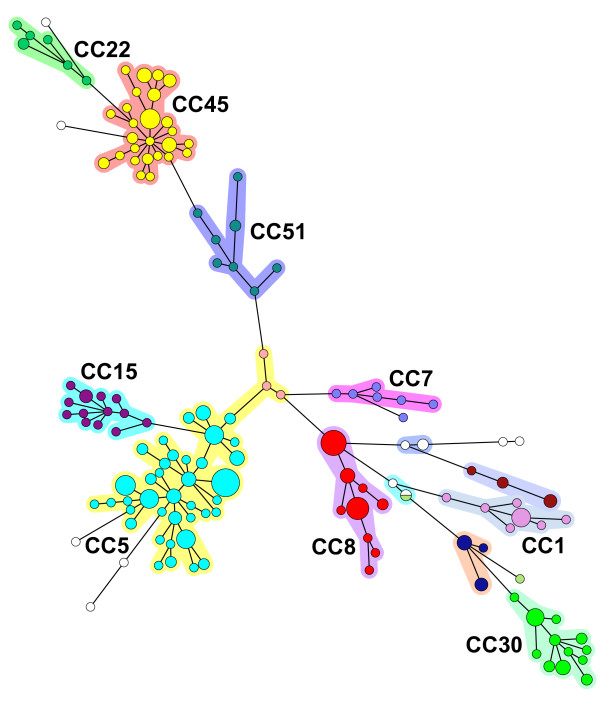
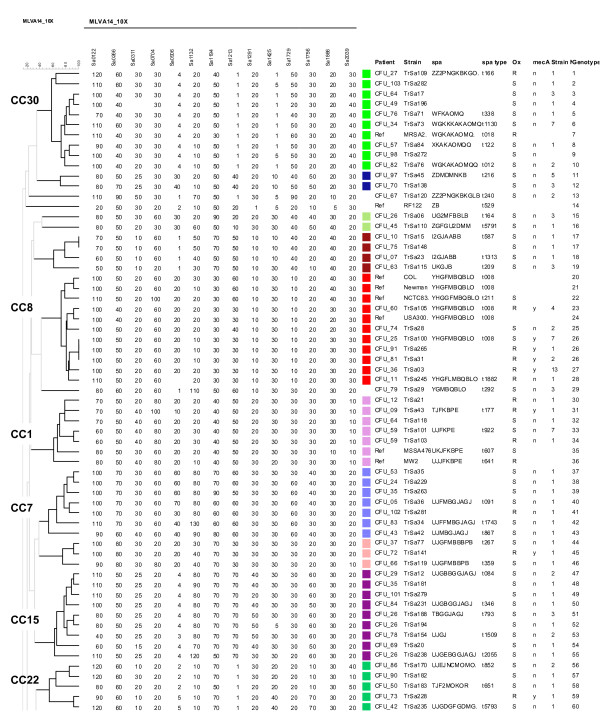
During a 30 months period, 108 patients, aged 2 to 21 years, regularly followed up at the centre, provided sputum for culture. From 79 patients, a total of 278 isolates were genotyped by MLVA, resolving into 110 genotypes and 19 clonal complexes (CC) composed of similar or closely related isolates. 71% of the strains were distributed into four main CCs, in term of number of isolates and number of genotypes. Spa (Staphylococcus protein A) typing was performed on representative samples, showing an excellent concordance with MLVA. In 17 patients, strains from two to four different CCs were recovered over time. On six occasions, S. aureus isolates with the same genotype were shared by 2 different patients and they belonged to one of the four main clusters. Methicillin-resistance was observed in 60% of the isolates, 90% of which belonged to the main clonal complexes CC8, CC45 and CC5. In 5 patients, methicillin-resistance of S. aureus isolates was not associated with the mecA gene: for four patients, it was due to overproduction of beta-lactamase, leading to BOR-SA (borderline S. aureus) isolates, while a strain showing probably a new modified penicillin-binding capacity (MOD-SA) was observed from one patient.
Systematic genotyping of S. aureus isolates recovered from sputum of CF children allows a thorough analysis of the strains responsible for sporadic as well as chronic colonization and the follow up of their evolution over time. We show here that more than 70% of these strains belong to 4 major CCs. MSSA as well as MRSA, BOR-SA and MOD-SA isolates can persist over several years, despite antibiotic treatments.
金黄色葡萄球菌感染囊性纤维化(CF)患者较为常见,可能是由于少数致病谱系的定植所致。对所有分离株(包括耐甲氧西林金黄色葡萄球菌[MSSA]和耐甲氧西林金黄色葡萄球菌[MRSA])进行系统基因分型对于鉴定这些谱系以及在患者中监测其进化非常必要。多位点可变数目串联重复分析(MLVA/VNTR)被用于调查法国儿科 CF 中心的金黄色葡萄球菌临床分离株。
在 30 个月的时间里,对中心定期随访的 108 名 2 至 21 岁的患者进行了痰液培养。从 79 名患者中,共对 278 株分离株进行了 MLVA 基因分型,分为 110 种基因型和 19 个克隆复合物(CC),这些分离株由相似或密切相关的菌株组成。71%的菌株分布在四个主要的 CC 中,从菌株数量和基因型数量来看。对代表性样本进行了 Spa(葡萄球菌蛋白 A)分型,结果与 MLVA 具有极好的一致性。在 17 名患者中,随着时间的推移,从两个到四个不同的 CC 中回收了菌株。有 6 次,来自两个不同患者的相同基因型的金黄色葡萄球菌分离株被共享,它们属于四个主要簇之一。60%的分离株表现出耐甲氧西林,其中 90%属于主要克隆复合物 CC8、CC45 和 CC5。在 5 名患者中,金黄色葡萄球菌分离株的耐甲氧西林与 mecA 基因无关:4 名患者的耐甲氧西林是由于β-内酰胺酶过度产生引起的,导致 BOR-SA(边界金黄色葡萄球菌)分离株,而从 1 名患者中观察到一株可能具有新的修饰青霉素结合能力(MOD-SA)的菌株。
对从 CF 儿童痰液中分离的金黄色葡萄球菌进行系统基因分型可以全面分析导致散发性和慢性定植的菌株,并监测其随时间的演变。我们在这里表明,这些菌株中超过 70%属于 4 个主要 CC。MSSA 以及 MRSA、BOR-SA 和 MOD-SA 分离株可以在抗生素治疗的情况下持续多年存在。