Department of Pharmacology, University of Washington, Seattle, WA 98195-7280, USA.
Mol Pain. 2010 Jan 29;6:8. doi: 10.1186/1744-8069-6-8.
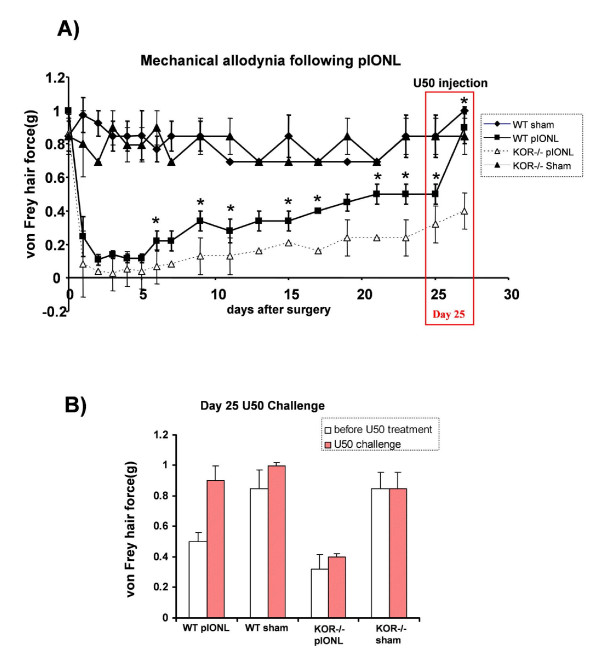
The dynorphin-kappa opioid receptor (KOR) system regulates glial proliferation after sciatic nerve injury. Here, we investigated its role in cell proliferation following partial ligation of infraorbital nerve (pIONL), a model for trigeminal neuropathic pain. Mechanical allodynia was enhanced in KOR gene deleted mice (KOR-/-) compared to wild type mice. Using bromodeoxyuridine (BrdU) as a mitotic marker, we assessed cell proliferation in three different areas of the trigeminal afferent pathway: trigeminal nucleus principalis (Vp), trigeminal root entry zone (TREZ), and trigeminal ganglion (TG).
In KOR-/- mice or norBNI-treated mice, the number of proliferating cells in the Vp was significantly less than in WT mice, whereas cell proliferation was enhanced in TREZ and TG. The majority of the proliferating cells were nestin positive stem cells or CD11b positive microglia in the Vp and macrophages in the TG. GFAP-positive astrocytes made a clear borderline between the CNS and the PNS in TREZ, and phosphorylated KOR staining (KOR-p) was detectable only in the astrocytes in CNS in WT mice but not in KOR-/- or norBNI-treated mice.
These results show that kappa opioid receptor system has different effects after pIONL in CNS and PNS: KOR activation promotes CNS astrocytosis and microglial or stem cell proliferation but inhibits macrophage proliferation in PNS. The trigeminal central root has a key role in the etiology and treatment of trigeminal neuralgia, and these newly identified responses may provide new targets for developing pain therapies.
强啡肽-κ 阿片受体(KOR)系统调节坐骨神经损伤后的神经胶质细胞增殖。在此,我们研究了它在眶下神经部分结扎(pIONL)后细胞增殖中的作用,pIONL 是一种三叉神经病理性疼痛模型。与野生型小鼠相比,KOR 基因缺失小鼠(KOR-/-)的机械性痛觉过敏增强。使用溴脱氧尿苷(BrdU)作为有丝分裂标志物,我们评估了三叉神经传入通路三个不同区域的细胞增殖:三叉神经主核(Vp)、三叉神经根入口区(TREZ)和三叉神经节(TG)。
在 KOR-/- 小鼠或 norBNI 处理的小鼠中,Vp 中增殖细胞的数量明显少于 WT 小鼠,而 TREZ 和 TG 中的细胞增殖增强。增殖细胞的大多数是 Vp 中的巢蛋白阳性干细胞或 CD11b 阳性小胶质细胞和 TG 中的巨噬细胞。GFAP 阳性星形胶质细胞在 TREZ 中形成 CNS 和 PNS 之间的明确边界,WT 小鼠的 CNS 中可检测到磷酸化 KOR 染色(KOR-p),而 KOR-/- 或 norBNI 处理的小鼠中则不可检测。
这些结果表明,κ 阿片受体系统在 pIONL 后对 CNS 和 PNS 有不同的作用:KOR 激活促进 CNS 星形胶质细胞和小胶质细胞或干细胞增殖,但抑制 PNS 中的巨噬细胞增殖。三叉神经中枢根在三叉神经痛的病因和治疗中具有关键作用,这些新发现的反应可能为开发疼痛治疗提供新的靶点。