McNally Randall, Bowman Gregory D, Goedken Eric R, O'Donnell Mike, Kuriyan John
Department of Molecular and Cell Biology, Department of Chemistry, California Institute for Quantitative Biosciences (QB3), Howard Hughes Medical Institute, University of California, Berkeley, Berkeley, CA 94720, USA.
BMC Struct Biol. 2010 Jan 30;10:3. doi: 10.1186/1472-6807-10-3.
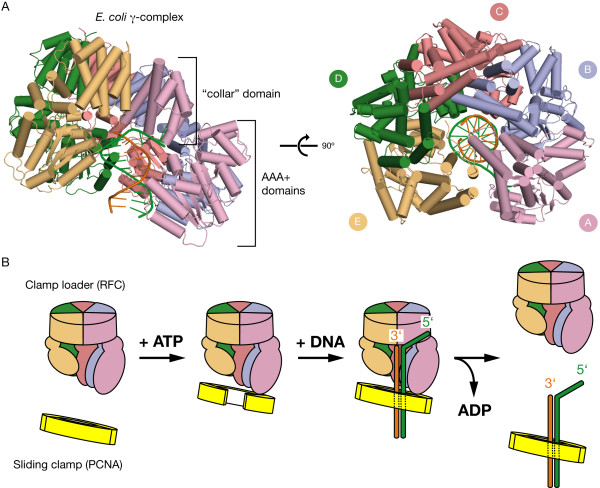
Sliding clamps, such as Proliferating Cell Nuclear Antigen (PCNA) in eukaryotes, are ring-shaped protein complexes that encircle DNA and enable highly processive DNA replication by serving as docking sites for DNA polymerases. In an ATP-dependent reaction, clamp loader complexes, such as the Replication Factor-C (RFC) complex in eukaryotes, open the clamp and load it around primer-template DNA.
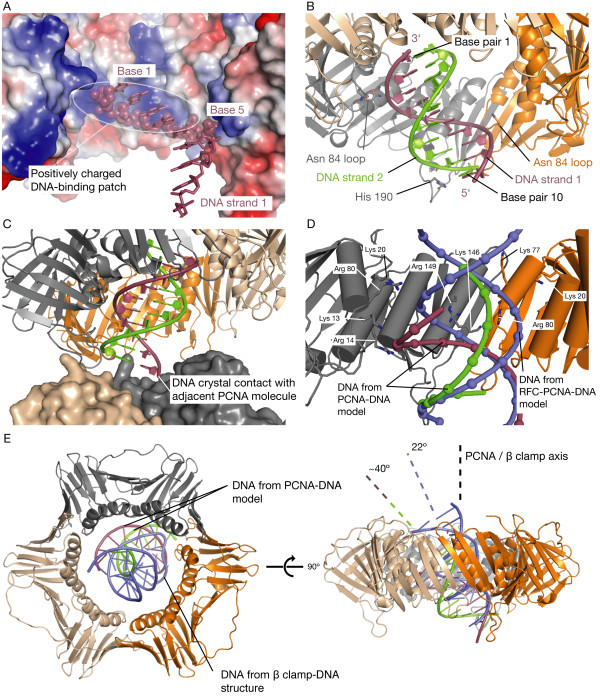
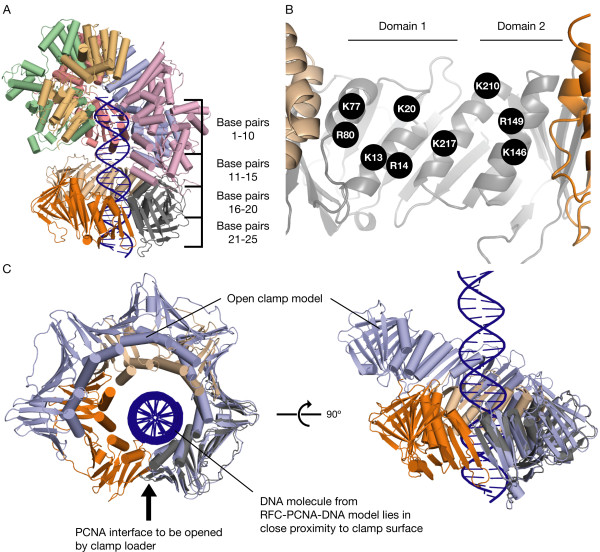
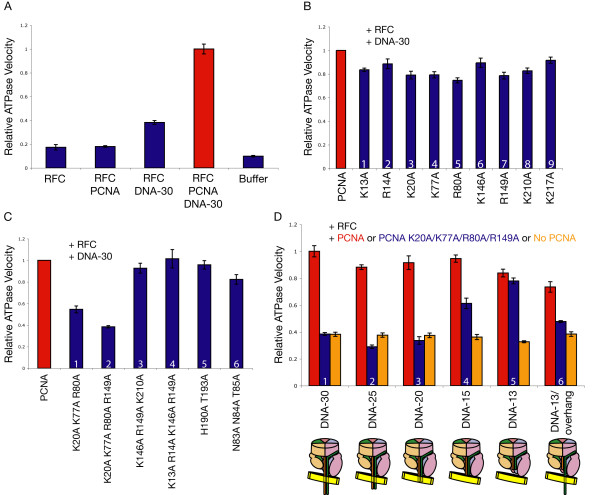
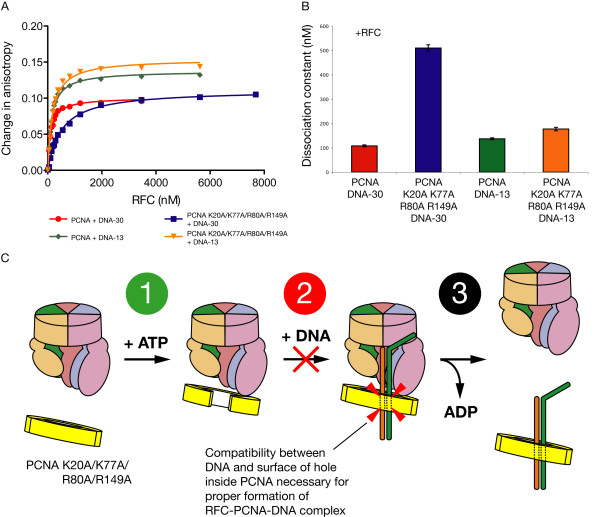
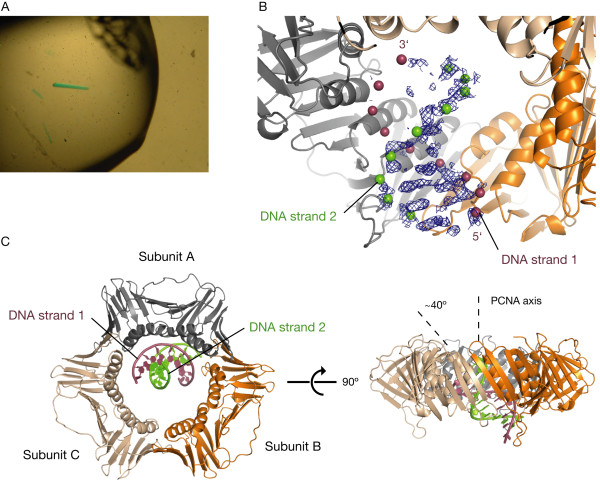
We built a model of RFC bound to PCNA and DNA based on existing crystal structures of clamp loaders. This model suggests that DNA would enter the clamp at an angle during clamp loading, thereby interacting with positively charged residues in the center of PCNA. We show that simultaneous mutation of Lys 20, Lys 77, Arg 80, and Arg 149, which interact with DNA in the RFC-PCNA-DNA model, compromises the ability of yeast PCNA to stimulate the DNA-dependent ATPase activity of RFC when the DNA is long enough to extend through the clamp. Fluorescence anisotropy binding experiments show that the inability of the mutant clamp proteins to stimulate RFC ATPase activity is likely caused by reduction in the affinity of the RFC-PCNA complex for DNA. We obtained several crystal forms of yeast PCNA-DNA complexes, measuring X-ray diffraction data to 3.0 A resolution for one such complex. The resulting electron density maps show that DNA is bound in a tilted orientation relative to PCNA, but makes different contacts than those implicated in clamp loading. Because of apparent partial disorder in the DNA, we restricted refinement of the DNA to a rigid body model. This result contrasts with previous analysis of a bacterial clamp bound to DNA, where the DNA was well resolved.
Mutational analysis of PCNA suggests that positively charged residues in the center of the clamp create a binding surface that makes contact with DNA. Disruption of this positive surface, which had not previously been implicated in clamp loading function, reduces RFC ATPase activity in the presence of DNA, most likely by reducing the affinity of RFC and PCNA for DNA. The interaction of DNA is not, however, restricted to one orientation, as indicated by analysis of the PCNA-DNA co-crystals.
滑动夹,如真核生物中的增殖细胞核抗原(PCNA),是环形蛋白质复合物,其环绕DNA并通过作为DNA聚合酶的停靠位点实现高度连续的DNA复制。在ATP依赖反应中,夹装载复合物,如真核生物中的复制因子C(RFC)复合物,打开夹子并将其装载到引物-模板DNA周围。
我们基于夹装载器的现有晶体结构构建了与PCNA和DNA结合的RFC模型。该模型表明,在夹装载过程中,DNA将以一定角度进入夹子,从而与PCNA中心的带正电残基相互作用。我们发现,在RFC-PCNA-DNA模型中与DNA相互作用的赖氨酸20、赖氨酸77、精氨酸80和精氨酸149同时发生突变,当DNA足够长以延伸穿过夹子时,会损害酵母PCNA刺激RFC的DNA依赖性ATP酶活性的能力。荧光各向异性结合实验表明,突变夹蛋白无法刺激RFC ATP酶活性可能是由于RFC-PCNA复合物对DNA的亲和力降低所致。我们获得了几种酵母PCNA-DNA复合物的晶体形式,对其中一种复合物测量了分辨率为3.0埃的X射线衍射数据。所得电子密度图表明,DNA相对于PCNA以倾斜方向结合,但形成的接触与夹装载过程中涉及的接触不同。由于DNA存在明显的部分无序,我们将DNA的精修限制在刚体模型。这一结果与之前对与DNA结合的细菌夹的分析形成对比,在该分析中DNA得到了很好的解析。
对PCNA的突变分析表明,夹子中心的带正电残基形成了一个与DNA接触的结合表面。这个以前未涉及夹装载功能的正表面的破坏,在有DNA存在时会降低RFC ATP酶活性,最有可能是通过降低RFC和PCNA对DNA的亲和力。然而,如PCNA-DNA共晶体分析所示,DNA的相互作用并不局限于一种取向。