Centre for Integrative Genetics, Dept. of Animal and Aquacultural Sciences, Norwegian University of Life Sciences, As, Norway.
BMC Genet. 2010 Feb 2;11:10. doi: 10.1186/1471-2156-11-10.
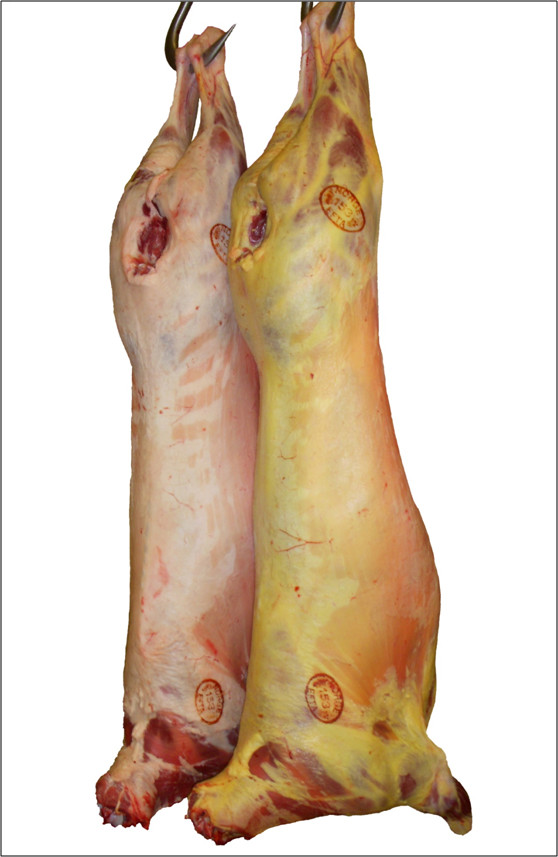
Sheep carcasses with yellow fat are sporadically observed at Norwegian slaughter houses. This phenomenon is known to be inherited as a recessive trait, and is caused by accumulation of carotenoids in adipose tissue. Two enzymes are known to be important in carotenoid degradation in mammals, and are therefore potential candidate genes for this trait. These are beta-carotene 15,15'-monooxygenase 1 (BCMO1) and the beta-carotene oxygenase 2 (BCO2).
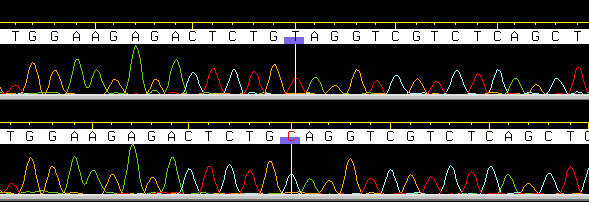
In the present study the coding region of the BCMO1 and the BCO2 gene were sequenced in yellow fat individuals and compared to the corresponding sequences from control animals with white fat. In the yellow fat individuals a nonsense mutation was found in BCO2 nucleotide position 196 (c.196C>T), introducing a stop codon in amino acid position 66. The full length protein consists of 575 amino acids. In spite of a very low frequency of this mutation in the Norwegian AI-ram population, 16 out of 18 yellow fat lambs were found to be homozygous for this mutation.
In the present study a nonsense mutation (c.196C>T) in the beta-carotene oxygenase 2 (BCO2) gene is found to strongly associate with the yellow fat phenotype in sheep. The existence of individuals lacking this mutation, but still demonstrating yellow fat, suggests that additional mutations may cause a similar phenotype in this population. The results demonstrate a quantitatively important role for BCO2 in carotenoid degradation, which might indicate a broad enzyme specificity for carotenoids. Animals homozygous for the mutation are not reported to suffer from any negative health or development traits, pointing towards a minor role of BCO2 in vitamin A formation. Genotyping AI rams for c.196C>T can now be actively used in selection against the yellow fat trait.
挪威屠宰场偶尔会发现黄色脂肪的绵羊胴体。这种现象被认为是隐性遗传的,是由于类胡萝卜素在脂肪组织中的积累引起的。两种酶已知在哺乳动物的类胡萝卜素降解中很重要,因此是该性状的潜在候选基因。这些酶是β-胡萝卜素 15,15'-单加氧酶 1(BCMO1)和β-胡萝卜素加氧酶 2(BCO2)。
在本研究中,对黄色脂肪个体的 BCMO1 和 BCO2 基因的编码区进行了测序,并与具有白色脂肪的对照动物的相应序列进行了比较。在黄色脂肪个体中,在 BCO2 核苷酸位置 196(c.196C>T)处发现了一个无义突变,在氨基酸位置 66 处引入了一个终止密码子。全长蛋白由 575 个氨基酸组成。尽管这种突变在挪威 AI-ram 群体中的频率非常低,但在 18 只黄色脂肪羔羊中有 16 只是这种突变的纯合子。
在本研究中,发现β-胡萝卜素加氧酶 2(BCO2)基因中的一个无义突变(c.196C>T)与绵羊的黄色脂肪表型强烈相关。存在没有这种突变但仍表现出黄色脂肪的个体,表明其他突变可能在该群体中导致类似的表型。结果表明 BCO2 在类胡萝卜素降解中具有重要的定量作用,这可能表明该酶对类胡萝卜素具有广泛的酶特异性。突变纯合子的动物未报告有任何负面的健康或发育特征,这表明 BCO2 在维生素 A 形成中的作用较小。现在可以积极对 AI 公羊进行 c.196C>T 基因型检测,以选择对抗黄色脂肪性状。