Department of Psychiatry, Vanderbilt University, Nashville, TN 37232,USA.
Mol Psychiatry. 2010 Oct;15(10):987-95. doi: 10.1038/mp.2010.1. Epub 2010 Feb 2.
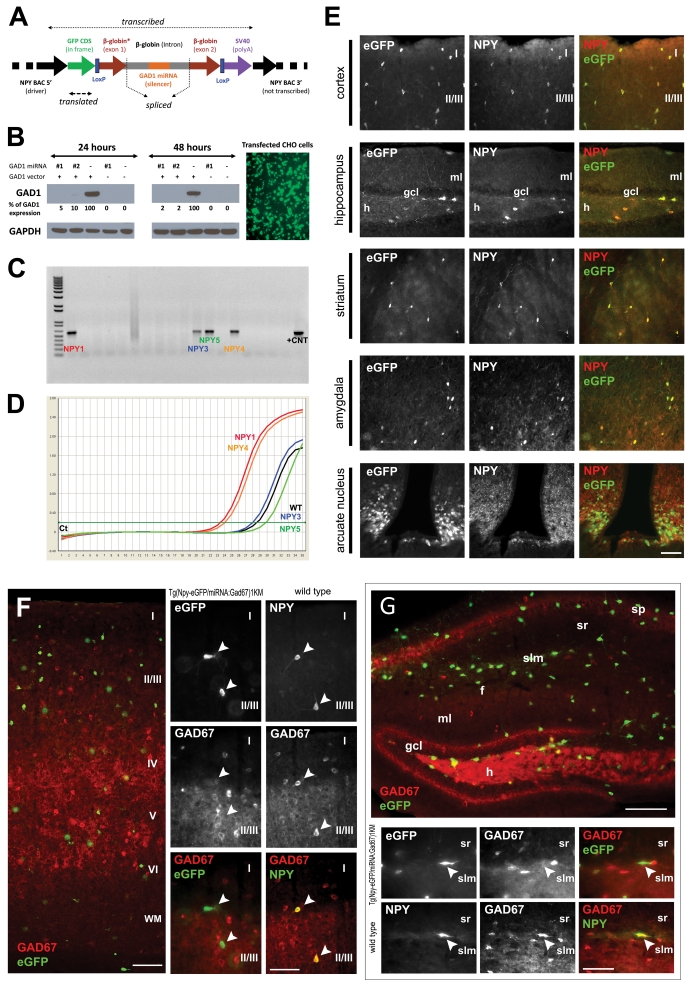
In schizophrenia, glutamic acid decarboxylase 1 (GAD1) disturbances are robust, consistently observed, cell-type specific and represent a core feature of the disease. In addition, neuropeptide Y (NPY), which is a phenotypic marker of a sub-population of GAD1-containing interneurons, has shown reduced expression in the prefrontal cortex in subjects with schizophrenia, suggesting that dysfunction of the NPY+ cortical interneuronal sub-population might be a core feature of this devastating disorder. However, modeling gene expression disturbances in schizophrenia in a cell type-specific manner has been extremely challenging. To more closely mimic these molecular and cellular human post-mortem findings, we generated a transgenic mouse in which we downregulated GAD1 mRNA expression specifically in NPY+ neurons. This novel, cell type-specific in vivo system for reducing gene expression uses a bacterial artificial chromosome (BAC) containing the NPY promoter-enhancer elements, the reporter molecule (eGFP) and a modified intron containing a synthetic microRNA (miRNA) targeted to GAD1. The animals of isogenic strains are generated rapidly, providing a new tool for better understanding the molecular disturbances in the GABAergic system observed in complex neuropsychiatric disorders such as schizophrenia. In the future, because of the small size of the silencing miRNAs combined with our BAC strategy, this method may be modified to allow generation of mice with simultaneous silencing of multiple genes in the same cells with a single construct, and production of splice-variant-specific knockdown animals.
在精神分裂症中,谷氨酸脱羧酶 1(GAD1)的紊乱是强大的、一致观察到的、细胞类型特异性的,代表了疾病的核心特征。此外,神经肽 Y(NPY)是 GAD1 包含的中间神经元亚群的表型标志物,在精神分裂症患者的前额叶皮层中显示出表达减少,这表明 NPY+皮质中间神经元亚群的功能障碍可能是这种破坏性疾病的核心特征。然而,以细胞类型特异性的方式模拟精神分裂症中的基因表达紊乱一直极具挑战性。为了更紧密地模拟这些分子和细胞的人类死后发现,我们生成了一种转基因小鼠,其中我们特异性地在 NPY+神经元中下调了 GAD1 mRNA 表达。这种新型的、细胞类型特异性的体内降低基因表达系统使用了包含 NPY 启动子增强子元件、报告分子(eGFP)和包含针对 GAD1 的合成 microRNA(miRNA)的修饰内含子的细菌人工染色体(BAC)。同基因系的动物可以快速生成,为更好地理解精神分裂症等复杂神经精神障碍中观察到的 GABA 能系统中的分子紊乱提供了新的工具。将来,由于沉默 miRNA 的体积小,结合我们的 BAC 策略,这种方法可以修改为允许使用单个构建体在同一细胞中同时沉默多个基因,并生成剪接变体特异性敲低动物。