UCSF Liver Center, University of California San Francisco, San Francisco, California, United States of America.
PLoS One. 2010 Feb 1;5(2):e8984. doi: 10.1371/journal.pone.0008984.
Mutations in ATP8B1 (FIC1) underlie cases of cholestatic disease, ranging from chronic and progressive (progressive familial intrahepatic cholestasis) to intermittent (benign recurrent intrahepatic cholestasis). The ATP8B1-deficient mouse serves as an animal model of human ATP8B1 deficiency.
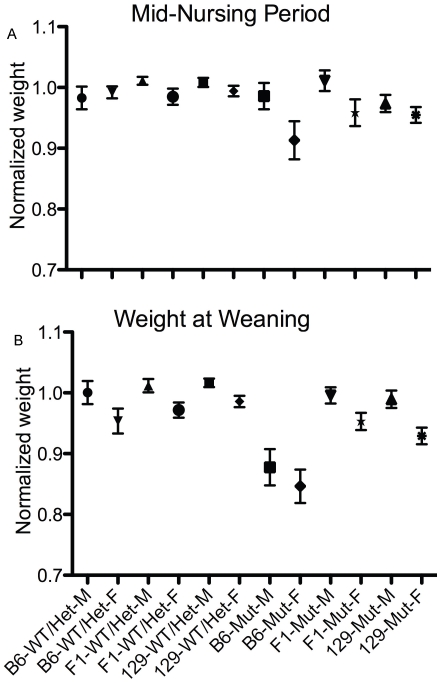
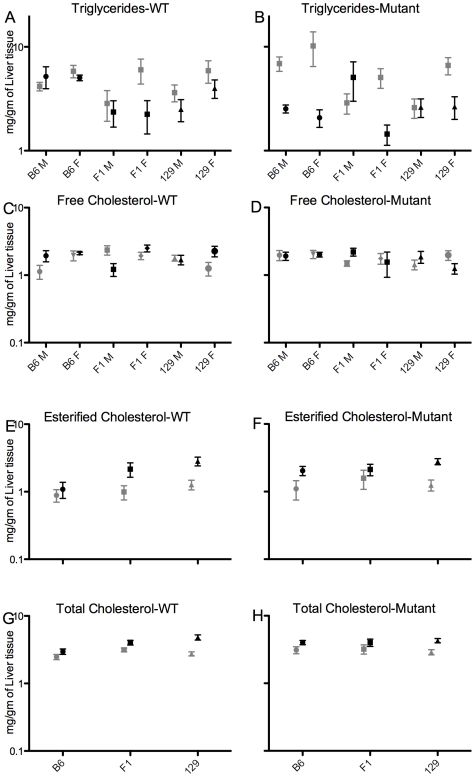
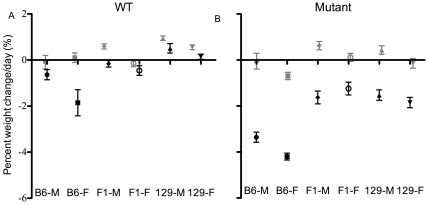
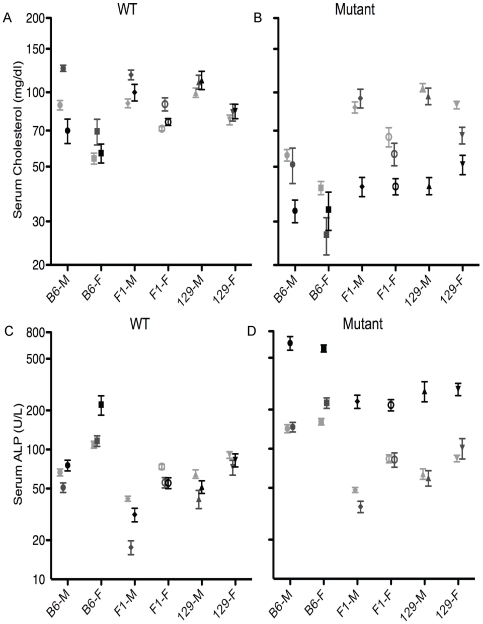
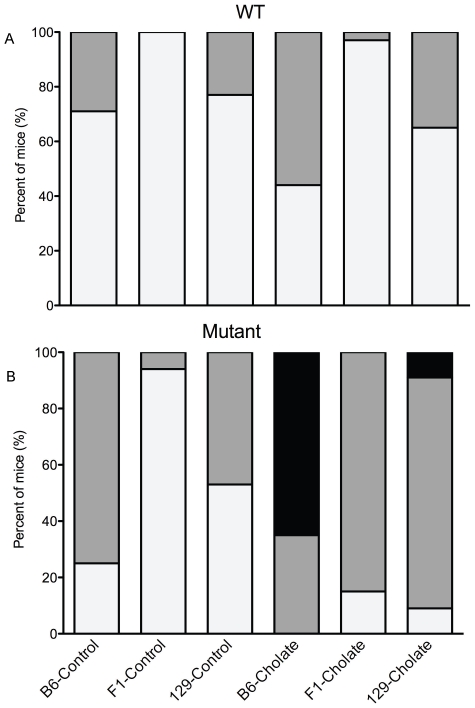
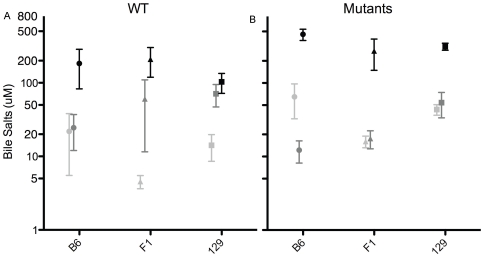
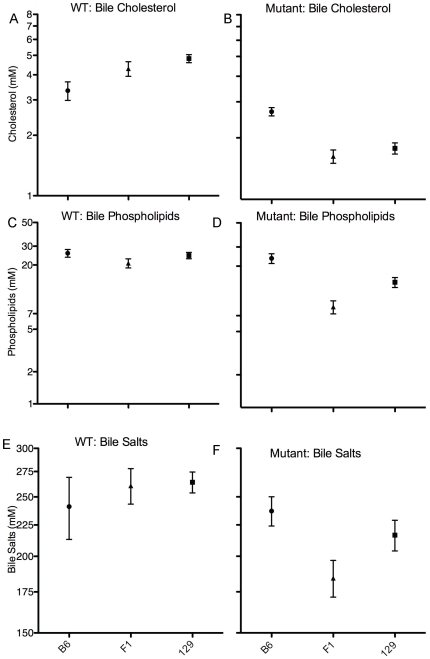
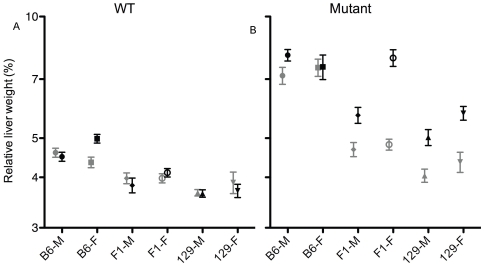
METHODOLOGY/PRINCIPAL FINDINGS: We investigated the effect of genetic background on phenotypes of ATP8B1-deficient and wild-type mice, using C57Bl/6 (B6), 129, and (B6-129) F1 strain backgrounds. B6 background resulted in greater abnormalities in ATP8B1-deficient mice than did 129 and/or F1 background. ATP8B1-deficient pups of B6 background gained less weight. In adult ATP8B1-deficient mice at baseline, those of B6 background had lower serum cholesterol levels, higher serum alkaline phosphatase levels, and larger livers. After challenge with cholate-supplemented diet, these mice exhibited higher serum alkaline phosphatase and bilirubin levels, greater weight loss and larger livers. ATP8B1-deficient phenotypes in mice of F1 and 129 backgrounds are usually similar, suggesting that susceptibility to manifestations of ATP8B1 deficiency may be recessive. We also detected differences in hepatobiliary phenotypes between wild-type mice of differing strains.
CONCLUSIONS/SIGNIFICANCE: Our results indicate that the ATP8B1-deficient mouse in a B6 background may be a better model of human ATP8B1 deficiency and highlight the importance of informed background strain selection for mouse models of liver disease.
ATP8B1(FIC1)突变可导致胆汁淤积性疾病,其范围从慢性、进行性(家族性肝内胆汁淤积症)到间歇性(良性复发性肝内胆汁淤积症)。ATP8B1 缺陷型小鼠可作为人类 ATP8B1 缺乏症的动物模型。
方法/主要发现:我们使用 C57Bl/6(B6)、129 和(B6-129)F1 三种遗传背景来研究遗传背景对 ATP8B1 缺陷型和野生型小鼠表型的影响。B6 遗传背景导致 ATP8B1 缺陷型小鼠的异常情况比 129 和/或 F1 遗传背景更严重。B6 遗传背景的 ATP8B1 缺陷型幼鼠体重增长较少。在基线时,B6 遗传背景的成年 ATP8B1 缺陷型小鼠血清胆固醇水平较低,血清碱性磷酸酶水平较高,肝脏较大。在用胆酸钠饮食处理后,这些小鼠的血清碱性磷酸酶和胆红素水平升高,体重减轻更多,肝脏更大。F1 和 129 遗传背景的 ATP8B1 缺陷型小鼠的表型通常相似,这表明对 ATP8B1 缺乏表现的易感性可能是隐性的。我们还检测了不同遗传背景的野生型小鼠的肝胆表型差异。
结论/意义:我们的结果表明,B6 遗传背景下的 ATP8B1 缺陷型小鼠可能是人类 ATP8B1 缺乏症的更好模型,并强调了在选择用于肝脏疾病的小鼠模型时,应充分了解遗传背景的重要性。