
非麦角衍生多巴胺激动剂喹高利德预防体外受精患者早期卵巢过度刺激综合征:一项随机、双盲、安慰剂对照试验。
The non-ergot derived dopamine agonist quinagolide in prevention of early ovarian hyperstimulation syndrome in IVF patients: a randomized, double-blind, placebo-controlled trial.
机构信息
IVI Valencia, Plaza de la Policía Local, 3, 46015 Valencia, Spain.
出版信息
Hum Reprod. 2010 Apr;25(4):995-1004. doi: 10.1093/humrep/deq005. Epub 2010 Feb 6.
BACKGROUND
Ovarian hyperstimulation syndrome (OHSS) seems to be induced by the ovarian release of vascular endothelial growth factor (VEGF), which increases vascular permeability. Dopamine agonists inhibit VEGF receptor phosphorylation and thereby decrease vascular permeability.
METHODS
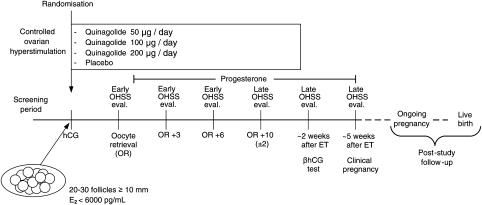
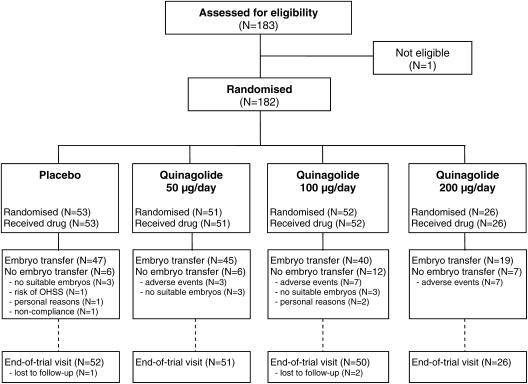
A randomized, double-blind, placebo-controlled, multicentre study assessing three oral doses (50, 100, 200 microg/day) of the non-ergot derived dopamine agonist quinagolide started on the day of human chorionic gonadotrophin (hCG) and continued for 17-21 days without dose-titration in comparison to placebo in preventing moderate/severe early OHSS (onset < or =9 days after hCG administration) in 182 IVF patients with > or =20 but less than 30 follicles > or =10 mm.
RESULTS
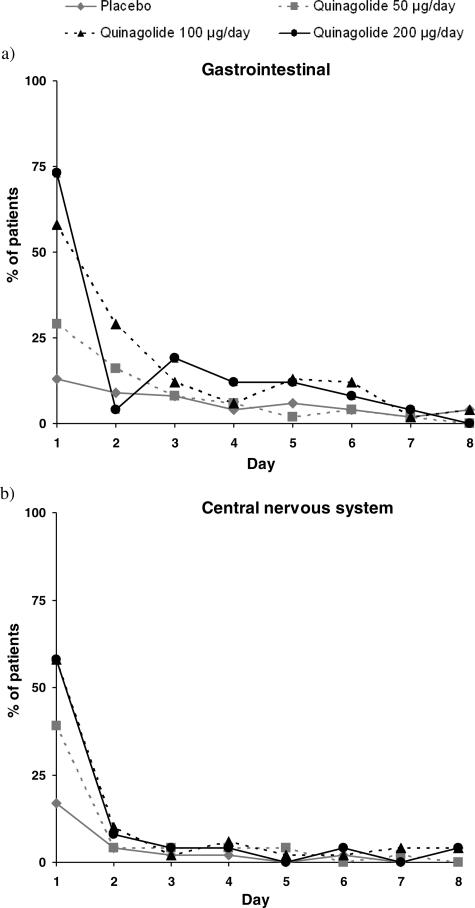
The incidence of moderate/severe early OHSS was 23% (12/53) in the placebo group and 12% (6/51), 13% (7/52) and 4% (1/26) in the quinagolide 50, 100 and 200 microg/day groups, respectively. The moderate/severe early OHSS rate was significantly lower with all quinagolide groups combined compared with placebo [P = 0.019; OR = 0.28 (0.09-0.81)]. The incidence of ultrasound evidence of ascites among patients with no clinical pregnancy was significantly reduced from 31% (8/26) with placebo to 11% (8/70) with all quinagolide groups combined [P = 0.033; OR = 0.29 (0.10-0.88)], although there was no difference for those with clinical pregnancy. Quinagolide did not have a detrimental effect on pregnancy or live birth rates. The incidence of gastrointestinal and central nervous system adverse events increased with increasing doses of quinagolide.
CONCLUSIONS
Quinagolide appears to prevent moderate/severe early OHSS while not affecting treatment outcome. The effect is more marked in patients who did not achieve a clinical pregnancy. Quinagolide administered in high doses without dose-titration is associated with poor tolerability. ClinicalTrials.gov Identifier: NCT00329693.
背景
卵巢过度刺激综合征(OHSS)似乎是由卵巢释放血管内皮生长因子(VEGF)引起的,VEGF 可增加血管通透性。多巴胺激动剂可抑制 VEGF 受体磷酸化,从而降低血管通透性。
方法
一项随机、双盲、安慰剂对照、多中心研究,评估了三种口服剂量(50、100、200μg/天)的非麦角衍生多巴胺激动剂喹高利德,从人绒毛膜促性腺激素(hCG)日开始,并且在没有剂量滴定的情况下,连续使用 17-21 天,与安慰剂相比,可预防 182 名 IVF 患者中 20 至 30 个卵泡≥10mm 的中度/重度早期 OHSS(hCG 给药后 9 天内发生)。
结果
安慰剂组中中度/重度早期 OHSS 的发生率为 23%(12/53),喹高利德 50、100 和 200μg/天组分别为 12%(6/51)、13%(7/52)和 4%(1/26)。与安慰剂相比,所有喹高利德组联合使用的中度/重度早期 OHSS 发生率显著降低[P=0.019;OR=0.28(0.09-0.81)]。在没有临床妊娠的患者中,超声证据表明腹水的发生率从安慰剂组的 31%(8/26)显著降低至所有喹高利德组联合使用的 11%(8/70)[P=0.033;OR=0.29(0.10-0.88)],尽管对于有临床妊娠的患者没有差异。喹高利德对妊娠或活产率没有不良影响。随着喹高利德剂量的增加,胃肠道和中枢神经系统不良事件的发生率增加。
结论
喹高利德似乎可预防中度/重度早期 OHSS,而不影响治疗结局。在未获得临床妊娠的患者中,效果更为明显。不进行剂量滴定就给予高剂量的喹高利德会导致较差的耐受性。临床试验注册号:NCT00329693。


 Zotero 插件